
B2B Go-to-Market: How to Build a Plan That Sells
A B2B go-to-market (GTM) plan answers four questions: who you sell to, what you promise them, how you reach them, and how you turn interest into revenue. It is a plan that product, marketing and sales all run together. It is not a launch checklist owned by one team. This guide walks through the components, the five steps to build one, and the metrics that tell you whether it is working.
TL;DR
- A B2B go-to-market plan connects positioning, messaging, target accounts, channels, pricing, sales and measurement into one revenue plan.
- Start with the ideal customer profile (ICP) built from your best existing deals, not from assumptions.
- Positioning comes before channels: pick one primary promise, back it with proof, and adapt it by buyer role.
- Product, marketing and sales must co-design the plan, because misalignment is a leading reason GTM efforts stall.
- Treat the plan as a living system: review a short list of metrics monthly and change one thing at a time.
Table of Contents
- What B2B go-to-market means
- Why a B2B company needs a go-to-market strategy
- The core components of a B2B GTM plan
- Step 1: Define your ICP from real deals
- Step 2: Build positioning buyers can repeat
- Step 3: Choose channels and a sales motion
- Step 4: Align product, marketing and sales
- Step 5: Launch, measure and refine
- Our perspective
- Work with us on your go-to-market plan
- FAQ
- Sources
What B2B go-to-market means
A go-to-market strategy is a step-by-step plan for putting an offer in front of buyers and driving revenue. It rests on research into the market, customers, channels, pricing and competition, according to Salesforce’s overview of GTM strategy. The same source notes that B2B selling is more relationship-driven than B2C, involves several stakeholders, and runs through longer approval processes.
That last point shapes everything. In B2B you rarely sell to one person. A founder may love your product, but a finance lead, a security reviewer and an operations head each need a reason to say yes. A GTM plan makes those reasons explicit before the first outreach goes out.
GTM is also broader than a product launch. Forbes’ 2024 guide points out that it applies to new positioning, new pricing and market-expansion initiatives too. If you are repositioning an existing product or entering a new segment, you need one.
Why a B2B company needs a go-to-market strategy
The practical case is risk. A GTM plan helps you bring an offer to market with less guesswork, align stakeholders, reach the right people and communicate value clearly. HubSpot’s guide frames this as testing feasibility through market and competitive research, then linking positioning to both conversion and retention.
Salesforce says a GTM strategy is most useful for new products, relaunches, changes to existing products, and expansion into a new target audience. It also lists stronger internal alignment, fewer revenue gaps and more effective budget use as benefits when the plan is tied to CRM and analytics.
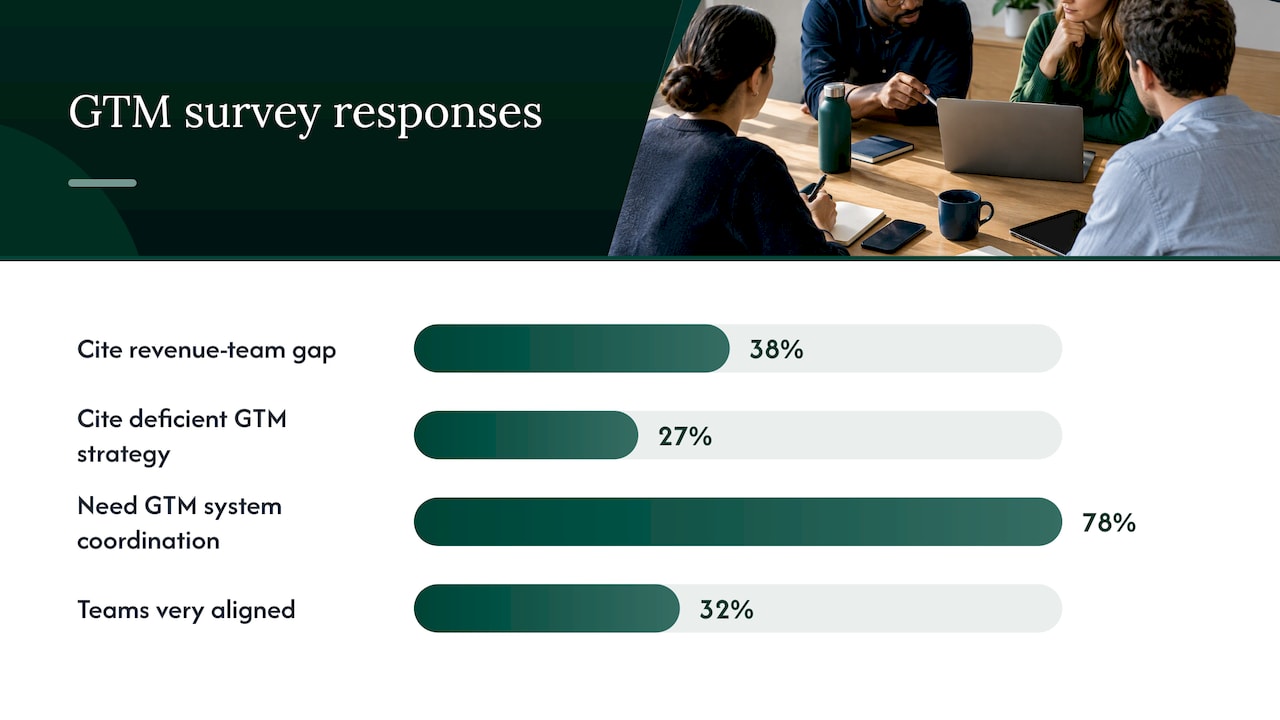
The alignment point is the one we see matter most. A Harvard Business Review Analytic Services report on revenue enablement found that 38% of respondents cited lack of coordination across revenue teams as a top challenge, and 27% cited a deficient GTM strategy. A separate summary of HBR research reports that 78% of respondents agree they need better coordination across GTM systems, while only 32% say the relevant teams are very aligned. Most companies know the problem. Few have fixed it.
The core components of a B2B GTM plan
Different guides slice the plan differently, but they agree on the substance. Salesforce’s 2026 playbook groups it into four blocks. HubSpot adds the market problem, pricing and distribution channels. ZoomInfo reduces it to four pre-launch questions: what you sell, who it is for, how buyers will be reached, and how demand will be created and converted.
Here is a working version you can adapt:
| Component | The question it answers | What you should have in hand |
|---|---|---|
| Market and ICP | Who exactly are we selling to? | A written ICP, buyer roles, segment priorities |
| Positioning and messaging | Why us, for them, over the alternatives? | One primary promise, proof points, role-based messages |
| Channels and sales motion | How do buyers find and buy from us? | Chosen channels, sales model, partner approach, pricing |
| Enablement | Can the team actually sell this? | Talk tracks, objection handling, collateral |
| Execution and measurement | How will we know it works? | KPIs, owners, review cadence, feedback loops |
Notice that positioning sits second, before channels. Teams often reverse that order, pick LinkedIn or outbound first, and then try to find something to say. The message should decide the channel, not the other way around.
Step 1: Define your ICP from real deals
The most common GTM failure is a target market described as “mid-market companies that need growth.” That describes nobody.
An ICP gets specific. Andreessen Horowitz’s ICP framework lists attributes such as company size or revenue, business type, geography, industry, relevant job titles, solvable problems, technologies used and buyer behaviors. To sketch the first version, it suggests looking at which current customers get the most value, what your best customers have in common, recurring objections from lost deals, upsell patterns, and who your competitors’ customers are.
Gather the evidence from several places. Miro’s guide to B2B personas recommends interviews, surveys, CRM and win/loss analysis, call recordings, support tickets and product usage. Then segment by buyer role and context, and validate with sales and customer success. Write down where people disagree. That disagreement is information.
A simple working method:
- Pull your best 10 to 20 accounts: highest retention, fastest sales cycle, strongest expansion.
- List what they share: size, industry, trigger event, the problem they hired you to solve.
- Pull your worst-fit or lost deals and list what they share too.
- Write the ICP as a one-page profile, then test it against three recent sales calls.
If you want a deeper walkthrough, we cover it in our ideal customer profile framework, and the research side in B2B customer research methods. Before you commit to a segment, our piece on go-to-market research lists what to study first.
Step 2: Build positioning buyers can repeat
Positioning is where B2B GTM plans are won or lost, because buyers compare you to something whether you invite it or not. If you do not frame the comparison, they will.
Forbes’ guide describes the building blocks: the urgent customer problem, the outcome your product creates, the alternatives buyers would otherwise use, and the evidence that your offer is better suited to the chosen ICP. From there you create a messaging hierarchy with one primary promise, supporting benefits, proof points, and versions adapted to each buyer role.
Two practical tests:
- The repeat test. Ask a recent customer to describe what you do to a colleague. If their words differ from yours, the message is not landing.
- The alternatives test. List what buyers do instead of buying from you: a competitor, an internal build, a spreadsheet, nothing. Your positioning must beat each of these for your ICP.
Validate the language with customers and with the reps who use it daily. Messaging that sounds good in a workshop but fails in a discovery call is a draft, not a position.
Pricing belongs in this conversation too. If you are unsure how to quantify value and set prices that reflect your position, see our article on pricing and positioning strategy. Markets also move, so the plan has to stay responsive; changing your pricing strategy is one place buyer-preference shifts show up first.
Step 3: Choose channels and a sales motion
Once the ICP and message are set, choose how buyers will meet you. Common B2B options include outbound sequences, content, account-based programs, partnerships, events and communities. The right mix depends on deal size, sales cycle length and where your buyers already look for answers.
Sequence channels by intent and payback rather than launching everything at once. Start with the one or two channels closest to buyers who already have the problem. Add others only when the first ones produce a repeatable result.
Also decide the sales motion: self-serve, inside sales, field sales, or a mix. A product with a five-figure annual contract and several approvers rarely works with a purely self-serve motion. A low-priced tool rarely justifies a long enterprise cycle. Match motion to deal size, and write down who owns each handoff from first touch to renewal.
If you are weighing entry into a new segment or region instead of launching into your current one, our market expansion strategy article shows how to score markets you can realistically win.
Step 4: Align product, marketing and sales
A plan that only marketing understands is a campaign. For a real GTM plan, product, marketing, sales and customer success need to share one picture.
Forbes recommends bringing cross-functional stakeholders into launch planning early, sharing milestones and early customer feedback, and keeping everyone informed of pivots and results. The key distinction: involve people in designing the launch process, not just informing them of decisions. When customer-facing teams help design the plan, they carry it into every conversation.
ZoomInfo’s 2026 guide notes that B2B GTM commonly includes marketing, sales, sales development, RevOps and customer success operating as one system. In practice, that means:
- One shared definition of a qualified account and an agreed handoff.
- One set of numbers everyone reviews, not separate dashboards per team.
- A standing meeting where sales shares what buyers are saying and marketing shares what is converting.
- A named owner for each stage of the buyer journey.
We go deeper in marketing and sales alignment and revenue team alignment. Because the buying experience does not end at signature, B2B customer experience orchestration is worth reading as well.
Step 5: Launch, measure and refine
A launch is the start of learning, not the end of planning. Salesforce’s playbook suggests tracking customer acquisition cost (CAC), lifetime value (LTV), pipeline velocity, win rate, stage conversion rates, CAC payback and marketing-influenced revenue. It recommends reviewing lead volume, conversion, channel efficiency, sales bottlenecks and projected revenue monthly, and combining dashboard data with win/loss analysis, customer interviews and sales-team insight.
Do not track all of these on day one. Pick four or five that map to your biggest uncertainty. Early on, that is usually stage conversion and win rate. Later, CAC payback tells you whether the engine scales.
The quality of your pipeline definitions affects every metric above. If stages are vague, conversion numbers are noise. Good pipeline stage design uses clear criteria for what moves a deal forward, so your reviews reflect reality.
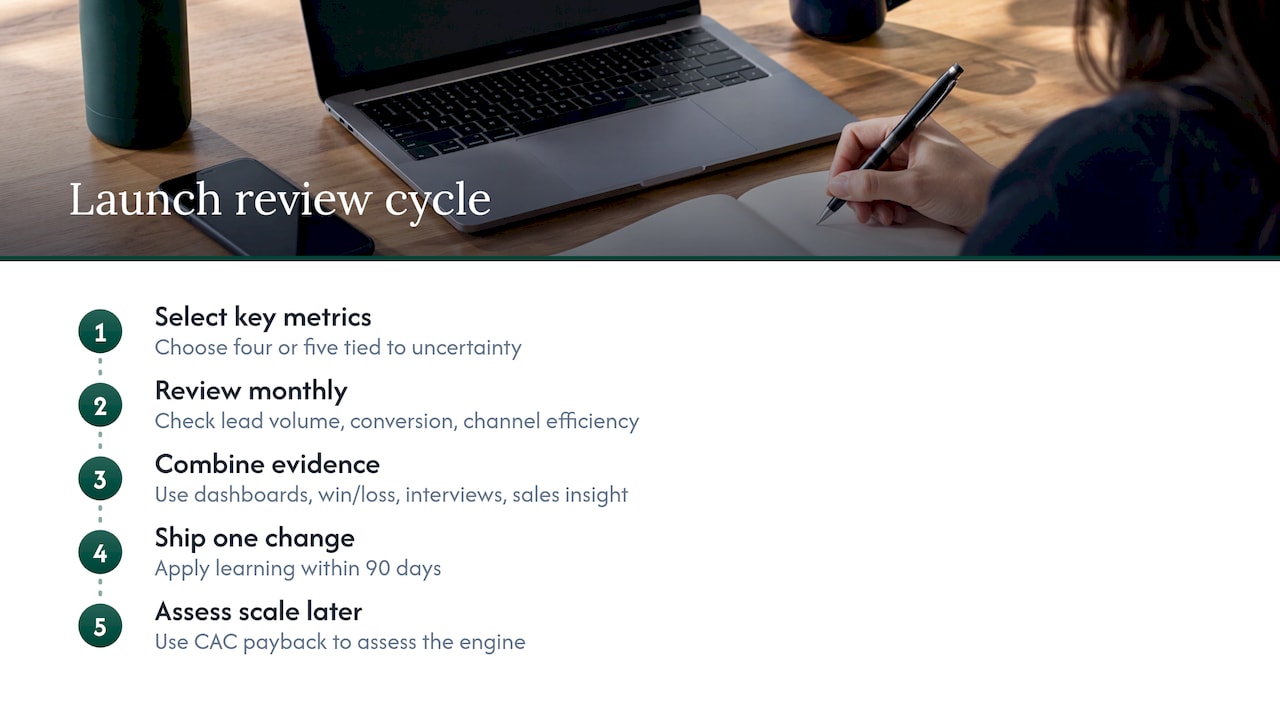
For the qualitative side, run a structured review of closed deals. Our B2B win/loss analysis guide shows how to ship one change in 90 days from what you learn. Salesforce’s view that GTM should be a living system fits here: markets, competitors and buyer preferences change, so the plan needs regular feedback from customers, sales and performance data.
A simple 90-day rhythm
- Days 1 to 30: finalize ICP, positioning and message; set metrics and owners; brief every customer-facing team.
- Days 31 to 60: launch the first one or two channels; run weekly pipeline reviews; collect objections.
- Days 61 to 90: analyze wins and losses; change one message, channel or handoff; decide what to scale.
Our perspective
Most go-to-market problems we see are not channel problems. They are clarity problems. The product says one thing, marketing says another, and sales improvises a third. Buyers feel that drift, and they respond by comparing you on price.
We treat brand as a core business strategy, not a layer of messaging added at the end. That is why our approach ties positioning, marketing, product and sales together through iterative frameworks, so the plan connects to measurable performance and the customer experience, rather than a one-time branding exercise.
Our operator’s view comes from real-world brand building and exit experience, and from work across more than 200 international retail locations. The lesson that keeps repeating: decide who you win with and why, write it down in words buyers repeat back to you, and make every team accountable to the same plan. Then measure, learn and adjust.
If your GTM plan feels busy but not decisive, start with positioning. Everything downstream gets easier.
Quincy
Work with us on your go-to-market plan
If you are a founder, executive team or marketing leader who wants help turning positioning into a go-to-market plan your teams can run, that is the work we do. Our services cover brand strategy, brand positioning, growth and go-to-market strategy, customer experience, AI and marketing strategy, and founder and executive advisory.
See how we work on the growth and go-to-market strategy page, explore our brand strategy frameworks, or read more in our journal on brand, growth and strategy. If you are planning an event, we also offer keynote speaking.
FAQ
What does B2B GTM mean?
GTM stands for go-to-market. In B2B, it is the plan for how a company reaches business buyers and turns them into customers: target accounts, positioning, channels, pricing, sales motion and measurement. It covers launches, but also repositioning and entry into new segments.
What is the difference between a GTM strategy and a marketing strategy?
A marketing strategy focuses on how you create awareness and demand. A GTM strategy is wider: it also covers who you target, pricing, the sales model, enablement and customer success. Marketing is one part of the plan, and it works best when sales and product share the same targets and message.
When should a B2B company build a GTM strategy?
Build one before a new product launch, a relaunch, a significant product change, or a move into a new audience or market. It is also worth revisiting when growth stalls, win rates fall or teams describe the offer differently. Revisit it regularly rather than treating it as a one-time document.
What should a B2B GTM plan measure?
Start with a short list: pipeline velocity, win rate, stage conversion, CAC and CAC payback. Add LTV and marketing-influenced revenue as data matures. Review them monthly and pair the numbers with win/loss interviews so you understand why they move.
Sources
- Go to Market Strategy | Salesforce
- The GTM Strategy Playbook | Salesforce
- How To Create Good, Better and Great Go-To-Market Strategy | Forbes
- What is a Go-to-Market Strategy? | HubSpot
- What Is a Go-to-Market Strategy? 2026 B2B Guide | ZoomInfo
- A Framework for Defining and Refining Your ICP | Andreessen Horowitz
- A Guide to B2B Buyer Personas | Miro
- Accelerating Growth Through Revenue Enablement | Harvard Business Review Analytic Services
- Aligning GTM Execution with Strategy | LeanData
- Changing pricing strategy | AMAUTA Public Affairs
- Pipeline Stage Design: 5 Criteria for Service Business Deals