
Brand Maturity Model: Five Levels and How to Place Your Brand
A brand maturity model is a scorecard for how far your brand actually runs the business. It rates how clearly positioning is defined, how consistently product, marketing and sales act on it, and whether anyone measures the result. Most published models describe five levels, from a brand that exists only as a logo and a style guide to a brand that steers investment decisions. The useful part is not the label you land on. It is the gap list you get when you score honestly, and the order in which you close those gaps.
This guide is for founders, marketing leaders and executives who suspect their brand is drifting or being compared on price, and want a plain way to find out why.
TL;DR
- A brand maturity model rates how well a brand is managed and used across the organization, not how good the logo or campaign looks.
- Published models share a pattern: ad hoc or latent at the start, measured and integrated in the middle, a corporate priority at the top.
- Score yourself on strategy, people, process, measurement and impact. Your weakest dimension sets your real level.
- Pick two or three gaps, attach a metric to each, and work them over 12 months rather than trying to move every dimension at once.
- Outside perspective helps most when product, marketing and sales each believe the brand is someone else’s job.
Table of Contents
- What a brand maturity model actually measures
- Brand maturity is not marketing maturity
- The five levels, in plain terms
- How to assess your own brand maturity
- Measures that show whether things are improving
- Turning the score into a 12-month roadmap
- Where a maturity model helps and where leaders get stuck
- Our perspective
- Getting an outside read on your score
- FAQ
- Sources
What a brand maturity model actually measures
A maturity model is a staged framework. You describe what an organization does at each level, then check which description matches reality. Brand versions apply that logic to one question: how well does the company manage and use its brand?
The published versions look at slightly different things:
- Forrester built a B2B brand lifecycle tool that lets marketing teams collectively assess how they manage the company brand across organizational alignment, brand development and activation, and returns a scored readout.
- Acquia uses five levels (Ad hoc, Allocated, Dedicated, Strategic, Distinguished) across six dimensions: strategy, people, process, technology, AI readiness and impact. AI readiness was added in 2026.
- DISQO takes an audience view. It defines brand maturity as a brand’s position in its growth journey, from launch to legacy, based on how well consumers recognize, consider and trust it.
Those are two different questions. One asks how well the company runs its brand internally. The other asks how far the market has accepted it. A founder with a young company often has a weak external position but a clear internal one. A mid-sized company that grew through acquisitions often has the reverse: decent awareness and a brand that nobody inside agrees on. You need both lenses, and you should know which one a given model uses before you trust its score.
Brand maturity is not marketing maturity
Marketing, digital, product and measurement maturity models are close relatives, and the search results mix them together. They are not the same thing.
Marketing maturity models grade the sophistication of the marketing function. Zion & Zion’s version, for example, defines five levels and applies them to areas such as brand, data and analytics, media, content, automation and customer experience. Brand is one row in that grid. An older model from EMM Group, built with the ANA, looks at how well marketing processes link together and at five go-to-market capabilities: insights, market strategy, annual planning, integrated marketing and performance metrics.
A brand maturity model is narrower and, in practice, reaches further. It asks whether the brand is a shared decision rule. Marketing can be highly sophisticated, with automation, attribution and a full content calendar, while the brand is still ad hoc because sales pitches a different story and product ships features nobody positioned. That mismatch is the most common reason a company with a healthy marketing budget keeps getting compared on price.
The five levels, in plain terms
Models name the levels differently, but they describe the same climb. BERA’s version frames five ways organizations use brand to guide decisions: brand latent, brand measurement, a brand growth framework, brand integrated into marketing workflows, and brand building as a corporate priority. Read next to Acquia’s levels, a common shape emerges.
| Level | What it looks like day to day | Typical signal |
|---|---|---|
| 1. Ad hoc / latent | Brand means the logo and website. Decisions are made by whoever is closest to the work. | Every team describes the company differently. |
| 2. Allocated / measured | Someone owns brand part time. Basic tracking such as awareness exists. | Guidelines exist, but they are rarely used outside marketing. |
| 3. Dedicated / framework | A defined positioning and a growth framework. A named owner and a process. | New campaigns start from the positioning, not from a blank page. |
| 4. Strategic / integrated | Brand is built into marketing workflows, sales enablement and product planning. | Sales and marketing share definitions and targets. |
| 5. Distinguished / priority | Brand is a leadership agenda item. Equity is a KPI and informs investment. | Leaders can forecast brand effects on revenue. |
At the top of BERA’s scale, marketing stewards the brand while every function amplifies it. Brand equity is a KPI, brand growth plans are built into wider business investments, and advanced analytics predict brand performance.
The table is a synthesis, not a standard. No single body certifies these levels. Treat them as a vocabulary for a conversation among your leadership team, not a grade.
The audience view: new, emerging, established
If you want to know where the market has placed you, DISQO’s approach is simple. It sorts brands by aided awareness: new brands at 33% or less, emerging brands at 34% to 66%, and established brands at 67% or more. Aided awareness means the share of your target audience who say they know you when shown your name.
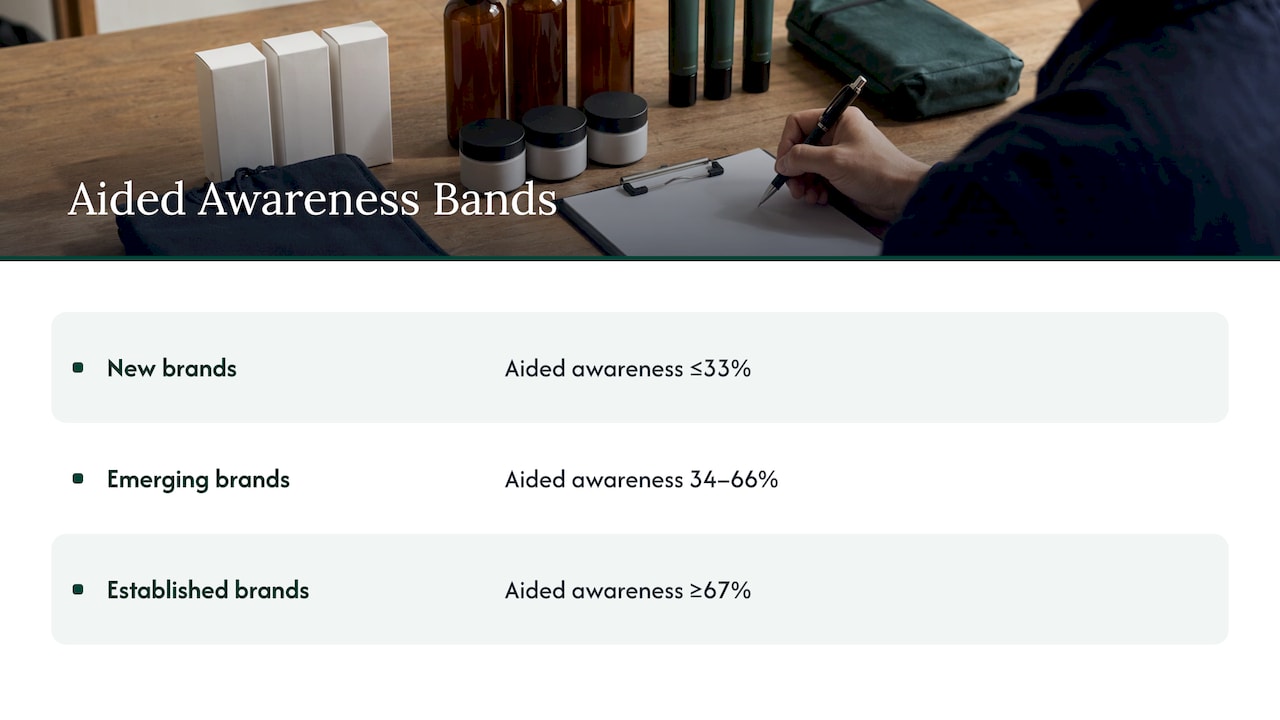
That tells you which problem you have. A new brand’s job is to be recognized. An established brand’s job is to stay distinct and avoid drifting into the category average. The same message does not work for both, and a lot of brand drift comes from an established company still behaving as if it were new.
How to assess your own brand maturity
You do not need a software license to run a first pass. You need an honest hour with the people who touch the brand. The steps below turn the models into a working assessment.
1. Pick one set of dimensions
Start from the dimensions the published models agree on. A workable set for a B2B company:
- Strategy: a written positioning that says who you serve, what you replace and why you win.
- People: a named owner, and leaders who can state the positioning without notes.
- Process: how the brand shows up in briefs, launches, proposals and onboarding.
- Measurement: which signals you track and how often.
- Impact: whether anyone can link the brand to pipeline, win rate or price realization.
Acquia’s six dimensions add technology and AI readiness. Include them if asset management or AI-generated content is already a day-to-day issue for your team.
2. Score each dimension separately
Use a 1 to 5 scale, with the level descriptions above. Ask each person to score alone first, then compare. Do this with at least one person from marketing, one from sales and one from product. The most revealing output is not the average. It is where the scores split. If marketing scores strategy a 4 and sales scores it a 2, you have found an alignment gap, which is usually more expensive than a creative gap.
3. Test the scores against evidence
Self-scoring flatters. For each dimension, pick one piece of evidence:
- Strategy: can three executives write the positioning in one sentence, and do the sentences match?
- People: who decides when a product team wants to name a feature or a sales rep wants to rewrite the deck?
- Process: open the last five proposals. Do they open with the same story?
- Measurement: when did you last look at brand metrics, and what did you change because of them?
- Impact: pick a recent lost deal. Was the loss about price, and was the buyer able to say how you differ?
4. Let the weakest dimension set the level
A brand with a strong strategy document (level 4) and no process for using it (level 1) behaves like a level 1 brand. The document sits in a folder. Rate overall maturity by the weakest dimension, and you will prioritize correctly.
Measures that show whether things are improving
A maturity score only matters if it moves something. DISQO links brand maturity to measurable signals: aided and unaided awareness, favorability and familiarity, purchase intent, competitive search behavior, site visits and category-level ecommerce activity. Those are market-side measures and suit consumer-facing brands well.
For a B2B company, pair them with internal and commercial signals: how often sales uses the approved story, win rate against the same two or three competitors, sales cycle length, and how often deals close without a discount. Our guide to 11 metrics brand teams use to measure brand performance shows how to choose a small set and avoid a dashboard nobody reads.
Two rules keep measurement honest. Pick two or three metrics, not twelve. And record a baseline before you change anything, so the improvement is visible later.
Turning the score into a 12-month roadmap
Acquia suggests a practical first year for its own model: write a governance document, set aside eight hours a week for maintenance, document upload and tagging workflows, map the marketing technology stack, pick two or three KPIs, and score AI readiness. The specifics are tied to asset management, but the sequence generalizes well: define the rules, assign time, document the workflow, map the tools, choose the metrics.
Here is how that looks for the usual gaps.
If strategy is the gap (levels 1 to 2). Settle the positioning before anything else. A clear framework matters more than polish. Our brand strategy framework guide walks through the elements and how to choose between approaches. If you sell several offers or came out of acquisitions, check whether your brand architecture is helping or confusing buyers.
If alignment is the gap (levels 2 to 3). The brand is defined but not shared. The fix is a working agreement between functions, with shared definitions of a good lead, a clear handoff and a joint review. We cover the mechanics in sales and marketing alignment.
If go-to-market is the gap (levels 3 to 4). Positioning exists, but launches do not follow it. Tie the brand to segments, channels and offers through a B2B go-to-market plan, and sharpen who you target with a customer segmentation framework.
If experience is the gap (levels 4 to 5). The brand promise is made in marketing and broken after the sale. Treat the customer journey as part of the brand, as described in our piece on B2B customer experience as a revenue discipline.
A realistic target is to move one level in a year, or to raise your weakest dimension by one. Zion & Zion notes that it gets harder to move up each level, so skipping levels rarely works.

Where a maturity model helps and where leaders get stuck
Three patterns come up again and again.
- Scoring becomes the project. Teams spend a quarter refining the assessment and never change a brief, a deck or a pricing page. Run the assessment in a week, then act.
- Everyone owns the brand, so no one does. Top levels require leadership ownership. If the CEO sees brand as a marketing expense, no process will lift you past level 3.
- The model is borrowed from a different problem. A digital or measurement maturity model grades tools and data. Using it to answer a positioning question yields a tidy score and the wrong plan.
Our perspective
We treat brand as a core business strategy, not a marketing tool. That changes how we read a maturity model. The levels are not a ladder of marketing sophistication. They describe how many decisions in the company are made with the brand as the reference point.
In our work, the same two problems show up under different names: drift and comparison. Drift is what happens when product, marketing and sales each describe the company a little differently. Comparison is what happens when buyers cannot see a reason to choose you, so they fall back on price. Both are alignment problems before they are creative problems.
That is why our approach connects brand strategy to measurable performance, and why we bring an operator’s view shaped by real brand building and exit experience. A score is only useful if it leads to a specific decision: sharpen the positioning, fix the handoff between sales and marketing, or redesign a customer moment that contradicts the promise.
If your assessment shows a split between functions, do not start with a new logo or a new campaign. Start with one shared statement of who you serve and why you win, and make every function accountable to it.
Quincy
Getting an outside read on your score
Self-assessment finds the obvious gaps. It struggles with the ones everyone inside has stopped noticing. Quincy Samycia works with founders, executive teams and marketing teams on brand strategy, positioning, growth and go-to-market strategy, customer experience and executive advisory, through structured engagements that connect brand to measurable business results. If your scores split between marketing, sales and product, that is the right moment to bring in an advisor.
For leadership teams that want to work through brand alignment together, Quincy also leads keynotes and sessions on brand and growth.
FAQ
What is the difference between brand maturity and brand equity?
Brand maturity describes how well a brand is managed and how far it has progressed with its audience. Brand equity is the value the brand adds, for example through preference or pricing power. Higher maturity usually supports higher equity. At the top of BERA’s scale, brand equity is tracked as a KPI.
How long does it take to move up a brand maturity level?
Plan on roughly a year for one level, and less for a single dimension. Moving up gets harder at each stage, so the early gains come from writing down positioning, assigning ownership and choosing a few metrics. Larger organizations with several business units usually take longer.
Which model should a startup use?
A startup should begin with the audience view, since early on the main question is whether the market recognizes you. Aided awareness bands such as 33% or less for new brands give a rough benchmark. Add the internal dimensions of strategy, people and process as the team grows beyond the founders.
Do I need a consultant to run a brand maturity assessment?
You can run a first pass internally with the five dimensions above. Leaders usually bring in an advisor when scores diverge between functions, when the positioning has to be rebuilt, or when the plan needs to connect to go-to-market and revenue targets. We help with that work directly.
How is a brand maturity model different from a marketing maturity model?
A marketing maturity model grades the sophistication of the whole marketing function, with brand as one area among many. A brand maturity model asks how far the brand guides decisions across the company, including product and sales. A company can score high on the first and low on the second.
Sources
- The Forrester B2B Brand Lifecycle Maturity Tool
- Brand Management Maturity Model + AI Readiness
- What Is Brand Maturity? A Guide To Scaling Growth
- Brand Management Maturity Model
- Marketing Maturity Model for Strategic Marketing Roadmaps
- Marketing Maturity Model - Part 3