Brand Positioning Examples for Marketing Teams’ 60–90 Minute Workshop
Brand positioning is the single, repeatable promise a brand owns in buyers’ minds, so study real examples, pick one pattern that fits your market, and adapt it with a simple positioning statement. A 2020 literature review and Yale School of Management findings back that focus, and we at Quincy Samycia can guide the testing.
TL;DR:
- A 2022 study found narrow brands form more accessible memory associations, resist new competitors more easily, and gain greater acceptance for brand extensions.
- Benefit based and user based positioning often beat feature based approaches on favorability, differentiation, and credibility in some categories, though results depend on market.
- Treat the positioning statement as an internal alignment tool, then simplify it until customers can repeat it in their own words.
- Ask five to ten customers to describe the brand in one sentence, then compare two landing page or ad headlines by click through rate.
Table of Contents
- 1. Which brand positioning examples are worth borrowing from?
- 2. What do these examples tell you about positioning types?
- 3. How do you write a positioning statement you can test?
- 4. How do you turn an example into your own position in four steps?
- 5. What does the research say about brand positioning?
- 6. What do most teams underestimate about positioning?
- 7. How can we help your team turn examples into a measurable position?
- FAQ
- Sources
1. Which brand positioning examples are worth borrowing from?
Each example below gives you the one-line position, why it works, and two ways to apply the pattern. Positions are our own reading of each brand’s public stance, not claims from a study.
1. Apple: premium simplicity. The position is technology that feels effortless and well designed. It works because every product, store and ad repeats the same idea, so buyers never have to decode what Apple stands for.
- Pick one experience quality (simple, fast, calm) and let every product decision serve it.
- Cut features that dilute that quality, even popular ones.
2. Tesla: the electric car as a status and performance product. Tesla reframed electric vehicles from a sacrifice into something desirable. It works because it changed what the category meant instead of fighting inside the old one.
- Redefine what your category is “for” before you compete on price.
- Lead with performance or emotion, not a list of specifications.
3. Nike: personal achievement for every athlete. Nike sells the feeling of pushing past limits, and the product becomes proof of that identity. It works because customers buy the self-image, not just the shoe.
- Write your promise as a belief your customer holds about themselves.
- Use customer stories as proof, not feature sheets.
4. Trader Joe’s: a friendly neighborhood find. The store promises discovery, personality and good value in a small-store feel. It works because the experience, the private-label range and the staff tone all point the same way.
- Make your format part of the position, such as a curated range instead of endless choice.
- Keep tone consistent across packaging, signage and support.
5. Patagonia: environmental responsibility as the reason to exist. The brand’s values shape what it makes, says and refuses to do. This mirrors the values-based approach OpenStax describes, where the brand’s beliefs, not its attributes, anchor the position.
- Choose a value you will act on even when it costs you a sale.
- Back every statement with an operational proof point.
6. IKEA: well-designed home goods most people can afford. IKEA combines design and low prices with a self-assembly model. It works because the price promise is supported by the way the whole business is built.
- Pair a price promise with a business model that can actually deliver it.
- Explain the trade-off openly so customers feel smart, not shortchanged.
7. Starbucks: the “third place” between home and work. The position is a comfortable, consistent place to spend time, with coffee as the ticket in. It works because the environment carries as much weight as the drink.
- Define the context your product lives in, not just the product.
- Standardize the experience so it feels the same in every location.
8. Coca-Cola: happiness and shared moments. Coca-Cola sells an emotion and a social ritual more than a flavor. It works because the idea is simple, universal and repeated for decades.
- Own one emotion and tie it to a recurring occasion.
- Protect consistency; a broad emotional promise only works with relentless repetition.
9. Walmart: everyday low prices. The promise is saving money on almost everything under one roof. It works because price leadership is visible, easy to repeat and reinforced by scale.
- Use a price position only if your costs let you hold it.
- Make the saving obvious at the moment of purchase.
10. Lululemon: technical apparel for an active, mindful lifestyle. The brand blends performance fabrics with a community and wellness identity. It works because quality and personality reinforce each other.
- Combine a functional proof point with a lifestyle identity.
- Build community touchpoints, such as classes and ambassadors, that make the identity real.
11. Avis: “We try harder.” Positioned against the market leader, Avis turned second place into a service promise. OpenStax cites it as a classic head-to-head position that accepts the comparison instead of avoiding it.
- If you are not the leader, make effort or attentiveness your edge.
- Keep the comparison implied and let your proof do the talking.
12. Curves: a fitness experience designed for women who skip traditional gyms. OpenStax uses Curves as a differentiation example: it created a new experience and with it new demand. It works because it skipped a crowded fight and defined a fresh niche.
- Find the customers a category ignores and design for them specifically.
- Name the experience you removed as clearly as the one you added.
2. What do these examples tell you about positioning types?
Look across the twelve and a small set of repeatable moves appears. Pick the one that fits your evidence, not the one that sounds most impressive.
- Benefit-based: you promise the outcome the customer gets. Nike’s achievement and Coca-Cola’s happiness fit here.
- Attribute-based: you lead with a feature or trait. Apple’s design and Lululemon’s technical fabrics are examples.
- Values-based: you stand for a belief. Patagonia is the clearest case.
- Price and volume: you win on cost. Walmart and IKEA show how a price position needs an operating model behind it.
- Quality-led: you own the best version of something, as Apple does in consumer devices.
- Personality-led: the brand’s character does the work. Trader Joe’s and Lululemon lean on tone and community.
- Experience or category redefinition: you change what the category means. Tesla and Curves did this, and Starbucks did it with its third-place idea.
No single type wins everywhere. Empirical work on consumer response found that benefit-based and user-based positioning often beat feature-based approaches on favorability, differentiation and credibility in some categories, but results depend on the market.
The other big choice is narrow versus broad. A narrow position names a specific customer or need; a broad one tries to serve many. Coca-Cola can carry a broad emotional promise because of its scale and decades of repetition. Most firms cannot.
A 2022 study in the European Journal of Marketing found that narrow positioning often creates competitive advantage: narrow brands have more accessible memory associations, resist new competitors more easily, and win more acceptance for brand extensions than broad brands.
The practical reading: if you are small or entering a crowded market, narrow first, then extend once the position is owned.
3. How do you write a positioning statement you can test?
A positioning statement is an internal sentence your team uses to align decisions. It differs from a mission, which explains why you exist, and from a USP, which is the specific reason someone picks you over alternatives. Before drafting, WordStream’s practitioner guide advises assembling your target market, category, key benefits, key features, competitors and distinct advantage. Then use one of these templates.
- Benefit-feature: For [target customer] who [need], [brand] is the [category] that delivers [benefit] because [feature]. Example: For small clinics that lose hours to scheduling, our booking tool is the calendar software that fills empty slots automatically because it learns patient habits.
- Competitor differentiation (generic): Unlike [type of alternative], [brand] [distinct advantage]. Example: Unlike generic template platforms, our studio builds identities from customer interviews first.
- Problem-solution: [Target customer] struggle with [problem]. [Brand] solves it by [approach]. Example: Regional distributors struggle with unpredictable restocking. We solve it with shared inventory forecasts.
- Market leader: [Brand] is the [category] leader in [specific segment], trusted for [proof]. Example: We are the payroll provider for restaurant groups, trusted for tip-compliance accuracy.
- USP validation: [Brand] is the only [category] that [claim], proven by [evidence]. Use “only” sparingly and only when you can document it.
Whichever template you pick, read the draft aloud to a customer. If they cannot repeat it back in their own words, simplify it.
4. How do you turn an example into your own position in four steps?
Run this as a focused session with your team.
- Audit current perception (15 minutes). Collect what customers say in reviews, sales calls and support tickets. Note the exact words they use for your strengths and for your competitors. Write down three things people already associate with you.
- Pick one pattern and define the core promise (20 minutes). Choose one type from the list above that fits your evidence and market size. Write the promise in one sentence, then cross out anything that does not support it.
- Draft the statement and list proof points (25 minutes). Use one template. Under it, list three proofs you can show today: a number you can document, a customer outcome, a process nobody else follows.
- Test and measure (20 minutes to plan, then run for a few weeks). Use two fast signals. First, a customer language test: ask five to ten customers to describe you in one sentence and compare their words to your statement. Second, an early funnel check: run two versions of a landing page or ad headline and compare click-through rates.
Pro Tip: When teammates push to add “just one more” audience or benefit, ask which existing sentence it replaces; if nothing, it does not go in, and your position stays narrow.
5. What does the research say about brand positioning?
The 2020 literature review found that the field has no shared definition. It examined 152 definitions of positioning, and only 13% explicitly prioritized differentiation. The authors recommend combining five perspectives: competition, mind-space, consumer perception, differentiation and competitive advantage.
Yale School of Management research suggests niche positioning can help firms avoid brand dilution and can be more profitable in intermediate markets, where demand is sufficient but not extreme. Source: Yale School of Management, “Finding the Right Brand Position”
What this means for you: narrow positioning is not automatically right, because market conditions matter. Treat the research as a starting hypothesis and confirm it with your own customer tests, using the four-step session above.
6. What do most teams underestimate about positioning?
Most teams treat positioning as a wording exercise, when it is really a decision about what you will refuse to do. The examples that last, Patagonia and IKEA among them, are not clever sentences. They are operating choices that make the sentence believable. A tagline can be rewritten in an afternoon, but a position is earned by the products you decline to launch and the customers you stop chasing.
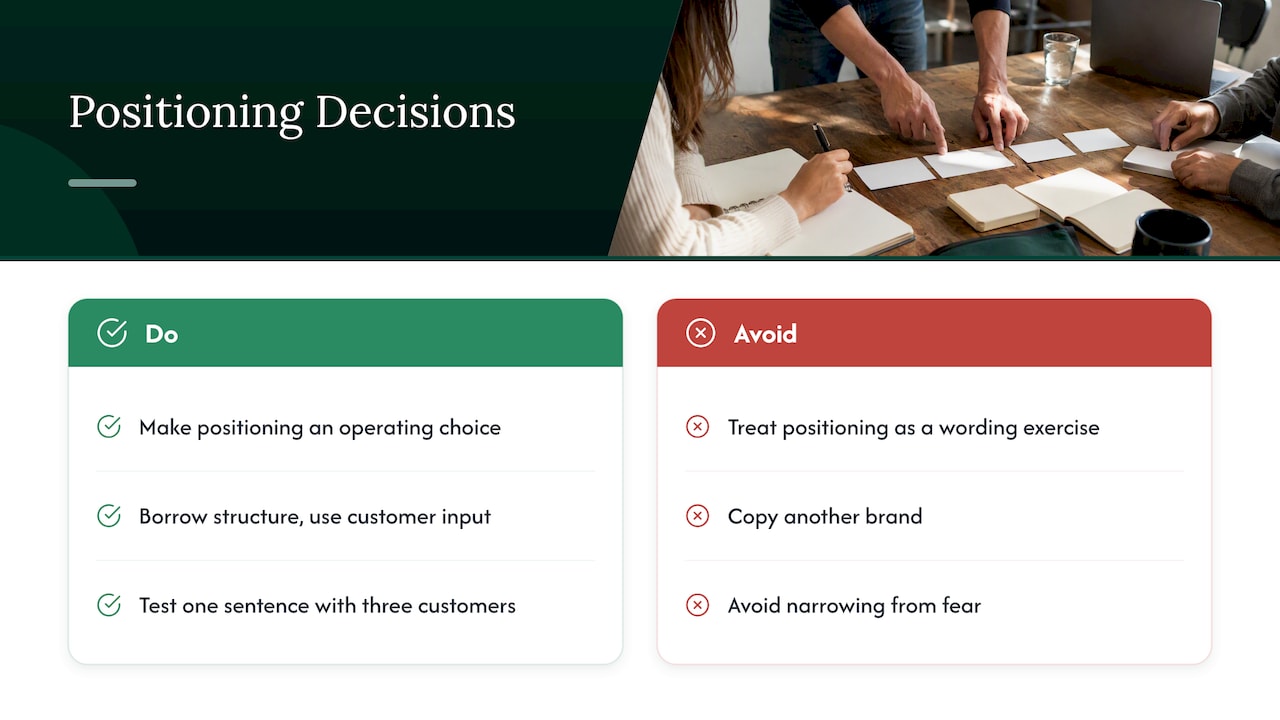
The second misconception is that borrowing a pattern means copying a brand. You are borrowing the structure: one promise, one proof, one audience. What goes inside the structure has to come from your own customers. When I see teams stall, it is rarely for lack of ideas; it is fear of narrowing. Narrowing feels like losing revenue, yet the research above points the other way for most small and mid-sized firms.
Try one thing after reading this: write your position in a single sentence, then show it to three customers without explanation and compare their reactions to your intent.
— Quincy
7. How can we help your team turn examples into a measurable position?
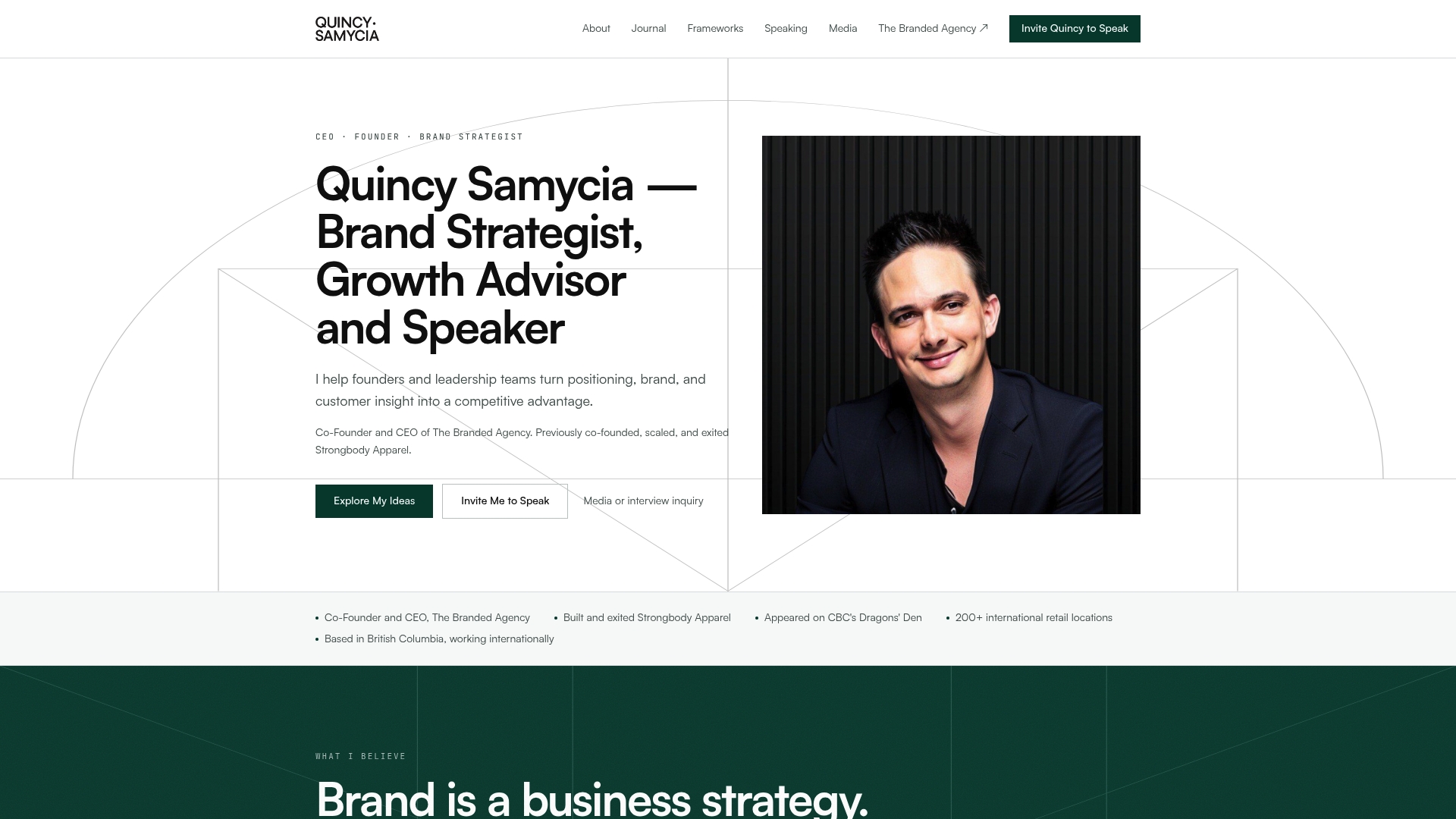
If you would rather not run this alone, we work with founders and leadership teams to connect positioning to measurable business results, from an operator’s perspective rather than a branding-exercise one. Our services include:
- Brand Strategy
- Brand Positioning
- Growth and Go-to-Market Strategy
- Customer Experience
- AI and Marketing Strategy
- Founder and Executive Advisory
We align product, marketing and sales around one clear promise, then track whether it moves the numbers that matter to your business. Current pricing details are on our site. To book a consult or a facilitated workshop, get in touch through our site.
FAQ
What are the 3 C’s of brand positioning?
The 3 C’s are usually described as customer, competitors and company. You define who you serve, how they see the alternatives, and what your company can credibly deliver, then position where those three overlap.
What is the difference between positioning and a USP?
Positioning is the overall place your brand holds in customers’ minds. A USP is the specific, provable reason someone chooses you. A practitioner guide treats the distinct advantage as one input into the statement, not the whole of it.
Is narrow or broad positioning better?
Narrow positioning often wins for smaller or newer brands. A 2022 study found narrow brands tend to resist new competitors more easily, though results depend on the market.
How do I know my positioning is working?
Check whether customers describe you in words close to your statement, and whether a clearer headline lifts early click-through rates. Keep testing, since no single approach works in every category.