
Brand Rollout Plan Starts With Employees, Not Customers
A brand rollout plan works when it moves in three phases: internal readiness, a pilot or soft launch, then public scale. Three things hold it together: clear owners, a full touchpoint audit, and measurement from day one. We build ours around a Customer Zero feedback loop and the frameworks from The Branded Agency, so employees and executives test the story before customers ever hear it.
TL;DR:
- Set the launch date backward from the longest lead time, often signage or packaging, and begin legal clearances and print orders early.
- Train executives to explain the change without slides, rehearse difficult questions, and equip customer facing teams with message maps and quick reference guides.
- Require vendors and franchisees to confirm assets and deadlines before launch; a go or no go gate prevents old branding from lingering across customer experiences.
- Track branded search, sentiment, engagement, and conversions from day one, use weekly feedback to assign fixes, and review results at 30, 60, and 90 days.
Table of Contents
- What does a brand rollout plan look like week by week?
- How do you prepare leaders and employees before the public sees anything?
- Which touchpoints do you need to update, and who owns each one?
- How do you set up governance so the rollout does not stall?
- How do you pressure-test the story and prepare for the first 72 hours?
- What should you measure, and how do you act on early feedback?
- What does a ready-to-copy 12-week timeline look like?
- How should you communicate with partners, suppliers, and other outside stakeholders?
- How do you budget and allocate resources across the rollout phases?
- Why does leadership fluency decide whether a rollout holds together?
- How can we help you run your rollout?
- FAQ
- Sources
What does a brand rollout plan look like week by week?
Think of the rollout as three phases, each with one outcome you can check.
- Internal readiness: leaders can explain the “why,” owners are named, and every touchpoint is inventoried. Nothing public happens yet.
- Pilot or soft launch: a small audience, such as employees, loyal customers, or one region, uses the new brand, and you fix what breaks.
- Public launch: the full reveal, paid media, press, and every customer-facing surface switching together.
For an 8–12 week rollout, spend roughly the first third on readiness, the middle on the pilot, and the final stretch on launch and the first 30 days of monitoring. A longer rollout stretches the same shape, usually because packaging, signage, or franchise locations take longer to change.
The critical path runs through your website and analytics. If tracking tags, redirects, and landing pages are not live and tested, paid media sends traffic you cannot measure and cannot convert. Legal clearances and print lead times are the other items that block everything behind them, so start them first.
Pro Tip: Schedule the launch date backward from your longest lead time item, usually signage or packaging, not forward from when the creative feels done.
How do you prepare leaders and employees before the public sees anything?
Your people are the first audience, and they are the ones customers will ask. Research on a major restaurant logo update found that narrative often trumps data in brand perception, and that executives must be fluent in the strategic intent behind a shift. Superficial buy-in leaves a gap between ambition and how leaders represent the change.
We close that gap with a few repeatable steps:
- Message maps: one page that states the why, the promise, and three proof points in plain language.
- Rehearsed Q&A: executives practice the hardest questions out loud, including “why did you change what people loved?”
- Quick-reference playbooks: a short guide for sales, support, and store teams covering what changed, what did not, and what to say.
- Training sessions: live walkthroughs for customer-facing teams, recorded for new hires.
- Brand ambassadors: a small group of employees from different departments who answer peers’ questions and report confusion early.
Gartner’s research on cross-functional engagement for brand launches points the same direction: the most successful CMOs focus on change management and use a Customer Zero feedback loop to align behaviors, operations, and customer experience. In practice, your ambassadors and pilot participants are that loop.
Pro Tip: Ask leaders to explain the rebrand to someone outside the project. If they need slides, they are not ready.
Which touchpoints do you need to update, and who owns each one?
Most launches stumble on the forgotten surface, not the big one. Audit everything a customer, partner, or employee can see, then assign one owner per line.
Digital
- Website pages, navigation, and footers, owned by web or product
- SEO titles, meta descriptions, and redirects, owned by marketing
- Analytics tags and conversion events, owned by data or growth
- Email templates, signatures, and sender names, owned by lifecycle marketing
- App UI, icons, and store listings, owned by product
- Customer experience flows such as onboarding, checkout, and confirmation messages, owned by CX
Marketing
- Social profiles, handles, bios, and pinned posts, owned by social
- Paid creative and ad accounts, owned by performance marketing
- Press kit, boilerplate, and executive bios, owned by communications
- Campaign landing pages, owned by marketing
Operations and sales
- Signage, vehicles, and uniforms, owned by operations
- Packaging and inserts, owned by supply chain
- Invoices, quotes, and contracts, owned by finance
- Sales decks and proposal templates, owned by sales enablement
- Support knowledge base and macros, owned by support
- Legal templates, trademarks, and disclaimers, owned by legal
Handles deserve their own line. If a preferred username is held by someone else, settle it before launch day. A transfer done without protection carries real risk, and this guide to escrow for username deals explains how safer handoffs work.
How do you set up governance so the rollout does not stall?
Use the simplest model that still names a decision maker for every deliverable. A one-to-two page RACI does the job: who recommends, who approves, who executes, and who is consulted.
- Executive sponsor: approves the strategy and breaks ties. One person, not a committee.
- Launch lead: owns the plan, the timeline, and the weekly status. This is the connective tissue between strategy and operations.
- Workstream owners: one each for digital, marketing, operations, sales, and legal, each executing their touchpoint list.
- Communications lead: owns the narrative, spokespeople, and response templates.
- Vendor and franchise coordinator: manages printers, agencies, and locations outside your direct control.
Vendors and franchisees need the same gate discipline as employees. Give them the asset package, a hard deadline, and a go or no-go check before the public date. A launch gate that requires every critical surface to be confirmed ready prevents the partial rollout where half the customer experience still wears the old identity.
How do you pressure-test the story and prepare for the first 72 hours?
Assume someone will misread the change. Plan for it before they do.
- Test the narrative small: show the new identity and story to Customer Zero participants and watch for reactions that conflict with customer memories or expectations.
- Write scenario plans: list the three likeliest misreadings, such as “they changed to cut costs” or “they abandoned their roots,” and draft a templated response to each.
- Train spokespeople: executives rehearse with a media coach, including the uncomfortable questions.
- Listen continuously: staff social monitoring during the initial launch period, with a clear escalation path to the sponsor.
The payoff of getting the reveal right can be large. An analysis of IHOP’s burger campaign reported 1.2 million tweets and more than 27,000 earned media stories, which shows how far a well-prepared moment can travel, and why an unprepared one can travel just as far in the wrong direction.
What should you measure, and how do you act on early feedback?
Track a small set of signals from day one:
- Awareness lift: branded search volume and direct traffic against your baseline
- Sentiment: the tone of social mentions, reviews, and support tickets
- Engagement: time on site, email clicks, and social interactions
- Conversion lift: lead or purchase rates on updated pages
- Early sales signals: pipeline quality and win rates from customer-facing teams
Then keep the Customer Zero loop running. Gartner’s work on elevating a Customer Zero program describes turning internal rollout testing into a strategic go-to-market advantage that can secure higher-quality deals. Collect feedback weekly, rank fixes by customer impact, and assign each to an owner.
Use 30/60/90 days as checkpoints: fix breakages by day 30, refine messaging and training by day 60, and review business outcomes by day 90.
Pro Tip: Review your sales team’s objections each week. They surface message problems faster than any dashboard.
What does a ready-to-copy 12-week timeline look like?
Paste this into your project plan and assign owners today:
- Early phase: name the sponsor and launch lead, finish the touchpoint audit, and start legal and print orders.
- Preparation phase: build message maps, train executives, and ready the website and analytics.
- Pilot phase: run the soft launch with employees and Customer Zero participants, then fix issues.
- Pre-launch phase: brief partners and vendors, finalize paid creative, and rehearse the response plan.
- Launch gate: hold the go or no-go check and switch all surfaces together.
- Launch period: monitor the rollout and begin regular feedback reviews.
At the outset, assign these priorities: the touchpoint audit, the legal and trademark review, and the website and analytics readiness plan. They unlock everything else. A constrained team can ship a minimum viable rollout with those three, one trained leadership group, and a single measurement dashboard.
How should you communicate with partners, suppliers, and other outside stakeholders?
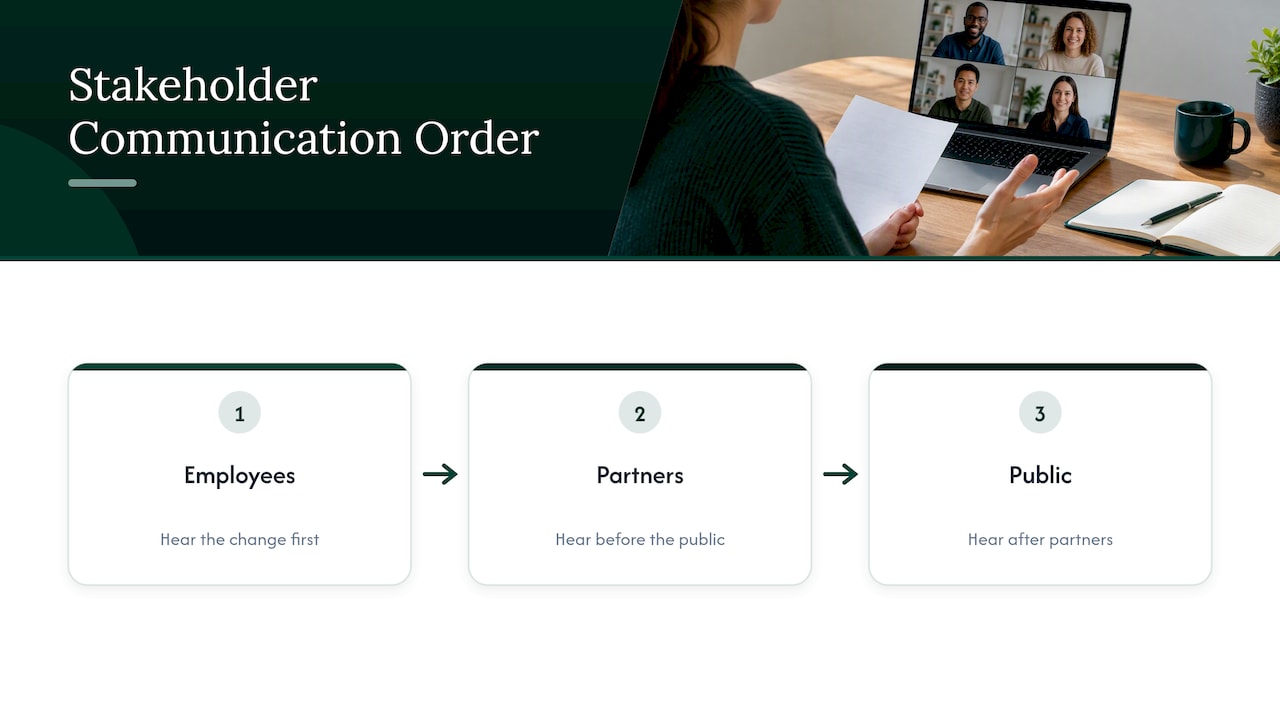
Partners and suppliers carry your brand to customers you never meet, so they hear the change before the public does, but after your employees. A good outside-in plan sequences who learn what, and when.
Start with a tiered list. Tier one is anyone who touches your customer experience or physical presence: franchisees, resellers, printers, installers, and agencies. Tier two is anyone who simply needs accurate details: payment processors, software vendors, and distributors. Tier three is the wider ecosystem, including trade press and industry groups.
For tier one, send a launch kit well before the public date. It should contain the story and message map, the new asset library, usage rules, key dates, and a named contact for questions. Ask for written confirmation that they understood the date and the rules. For tier two, a shorter notice covering new legal names, logos on invoices, and any change to remittance details is enough. Finance and legal should review this wave closely, because a mismatch between old and new details can delay payments.
Hold one live briefing for your most important partners, using the same Q&A your executives rehearsed. Partners will repeat what you tell them, so give them language they can say without improvising. After launch, send a short update with early results and a place to report problems, such as a misprinted asset or an outdated listing.
Keep a single source of truth, a shared page that always holds the current assets and dates. Version confusion is the most common cause of mixed branding in the field.
How do you budget and allocate resources across the rollout phases?
Budget by phase, not by deliverable, so you can see where money turns into risk reduction. We have no benchmark percentages to hand you, and published splits vary widely by industry, so build yours from your own audit and quotes.
Start with the touchpoint list. Price each line, then group the lines under the three phases. Readiness usually holds research, message development, training, and legal work. The pilot holds limited production runs, testing tools, and the Customer Zero program. Public launch holds large-volume production, paid media, events, and press support.
Three allocation habits protect the plan:
- Hold a contingency reserve. Keep money back for the surprises that appear during the pilot, such as a rejected trademark variant or a misprint. Release it only with the sponsor’s approval.
- Fund the unglamorous work. Training, analytics setup, and internal communication are cheap relative to media, and they decide whether the media spend converts.
- Stage the heavy spending. Commit to large print runs and paid campaigns only after the pilot confirms the story holds. Pilot learnings should be able to change the final spend.
Resourcing is also about people’s time. List who needs how many hours each week, and talk to their managers before the work starts. A launch lead splitting attention across five other priorities is the most common hidden cost of a rollout.
Finally, reserve a post-launch budget for the initial period. Fixes, extra training, and corrected assets always appear after the reveal, and planning for them keeps momentum instead of forcing a scramble.
Why does leadership fluency decide whether a rollout holds together?
In our experience, rollouts rarely fail on the logo or the color palette. They fail where strategy and execution stop talking to each other, and the research on a well-known logo update shows how quickly narrative can overtake a good product. Leaders who can state the why, a team that has rehearsed the hard questions, and metrics that tell you early when something is off prevent most derailments. Brand is business strategy, and the rollout is where that becomes visible.
— Quincy
How can we help you run your rollout?
We turn a strategy into a launch your teams can actually execute, and we can start wherever you are.
- Brand strategy and positioning that gives the rollout a clear why
- Go-to-market planning that sequences the phases and owners
- Customer experience mapping to find every touchpoint that needs attention
- Founder and executive advisory so leaders are fluent before launch day
We can support you while you execute. Book a discovery conversation and we will discuss your rollout together.
FAQ
What are the main phases of a brand rollout?
A rollout moves through internal readiness, a pilot or soft launch, and a public launch with monitoring afterward. Each phase should end with a clear check before the next one starts.
How long should a brand rollout take?
Many teams plan between 8 and 12 weeks for a contained rollout and longer when physical assets or many locations are involved. The longest lead time item, often signage or packaging, sets the real date.
Why test with Customer Zero before launching publicly?
Customer Zero testing surfaces confusing messages and broken experiences while they are cheap to fix. Gartner’s research ties a strong Customer Zero feedback loop to better cross-functional alignment, which is why we start there.
What should be in a brand rollout plan?
At a minimum, include phased timing, a touchpoint audit, named owners, a narrative and response plan, and measurement checkpoints. Training for customer-facing teams belongs in that list too.