
Brand Storytelling Framework That Survives Six Second Reels for Teams
The repeatable engine behind every brand story that works is the same: cast the customer as the hero, give them a real conflict, show a specific transformation, and back it with proof. Named spines like the three-act structure, Freytag’s five acts, StoryBrand’s SB7, the Pixar formula, and And-But-Therefore (ABT) are just different containers for that same engine. Pick the spine that fits your audience, your channel mix, and how much proof you actually have, and you get a story that compresses cleanly from a six-second Reel to a full case study.
TL;DR:
- Use ABT or Pixar frameworks for short-form videos to compress stories into a single, compelling sentence that includes protagonist, conflict, transformation, and proof.
- Pick a storytelling structure that matches your brand’s transformation complexity, proof availability, and target format, whether long-form or short-form content.
- Ensure your story clearly centers the customer as hero, states the real conflict openly, and only promises proof that is verifiable and believable.
- Develop a master story from customer language, then create channel-sized versions and narrative anchors to ensure consistency across formats and teams.
- Measure success over weeks and months by tracking attention, engagement, trust, and revenue, not just early-stage metrics.
Table of Contents
- Named Brand Storytelling Frameworks and What Each One Is Good For
- How to Choose the Right Storytelling Framework for Your Brand
- Build a Repeatable Brand Storytelling Framework Your Team Can Actually Use
- Templates and Channel-Sized Story Examples You Can Copy
- How Quincy Samycia Applies Storytelling Frameworks in Client Work
- Where Brand Storytelling Frameworks Usually Break
- How Quincy Samycia Helps You Build a System, Not a One-Off Story
- Sources
- FAQ
Named Brand Storytelling Frameworks and What Each One Is Good For
Every popular narrative model is a variation on one mechanism: someone wants something, hits a wall, and changes because of what happens next. What separates them is pacing, complexity, and how explicitly they demand proof at the end.
- Three-act structure. Setup, confrontation, resolution. Works well for founder stories and long-form video where you have two or three minutes to build tension before the payoff.
- Freytag’s five-act (five-act pyramid). Exposition, rising action, climax, falling action, resolution. Better suited to case studies or documentary-style brand films where the “climax” is a specific turning point in the customer’s business, not just an emotional beat.
- StoryBrand (SB7). A seven-step framework built specifically for marketing copy: a character has a problem, meets a guide, gets a plan, is called to action, and either succeeds or avoids failure. It’s the most operationally rigid of the group, which makes it the easiest to hand to a copywriter as a fill-in-the-blank template.
- Pixar formula. “Once upon a time… every day… until one day… because of that… until finally…” Built for emotional compression. It shines in 30 and 60 second video because the structure forces you to name the “every day” (status quo) and the “one day” (disruption) in a single breath.
- ABT (And, But, Therefore). The tightest of the five. One sentence: “We do X, but Y happens, therefore Z.” It’s the best stress test for whether your story survives compression, because if you can’t state your brand story in one ABT sentence, you probably don’t have one yet.
Every one of these frameworks shares the same skeleton: a protagonist, a conflict, a turning point, and proof that the change is real. Shopify’s build guide organizes this into protagonist, conflict, resolution, and moral, which maps almost exactly onto ABT and Pixar both. For compression, ABT and Pixar win. Freytag and the three-act structure need more runway and fit long-form formats like brand documentaries or investor decks better than a 15-second ad.
How to Choose the Right Storytelling Framework for Your Brand
Don’t pick a spine because it’s trendy. Pick it because it matches four things you already know about your brand: your strategic goal, the complexity of the transformation you’re selling, how much real proof you have, and where the story will actually run.
- Match complexity to format. If your customer’s transformation takes 18 months and six stakeholders (common in B2B), a Freytag or three-act structure gives you room to show that arc honestly. If the transformation is instant and emotional (a skincare brand, a fintech app), ABT or Pixar compress it without losing the punch.
- Audit your proof before you pick a spine. StoryBrand and ABT both demand a clear “success” or “therefore” moment. If you don’t have a customer outcome you can point to, either go get one or choose a spine that leans on brand purpose rather than a hard result.
- Consider your brand archetype. A guide-archetype brand (most B2B software, most consultancies) fits StoryBrand’s guide role naturally. A rebel or challenger brand often needs more conflict and tension than SB7’s tidy structure allows, which is where Freytag’s rising action does more work.
- Run the six-second test. Can someone understand the conflict and the stakes in six seconds of video with no sound? If not, the spine you picked is too slow for short-form.
- Run the 30-second pitch test. Say the story out loud in 30 seconds. If you stumble, the structure has too many moving parts for the channels where most people will actually encounter it.
- Run the proof check. Ask: “Would a skeptical prospect believe this ending?” If the answer is no, the spine is asking your brand to promise more than the proof supports.
Watch for three warning signs regardless of which spine you pick: the brand cast as hero instead of guide, a vague “after” state that could describe any competitor, and proof that can’t survive a follow-up question. HBS Online’s research on brand narrative makes the case plainly: stories that put the customer at the center build empathy and move people from awareness to purchase far more reliably than brand-centered narratives.
Pro Tip: If you can’t compress your brand story into one ABT sentence, don’t move to production yet. A story that needs five sentences to explain itself will never survive a 15-second placement, no matter how good the footage is.
Build a Repeatable Brand Storytelling Framework Your Team Can Actually Use
A brand story that lives in a single deck is not a framework. A framework survives contact with a dozen different creative briefs, three different channels, and a team member who wasn’t in the room when it was written. Building one takes five steps.
- Audit what customers are already saying. Pull language from reviews, support tickets, sales call notes, and DMs. Brands that mine their own customer language this way tend to find the real protagonist and the real proof already sitting in their inbox, rather than guessing at it in a workshop.
- Name the founding tension. What was broken before your brand existed? Write the before state and after state in one sentence each. If the after state could describe a competitor word for word, it’s too generic to be a story.
- Write the master story once. This is the long version, built on your chosen spine, with the full conflict, turning point, and proof spelled out. Academic research on strategic versus tactical storytelling backs this approach directly: one guiding narrative should sit above every campaign-level story, not the reverse.
- Compress into channel-sized versions. Take the master story down to a 30 second cut, then a 6 second cut, then a single line for a landing page hero. Each compression should keep protagonist, conflict, and proof, even as detail falls away.
- Build narrative anchors and a creative brief template. Narrative anchors are the two or three phrases (the conflict line, the transformation line, the proof line) that every creator or agency partner gets handed before they touch a brief. Systems that survive scaling brief every asset against these anchors instead of letting each creator reinvent the story.
Before you ship anything, pressure test the compressed versions against three tight formats: a six-second video brief with no sound, a 60 word email subject and preview line, and a three panel unboxing insert. If the story holds up in all three, it’s operationally usable. If it collapses in any of them, the master story has too much complexity baked in.
- Set a measurement plan before launch, not after.
- Track attention metrics (thumb stop rate, view time) in the first two weeks.
- Track engagement metrics (shares, saves, comments) over the next month.
- Track trust and revenue metrics (repeat purchase, assisted conversions) over a full quarter or longer.
Pro Tip: If a creative partner asks “what’s the story again?” more than once during production, your narrative anchors weren’t specific enough. Fix the anchor, not the creative brief.
Templates and Channel-Sized Story Examples You Can Copy
A usable master-story template reads like this: “[Protagonist] wanted [goal], but [conflict] stood in the way. They tried [obvious solution], and it didn’t work because [reason]. Then [turning point], and now [transformation], proven by [specific outcome].” That single paragraph is your master story. Everything else is a shrunk version of it.
Three compressed variants from one master story:
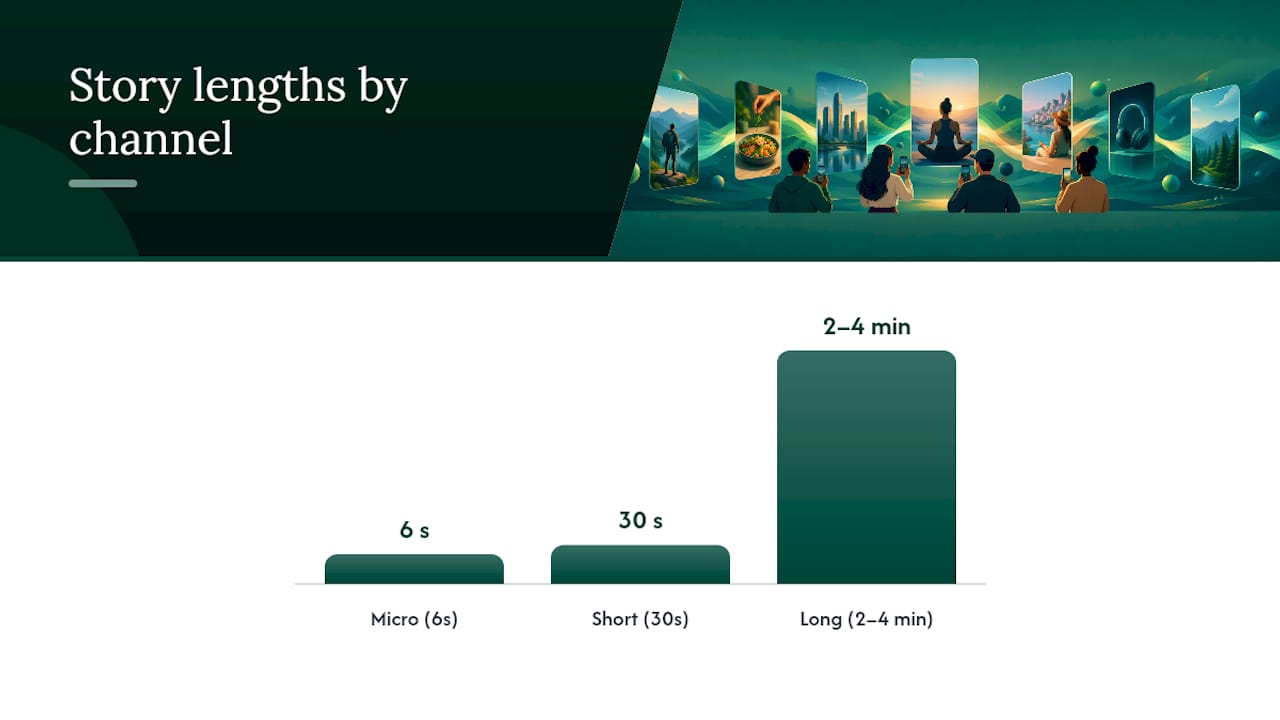
- Micro (6 seconds): Show the “before” visual, cut hard to the “after” visual, end on the proof stat or a single line of customer language.
- Short (30 seconds): Add the conflict beat and one line of the “obvious solution that didn’t work,” then the turning point and proof.
- Long (2 to 4 minutes): Full arc, including secondary characters (a teammate, a mentor, a skeptical stakeholder) and multiple proof points.
Consider three quick sketches of how this plays out by category. A B2B software brand: a revenue operations lead (protagonist) is drowning in spreadsheets (conflict), tries three point solutions that create more silos (obvious solution fails), adopts a unified platform (turning point), and cuts reporting time by naming a specific, verifiable number (proof). A DTC skincare brand: a customer with persistent breakouts (protagonist) has tried five products that promised too much (conflict), finds a formulation built around one active ingredient (turning point), and posts an unprompted before/after (proof). A mission-driven nonprofit: a rural clinic (protagonist) can’t retain staff (conflict), tries traditional recruiting that fails (obvious solution), partners with a training pipeline (turning point), and retains staff at a rate they can point to publicly (proof).
Each of those adapts across channels without changing the spine. The B2B story runs as a 6-second Reel showing the spreadsheet chaos cutting to the clean dashboard, as a landing page hero line (“Stop reporting from six different tools”), and as a full case study with the customer’s name attached. HubSpot’s four-pillar approach, people, places, purpose, plot, is a useful checklist for making sure none of those channel versions drop a piece the story needs to stay coherent.
How Quincy Samycia Applies Storytelling Frameworks in Client Work
Most storytelling frameworks stop at “here’s the structure.” Quincy Samycia’s practice starts from the assumption that a story only matters if it changes how a business performs, which is why his methodology pairs narrative structure with commercial proof at every step.
The Golden Spiral™ maps the same conflict-to-transformation arc described above onto a brand’s actual positioning decisions, so the master story and the go-to-market strategy are built from the same source material instead of drifting apart in separate documents. Brand-Backed Performance™ then ties that narrative directly to measurable outcomes, treating the story as a growth lever rather than a marketing asset that lives in isolation. You can see how the two connect in Quincy’s frameworks overview.
Consulting engagements typically start with a discovery process that mirrors the audit step above:
- What language do your best customers use, unprompted, to describe the “before” state?
- What proof already exists that you’re not using anywhere?
- Where does internal language contradict the story you’re telling externally?
[]
Where Brand Storytelling Frameworks Usually Break
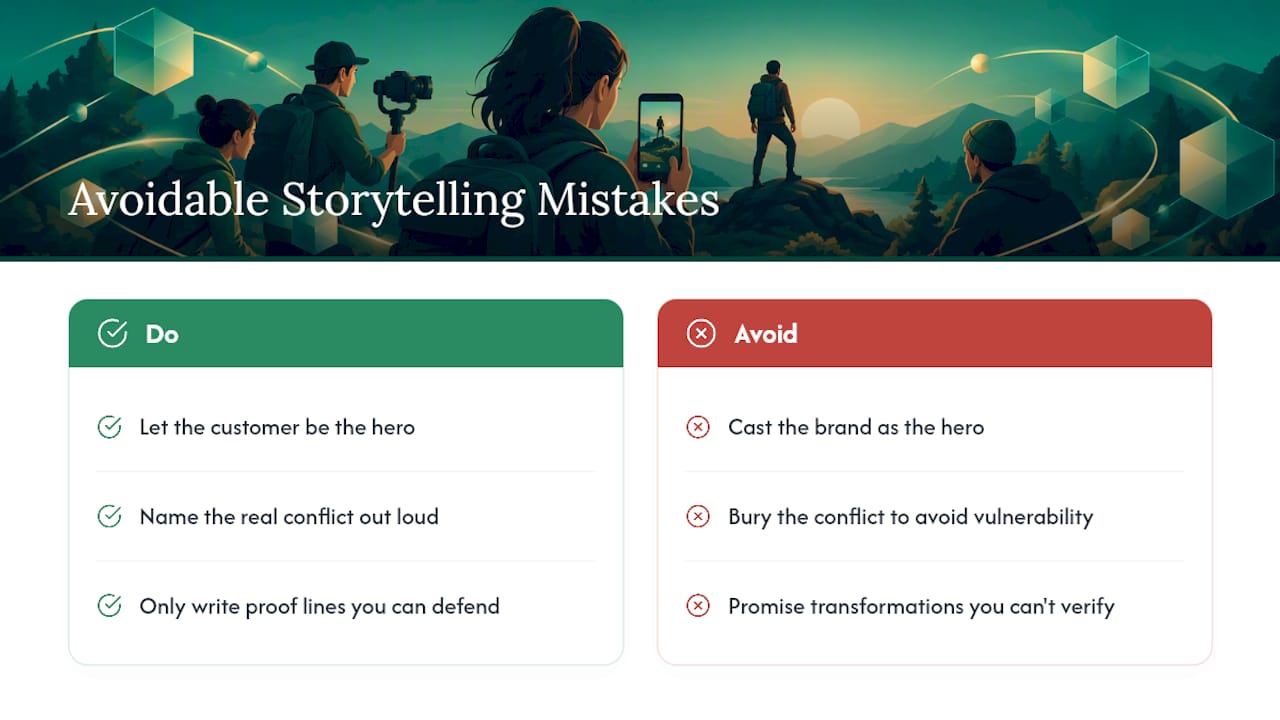
The biggest failure I see isn’t a bad spine choice. It’s a brand that casts itself as the hero, buries the conflict to avoid looking vulnerable, or promises a transformation it can’t back with a single verifiable outcome. Each fix is one sentence: let the customer be the hero, name the real conflict out loud, and never write a “proof” line you couldn’t defend to a skeptical prospect.
Measurement fails the same way. Attention moves in weeks. Trust and revenue move in quarters. Judging a new brand story by week two engagement numbers kills good narratives before they’ve had time to compound.
If your team needs one line to remember: a story that flatters the brand is marketing, and a story that changes the customer is strategy.
— Quincy
How Quincy Samycia Helps You Build a System, Not a One-Off Story
Everything above works better with a partner who’s built the master story, the compressed assets, and the creative brief template before, across enough categories to know where each spine breaks under pressure. Quincy Samycia’s engagements center on exactly that: Brand Strategy, Brand Positioning, and hands-on workshops that produce a working narrative system, not a slide deck that gets shelved after the kickoff call.
A first engagement typically produces three concrete outputs: a written master story built on the spine that fits your proof and your channels, a set of compressed versions sized for your highest-priority formats, and a creative brief template your internal team or agency partners can use without you in the room. Teams building creative in-house often pair this with production partners like Blistr for narrative-led content execution once the anchors are locked. For teams that want the framework taught directly to a broader group, speaking engagements translate the same system into a workshop format.
If you’re deciding between hiring a strategist for a single project or building this capability internally, start with the frameworks overview and book a conversation about what a first engagement would actually deliver for your brand.
Sources
- How to Tell a Better Brand Story | HBS Online
- Brand storytelling: How to build your brand story | Shopify
- Brand Storytelling Strategy 2026 — Pota Studio
- Brand stories and brand storytelling in brand management (journal article DOI)
FAQ
What are the four pillars of brand storytelling?
HubSpot’s widely cited framework names four pillars: people, places, purpose, and plot, which together map the story’s characters, setting, motivation, and structure. Mapping your narrative to the customer journey using these four pillars helps confirm nothing critical got lost when you compress a story for a shorter format.
What are the seven elements of StoryBrand (SB7)?
StoryBrand’s SB7 framework outlines a character with a problem who meets a guide, gets a plan, gets called to action, and ends in either success or avoided failure. It’s built specifically as a marketing copy template, which is why it’s often the easiest spine to hand directly to a copywriter.
What are the five C’s of storytelling?
Definitions of the “five C’s” vary across sources, and there’s no single agreed-upon version in the frameworks covered here. Rather than force a canonical list, focus on the mechanics that do have consistent support across frameworks: a protagonist, conflict, transformation, and proof.
What is the 3-7-27 rule of branding?
The 3-7-27 rule isn’t part of the storytelling frameworks or research referenced in this piece, and definitions of it vary widely depending on the source. If you’re evaluating a specific rule like this for your brand, it’s worth confirming the original source before applying it to a storytelling decision.
How do I know if my brand story is working?
Track attention metrics like thumb-stop rate in the first weeks after launch, then watch engagement metrics like shares and saves over the following month. Trust and revenue metrics, including repeat purchase and assisted conversions, move on a longer timeline and shouldn’t be judged against the same early window as attention data.