Write Brand Copy in Under Five Minutes: NN/g Backed Voice Guidelines
Brand voice guidelines should be a short, example-heavy document built around a tone table and a one-page checklist, not a lengthy manifesto nobody reopens. Voice is what a brand always sounds like; tone is how that voice flexes by situation, from a support ticket to a product launch email. Done well, this pairing produces messaging consistent enough to build trust, which is the trait that most reliably makes a brand feel worth choosing.
TL;DR:
- A practical brand voice guideline should be quick to use, with clear sections, real examples, and a focus on consistent traits across all content.
- Embedding voice principles directly into design systems and workflows ensures ongoing adoption and easy updates by assigned owners.
- Testing tone through workshops and reaction exercises reveals whether messaging conveys trustworthiness and credibility effectively.
- Using a small set of targeted tone words and clear do/don’t examples improves team consistency and reduces ambiguity in communication.
- Trustworthiness should be prioritized over friendliness, as it explains more of a brand’s desirability and influences customer perception.
Table of Contents
- What to include in a practical brand voice guidelines document
- Choosing tone targets with the four dimensions
- Building voice into design systems and daily workflows
- Testing whether your tone lands the way you intend
- Ready-to-use tone table and excerpt patterns
- Why voice is a business capability, not a marketing checkbox
- If you want help building and governing your voice
- Sources
- FAQ
What to include in a practical brand voice guidelines document
A brand voice guidelines document earns its keep only when someone can open it, find the answer, and get back to writing in under five minutes. That means structure matters more than prose.
- Brand promise and values: the one or two ideas every piece of content should reinforce.
- Voice principles: three to five stable traits that never change by channel.
- Tone spectrum: how much the voice flexes across formal, casual, playful, or serious contexts.
- Tone words and anti-words: the target adjectives and the ones to actively avoid.
- Channel rules: specific dos and don’ts for email, social, support, and product UI.
- Vocabulary list: preferred terms versus banned jargon or legal-sounding phrases.
- Governance and owners: who approves new copy patterns and how often the guide gets revisited.
- Examples: real excerpts, not hypotheticals, showing the voice in context.
For a quick-reference version, compress this into a single page: one paragraph per section, a five-word tone summary, and a named owner. Longer detail and full examples can live in a secondary reference doc that the one-pager links to.
Do and don’t pairs work best when they show the same message written two ways rather than abstract advice.
- Do: “Your payment didn’t go through. Here’s how to fix it.”
- Don’t: “An error has occurred during the transaction process.”
Pro Tip: Write your do/don’t pairs from real support tickets or marketing drafts, not invented examples. Borrowed sentences train the team faster than hypotheticals.
Choosing tone targets with the four dimensions
Voice needs a framework, not a vibe. Nielsen Norman Group’s tone research breaks tone into four dimensions you can rate for any piece of content:
- Funny versus serious
- Formal versus casual
- Respectful versus irreverent
- Enthusiastic versus matter-of-fact
Plot your brand’s target position on each, then translate that into three to five tone words (clear, direct, warm) plus one or two anti-words (never sarcastic, never stiff) that clarify the boundary.
This exercise matters because tone is not decoration. NN/g’s research on brand perception found that trustworthiness explains 52% of the variability in brand desirability, while friendliness adds roughly 8% more. Every tone word you choose should serve clarity and credibility first, warmth second.
A small tone spectrum helps apply this by content type: marketing copy can lean enthusiastic and a little playful, support content should stay calm and matter-of-fact, and product UI text should be terse, respectful, and free of any humor that could confuse someone mid-task.
Building voice into design systems and daily workflows
A voice guide that lives in a PDF gets read once and forgotten. Content Design London’s guidance on style guides recommends embedding it directly into the design system or content wiki people already use, with examples that grow over time instead of staying frozen at launch.
To make that real:
- Assign one content owner responsible for updates and questions.
- Add tone and vocabulary rules as components inside your CMS or Figma library, next to the UI patterns they govern.
- Build a lightweight approval workflow so new examples get reviewed and added rather than piling up in someone’s inbox.
- Include accessibility checks (plain language, reading level, screen reader friendliness) as part of the same review.
- Run a short internal show-and-tell when the guide launches or changes, and track adoption through spot checks on published content.
Pro Tip: Track one metric, like the percentage of new content that passes a quick tone audit, so adoption is visible instead of assumed.
Testing whether your tone lands the way you intend
Assumptions about tone fail often enough that testing is worth the hour it takes. Content Design London’s workshop method uses a highlighter test: give a cross-functional group a handful of real content samples and colored highlighters for each tone word, then have them mark where the tone lands or misses.
- Run the workshop in under 90 minutes with writers, product, and support represented.
- Follow with a modified product-reaction test: show the same message written two or three tonal ways and ask participants to pick the words that best describe each version.
- Measure specifically for trustworthiness, friendliness, and overall desirability rather than a vague “like or dislike” reaction.
- Pilot the winning version on a small channel before rolling it out everywhere, and gather a round of qualitative feedback before locking it in.
Treat every result as a prompt to adjust, not a verdict to defend.
Ready-to-use tone table and excerpt patterns
A filled-in tone table beats a blank template every time, because it shows the standard instead of describing it.
| Content type | Tone target | Do example | Don’t example |
|---|---|---|---|
| Support email | Calm, direct | “Here’s what happened and how we’re fixing it.” | “We regret to inform you of an unforeseen complication.” |
| Marketing email | Warm, confident | “You’re three steps from your first campaign.” | “Unlock unprecedented value with our platform.” |
Three excerpt patterns worth adapting: a support reply that names the problem before the fix, a product update that leads with what changed for the user rather than what the team built, and an error message that explains the next step in one sentence. Public guides from brands like Mailchimp follow this same structure. When adapting these, strip out anything that sounds like a legal disclaimer dressed up as brand voice, since that mismatch is one of the fastest ways to break reader trust.
Why voice is a business capability, not a marketing checkbox
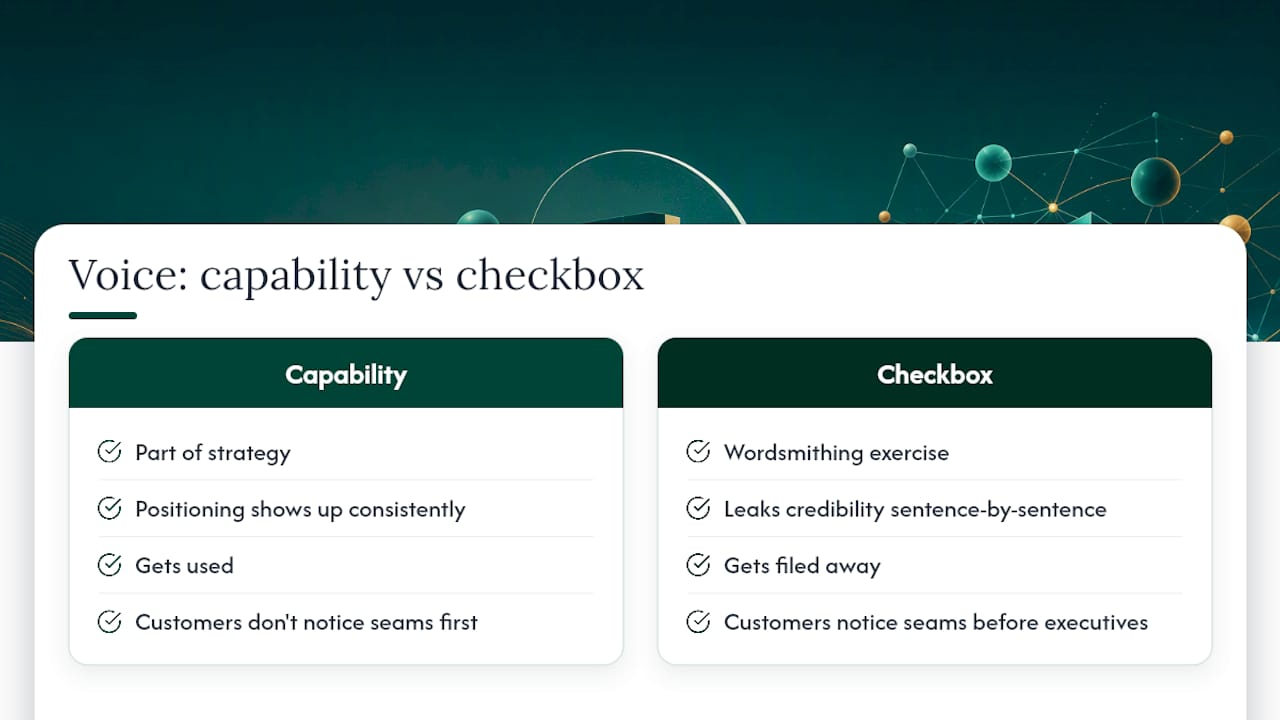
Most teams treat voice as a wordsmithing exercise. The more useful view is that voice is where positioning either shows up consistently or leaks credibility one inconsistent sentence at a time. When voice, product, and go-to-market messaging drift apart, customers notice the seams before any executive does.
Aligning voice with positioning is not a nice-to-have layered on top of strategy. It is part of the strategy, and treating it that way is what separates a guideline that gets used from one that gets filed away.
— Quincy
If you want help building and governing your voice
Writing the guide is the easy half, but many brands partner with agencies specializing in content creation and video editing to apply voice guidance effectively. Making it stick across product, marketing, and sales without drifting back into old habits is the part most teams struggle with alone. An expert in brand strategy works with founders and executive teams on exactly that gap, connecting voice and messaging to the broader positioning and growth strategy rather than treating it as a standalone writing project.
Engagements typically include:
- Tone and voice workshops that produce a working tone table, not just notes.
- Governance playbooks that assign ownership and review cadence.
- Strategic alignment work that ties voice back to positioning and go-to-market plans using frameworks like The Golden Spiral™.
If your team needs a guide that actually gets used, start at Quincysamycia to see current services and book a conversation.
Sources
For deeper reference, Nielsen Norman Group’s tone research covers the trust and desirability data, Content Design London covers adoption practices, and Microsoft’s style guide shows voice principles turned into concrete writing rules.
- The four dimensions of tone of voice — Nielsen Norman Group
- Create a great style guide that people use — Content Design London
FAQ
What is the difference between brand voice and tone?
Voice is the stable personality behind everything a brand publishes; tone is how that personality adjusts to context, like a serious support issue versus a celebratory launch email. A consistent voice can still shift tone across the four dimensions NN/g outlines without feeling inconsistent.
How many tone words should a brand voice guide use?
Most teams do best with three to five target tone words plus one or two anti-words that mark clear boundaries. Keeping the list short, as NN/g recommends, makes the guide easier to apply consistently across teams.
Why does trustworthiness matter more than friendliness in brand voice?
Trustworthiness has the strongest measured link to how desirable a brand feels, explaining 52% of the variability in desirability compared to about 8% for friendliness. That means clarity and competence should anchor tone choices before warmth or humor.
How often should a company update its brand voice guidelines?
There is no fixed schedule, but a living guide embedded in a design system or wiki should be revisited whenever new content types, channels, or major messaging shifts appear. Content Design London’s approach treats the guide as an evolving resource with a named owner rather than a document finalized once.
What is a common mistake when creating brand voice guidelines?
The most common mistake is writing abstract principles with no real examples, which leaves teams guessing how the voice applies to an actual sentence. Guides that pair every principle with a do and don’t example, drawn from real content, see far better adoption than ones built on description alone.