90 Minute Brand Workshop Exercises for Consultants
Ten exercises follow, each one built to produce a specific output, a positioning line, a set of voice adjectives, a competitive stress test, not just conversation. They come with a script, a materials list, and a timing suggestion, plus three sample agendas (90 minutes, half day, full day) so you can assemble a session today. Most work equally well over video or around a conference table, though a couple lean better in person, and each note tells you which.
TL;DR:
- The workshop should focus on clear goals like positioning or brand identity, with an appropriate attendee count of five to seven people to ensure balanced input.
- Pre-work such as surveys and competitor reviews helps maximize workshop efficiency, especially in remote sessions using tools like Miro.
- Timeboxing, parking lots, and Note & Vote are essential facilitation techniques to keep discussions focused and decision-making structured.
- Outputs must be captured with designated owners before leaving to create actionable strategies that influence sales, messaging, or product development.
- Avoid overloading sessions or ending without concrete deliverables; the true success lies in decisions that survive follow-up applications.
Table of Contents
- Brand Workshop Exercises You Can Run This Week
- How to Plan and Structure a Brand Workshop
- Facilitation Techniques That Keep the Room on Track
- Tools and Templates for Remote and Hybrid Sessions
- A 90-Minute Blueprint Built on Measurable Outcomes
- What a Strong Brand Workshop Outcome Actually Looks Like
- Handling Conflict When the Room Disagrees
- When a Workshop Is the Right Call, and When It Isn’t
- Turn Workshop Outputs Into a Strategy You Can Execute
- Templates and Guides Worth Bookmarking
- Sources
- FAQ
Brand Workshop Exercises You Can Run This Week
Every exercise below names its purpose, what to bring, how to run it in a handful of steps, how long it takes, and what you should walk away with on paper. Run them in the order listed for the cleanest logic: warm up loose, sharpen positioning, translate it into language, then lock outputs before anyone leaves the room.
- Cocktail Party. Purpose: surface brand personality fast. Materials: sticky notes, a whiteboard. Ask each participant to describe the brand as a guest at a party (what they wear, how they talk, who they avoid). Collect answers, cluster common traits, name three personality anchors. Time: 15 minutes. Output: a short personality profile.
- Comparison Game. Purpose: find real positioning gaps. Materials: printed competitor snippets or screenshots. Split into pairs, assign each a rival, have them list one thing the brand does better and one thing it does worse. Regroup and vote on the sharpest contrast. Time: 20 minutes. Output: a positioning contrast worth defending.
- Funeral/Eulogy. Purpose: clarify long-term legacy. Materials: none beyond paper. Ask the group to write a two-line eulogy for the brand as if it shut down tomorrow, then read a few aloud. Discuss what people actually mourned. Time: 15 minutes. Output: a legacy statement that hints at the real mission.
- This/Not That Spectrums. Purpose: draw verbal and visual boundaries. Materials: printed spectrum sheets (e.g., “playful” to “serious”). Have participants place a dot on each spectrum individually, then compare placements and debate outliers until the group reaches near consensus. Time: 20 minutes. Output: 5 to 8 locked spectrum positions.
- Brand Archetypes. Purpose: give personality a shared vocabulary. Materials: a printed archetype wheel (Hero, Sage, Rebel, and so on). Have small groups pick the top two archetypes that fit, then defend the choice with one customer example. Time: 20 minutes. Output: one or two chosen archetypes with supporting rationale.
- Kill the Company. Purpose: pressure-test the current position. Materials: none. Split into two teams; one plays a competitor plotting to make the brand irrelevant, the other defends. Debrief on which attacks landed hardest and why. Time: 25 minutes. Output: a list of real vulnerabilities to address in strategy.
- 20-Year Roadmap. Purpose: set ambition beyond quarterly goals. Materials: a long sheet of paper or a digital timeline board. Plot milestones the brand should hit at year 1, 5, 10, and 20, then work backward to what needs to be true now. Time: 25 minutes. Output: a directional vision statement.
- Positioning Sprint. Purpose: draft a claim, not just talk about one. Materials: a positioning worksheet (audience, category, benefit, proof). Fill the worksheet as a group, then have two volunteers read competing drafts aloud for a vote. Time: 30 minutes. Output: a working positioning statement.
- Newspaper Headlines. Purpose: imagine future reputation. Materials: blank headline templates. Ask each participant to write a headline about the brand five years from now, good or bad, and share the most repeated theme. Time: 15 minutes. Output: a reputation aspiration to measure against.
- Voice Adjectives Stack. Purpose: translate personality into tone. Materials: a stack of adjective cards or a shared doc. Each person picks three adjectives that describe how the brand should “sound,” then the group negotiates down to four or five final words. Time: 20 minutes. Output: a locked voice adjectives list.
Sequence matters more than exercise choice. Open with something loose like Cocktail Party or Newspaper Headlines to get people talking without stakes, move into positioning work (Comparison Game, Kill the Company, Positioning Sprint), then close with translation exercises like This/Not That and Voice Adjectives Stack that turn abstract agreement into language a copywriter or designer can actually use. Several practitioner guides describe grouping these exact activities this way, pairing a loose warm-up with a scoped positioning sprint to move a room from imagination to a one-line claim inside a single session.
How to Plan and Structure a Brand Workshop
A workshop only works if the invite list and agenda match the decision you actually need to make. Start by naming the objective in one sentence, “define our positioning against two new competitors,” not “improve our brand,” and pick exercises that serve that objective directly.
- Attendees (5 to 7 people): a senior marketing lead, one sales rep who hears objections daily, a product owner, a founder or executive sponsor, and a designer or writer who will build from the outputs. Fewer than five and you lack perspective; more than seven and decisions stall.
- Pre-work: send a short survey asking each attendee to name three words that describe the brand today and three they wish were true, plus a handful of competitor screenshots to review beforehand. Frontify’s guide recommends this kind of light pre-read so workshop time goes to debate, not orientation.
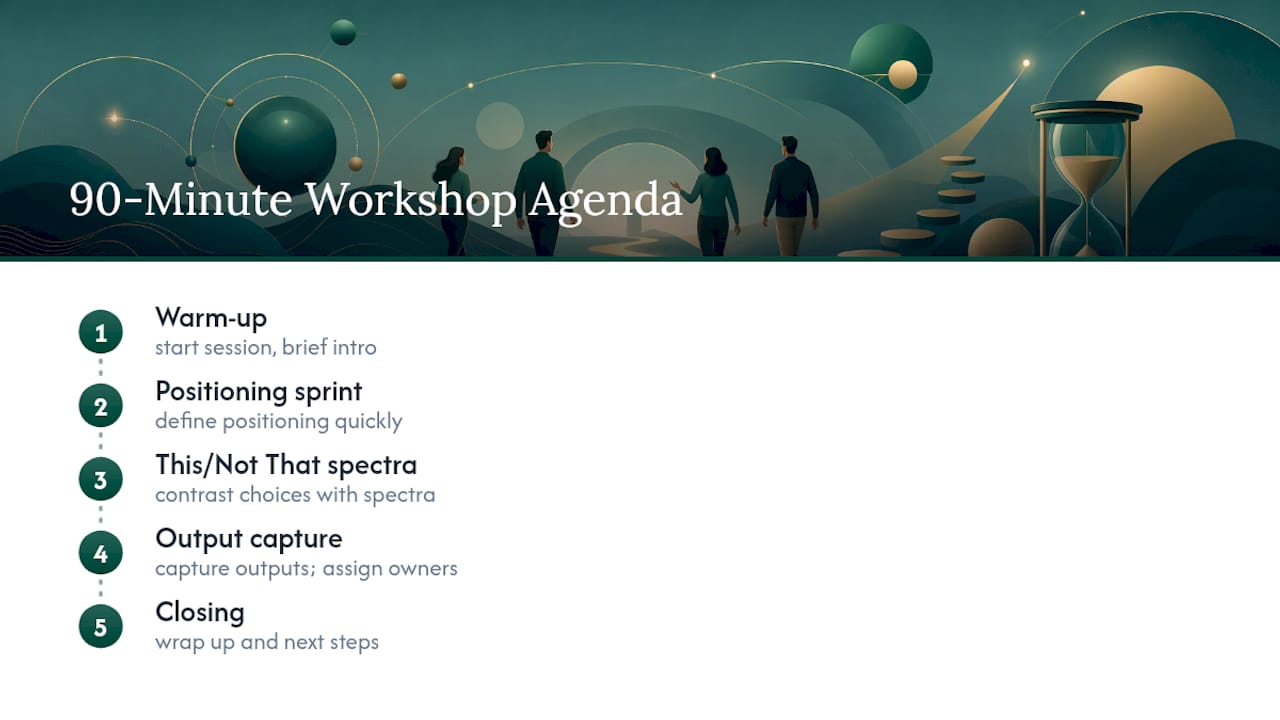
- 90-minute agenda: warm-up (10 min), positioning sprint (30 min), This/Not That spectrums (20 min), output capture and owners (20 min), close (10 min).
- Half-day agenda (4 hours): add Kill the Company and Brand Archetypes, insert a 15-minute break after the first two hours, and end with a full output review.
- Full-day agenda (7 hours): run all ten exercises across morning (personality and positioning) and afternoon (translation and roadmap), with a lunch break and two shorter stretch breaks.
- Deliverables: capture every decision live in a shared doc, assign a named owner to each output before anyone leaves, and set a follow-up date within one week.
Facilitation Techniques That Keep the Room on Track
Timeboxing is the single habit that saves most workshops from running long. Announce each exercise’s time limit out loud, set a visible timer, and cut discussion at zero even if it feels unfinished. Anything unresolved goes into a parking lot, a visible list on a whiteboard or sticky note column, so people feel heard without derailing the agenda.
When opinions split, run a Note & Vote: everyone writes their preferred option silently, votes go up simultaneously, and the majority view moves forward unless someone raises a genuine risk. This keeps the loudest voice in the room, often a senior executive or “HiPPO” (highest paid person’s opinion), from steering every decision by default. Facilitation guides point to timeboxing, parking lots, and note-and-vote specifically as the tools that keep sessions focused and turn conversation into recorded decisions.
Pro Tip: If a senior stakeholder keeps overriding votes, assign them the “devil’s advocate” role for one exercise. It channels their instinct to push back into something structured instead of something that shuts the room down.
- Common pitfall: cramming too many exercises into one session. Fix: cut the list to three or four core activities and protect time for output capture.
- Common pitfall: ending without a written deliverable. Fix: build the last 20 minutes into every agenda specifically for writing outputs down.
Tools and Templates for Remote and Hybrid Sessions
A collaborative whiteboard, Miro among them, handles most remote sessions well, and its “Minimum Viable Brand Workshop” template packages a two-hour remote agenda with timed blocks for values, personality, and positioning. Pair it with real-time polling for Note & Vote moments and an asynchronous form for pre-work surveys.
Prepare these before the session: digital exercise cards for each activity, spectrum sheets for This/Not That, a positioning worksheet, and an output capture template that maps directly to your final brand brief. Mobile apps for tools like Miro let remote attendees participate from a phone during breakouts, which matters when half the room is dialing in from different time zones.
A 90-Minute Blueprint Built on Measurable Outcomes
Experience shows the difference between a workshop that feels productive and one that actually changes a business decision. The gap is almost always what happens after the sticky notes come down, which is why every exercise here feeds directly into The Golden Spiral™ and Brand-Backed Performance™, frameworks built to carry workshop outputs into pricing, sales language, and product roadmap decisions rather than letting them sit in a slide deck.
A typical 90-minute agenda includes warm-up, positioning sprint, This/Not That spectra, output capture, and a closing session. Capturing outputs with assigned owners is essential before the meeting ends.
What a Strong Brand Workshop Outcome Actually Looks Like
The clearest sign a workshop worked isn’t enthusiasm in the room. It’s a positioning statement that survives contact with a sales call three weeks later. One retail team walked out of a single session with a locked voice adjectives list, “direct, warm, unfussy,” that showed up verbatim in their next email campaign and cut internal copy revisions by half, according to a practitioner account documenting a real brand workshop rebuild.
Another outcome can be a Kill the Company exercise that exposes vulnerabilities framed as competitor attacks rather than internal complaints, often producing widely referenced lists of risks identified before competitors exploit them.
The weakest outcomes share a pattern too: a workshop that generates energy but no artifact. If nobody leaves with a written positioning line, an adjective list, or a named owner for a follow-up task, the session was a good conversation, not a brand decision. The difference between the two is entirely about what gets captured in the last 20 minutes, not what gets discussed in the first 70.
Handling Conflict When the Room Disagrees
Disagreement is a feature, not a failure. A workshop where everyone agrees instantly usually means someone senior spoke first and the rest of the room fell in line, which produces a positioning statement nobody actually believes once they’re back at their desks.
When two camps form, resist the urge to broker a compromise that satisfies neither side. Instead, ask each camp to defend their position for two minutes using a specific customer example, not an opinion. Positions grounded in a real account tend to expose which argument is actually stronger, and the room usually shifts on its own once the abstract debate becomes concrete. If it still doesn’t resolve, use Note & Vote and move on, revisiting only if new evidence surfaces before the session ends.
The harder conflict is a senior stakeholder who disagrees with group consensus after a vote. Name this possibility before the workshop starts: agree as a group that votes stand unless someone can point to a specific business risk, not just a preference. That single ground rule, set at the top of the agenda, prevents most late-session power plays. For sessions where executive tradeoffs are the real sticking point, it helps to name who owns the final call before the workshop even begins, a point covered in more depth in why brand repositioning fails without executive tradeoffs.
When a Workshop Is the Right Call, and When It Isn’t
Run a workshop when you need alignment across departments, a repositioning decision, or buy-in from stakeholders who don’t naturally agree. Skip it for narrow tactical fixes or when the real gap is missing research, no exercise substitutes for customer data you don’t have yet. Ask: does this problem need shared belief, or just an answer?
— Quincy
Turn Workshop Outputs Into a Strategy You Can Execute
A workshop gives you language. What happens next determines whether that language changes how the business actually sells, prices, or builds product. Quincy’s frameworks, The Golden Spiral™ and Brand-Backed Performance™, exist specifically to take a positioning draft or a voice adjectives list out of the workshop room and connect it to measurable business decisions, not just a refreshed brand guide sitting in a shared drive.
If your team just ran, or is about to run, a session like the ones outlined here and wants help converting the outputs into a strategy an executive team will actually act on, explore the Brand Strategy Frameworks or book Quincy for a facilitated workshop or speaking engagement. For teams still building out their pre-work process, pairing a workshop with structured customer intelligence gathered beforehand tends to sharpen every exercise on this list.
Templates and Guides Worth Bookmarking
- Minimum Viable Brand Workshop Template: a ready-made two-hour remote session template.
- Frontify’s brand workshop guide: step-by-step positioning and identity exercises.
- The Strategy Haus: practical guidance on documenting collaborative strategy sessions.
Sources
- Minimum Viable Brand Workshop Template | Miroverse
- What is a brand workshop? (+ 6 exercises to run)
- Brand Workshop Guide: Exercises, Tools & Strategy In 2026
FAQ
How Long Should a Brand Workshop Last?
A focused session runs 90 minutes for a single decision like positioning; plan a half day or full day when you’re covering personality, positioning, and voice in one sitting.
Who Should Attend a Brand Workshop?
Keep it to 5 to 7 people: a senior marketing lead, a sales rep, a product owner, an executive sponsor, and a designer or writer who will build from the outputs.
What’s the Difference Between a Positioning Workshop and a Messaging Workshop?
A positioning workshop defines where the brand sits against competitors and who it serves; a messaging workshop translates that position into specific language for sales and marketing, often the next session after positioning is locked.
What Should We Walk Away With After a Brand Workshop?
Expect a draft positioning statement, a locked voice adjectives list, a few This/Not That spectrum decisions, and named owners for every follow-up task.
How Do You Keep One Person From Dominating the Session?
Use timeboxing and Note & Vote so every voice gets equal weight in the decision, and name a ground rule at the start that votes stand unless someone raises a specific business risk.
Can Quincy Facilitate a Brand Workshop for Our Team?
Yes, Quincy runs facilitated workshops and speaking engagements built around The Branded Agency methodology, designed to connect workshop outputs directly to measurable business strategy.