
Competitive Brand Analysis: A Practical Guide for Leaders
A competitive brand analysis is a structured comparison of your brand against the other options your buyers consider, covering positioning, audience, offer, price, messaging, identity, customer experience and results. Done well, it does not end in a report. It ends in a short list of choices: which customer to win, which promise to own, and what proof you still have to build. This guide shows how to run one in a few weeks, what to put in the matrix and how to avoid the mistakes that turn it into a slide deck nobody uses.
TL;DR
- Start with the decision you need to make and the customer you want to win, not with a list of rivals.
- Compare four kinds of competitors: direct, indirect, tertiary and aspirational. Buyers rarely compare only the obvious ones.
- Separate what competitors claim from what customers say they experience. The biggest openings are usually say-do gaps.
- Include AI search in the scope: being mentioned and being cited are different things.
- Finish with choices and metrics, and assign an owner to refresh the work. It is a living document, not a one-time project.
Table of Contents
- What a competitive brand analysis covers
- Step 1: Define the decision and the customer
- Step 2: Choose the right competitors
- Step 3: Gather evidence from both sides
- Step 4: Build the comparison matrix
- Step 5: Find the gap that is real
- Step 6: Include AI search and third-party perception
- Step 7: Turn findings into choices
- Metrics that show it worked
- Our perspective
- Working with us on competitive positioning
- Common mistakes to avoid
- FAQ
- Sources
What a competitive brand analysis covers
The Firesmith OPEN framework describes it as a structured comparison of direct, indirect, tertiary and aspirational competitors against your own brand. It looks at positioning, audience, offer, price, messaging, identity, customer experience, channels, reputation, strengths and weaknesses. Its purpose is to find positioning space you can defend and turn it into decisions.
That last part matters. Plenty of teams can describe their rivals. Far fewer can say what they will do differently on Monday because of what they learned.
It also helps to be clear about what this is not:
- Not a SWOT. A competitive analysis is the evidence-gathering and comparison. SWOT is a synthesis tool that can summarize findings but cannot replace competitor research or customer validation.
- Not a visual audit. Logos, colors and taglines matter, but a B2B buyer choosing an advisor or a platform is mostly weighing credibility, scope, proof and risk.
- Not a one-time report. Offers, messaging, buyer expectations and channels shift. Treat the work as iterative, with named owners, recorded assumptions and unresolved questions.
Step 1: Define the decision and the customer
Before you open a single competitor website, write two sentences:
- The decision this analysis must inform (for example: how we reposition for mid-market buyers, or whether we can charge for a diagnostic).
- The ideal customer whose point of view you will use to judge every competitor.
Without these, every observation feels equally important and the matrix balloons. If your ideal customer is still fuzzy, fix that first. Our ideal customer profile framework walks through six steps from data to rep actions.
Step 2: Choose the right competitors
The Shopify guide to competitor brand analysis recommends sorting rivals into types. We use four buckets, because each teaches something different:
| Type | Who they are | What you learn |
|---|---|---|
| Direct | Similar offer, similar buyer | Where you look interchangeable |
| Indirect | Solve the same need a different way | What the buyer does if they do not hire or buy from you |
| Tertiary | Adjacent players that compete for the same budget or attention | Where budget gets redirected |
| Aspirational | Brands in or outside your category that set the standard buyers expect | The bar for clarity, proof and experience |
For a startup selling a software product, the indirect competitor is often a spreadsheet and an in-house hire. For a services firm, it may be a fractional executive or an internal team. Start wide, then narrow to the handful that are most strategically relevant before going deep. Five to eight is usually enough.
Step 3: Gather evidence from both sides
You need two kinds of evidence.
Primary evidence comes from customers: win and loss interviews, sales call notes, onboarding conversations and a short survey of recent buyers. Ask who else they considered and why they chose or rejected each option.
Secondary evidence is public: websites, sales decks, pricing pages, reviews, press, social channels, ads, job postings and public reports. Shopify suggests a practical first pass of 15 to 30 minutes per competitor, experiencing the brand as a prospective buyer would. Do exactly that: visit the site, request the demo or the intro call, read the follow-up emails, note how long it takes to get a human reply.
Keep three kinds of notes apart, because they get mixed constantly:
- Observed fact: the pricing page lists three tiers.
- Customer perception: reviewers say onboarding is slow.
- Your interpretation: they are probably moving upmarket.
Labeling these keeps the matrix from turning opinions into false certainty.
Step 4: Build the comparison matrix
The Shopify competitive analysis template points to a set of columns that works as a minimum. Here is a version adapted for brand work:
| Field | Question to answer | Evidence link |
|---|---|---|
| Competitor type | Direct, indirect, tertiary or aspirational? | Yes |
| Target customer and use case | Who is it really for? | Yes |
| Offer and delivery model | What do they sell and how is it delivered? | Yes |
| Pricing or pricing signal | Published, tiered, “contact us”? | Yes |
| Value proposition and tagline | What do they promise in one line? | Yes |
| Proof points | Case studies, numbers, logos, awards | Yes |
| Voice and visual identity | How do they sound and look? | Yes |
| Channels | Where do they sell and market? | Yes |
| Content and search presence | What do they rank for and publish? | Yes |
| Reviews and sentiment | What do customers say? | Yes |
| Customer experience | What is it like to buy and use? | Yes |
| Strengths and weaknesses | Where are they strong or exposed? | Yes |
| Implication for us | What should we do about it? | n/a |
The last column is the one that earns the work its keep. Every row should end with a commercial implication, not just an observation.
Add the fields that fit your business
A generic matrix flatters generic brands. If you sell consulting or advisory services in the US, for example, the useful columns look different: operator credibility, strategic scope, how specific the positioning is, integration across product, marketing and sales, customer-experience capability, proof of measurable outcomes, access to senior people, engagement model and workshop formats. A product company would swap in onboarding time, integrations or support model. Pick the dimensions your buyer uses to decide.
Step 5: Find the gap that is real
Most positioning gaps are not empty slogans waiting to be claimed. The more valuable gap is often a mismatch between promise and delivery. Shopify’s guidance notes that a useful audit records the promise, the proof, the delivery experience and the recurring complaints side by side.
A simple way to do it:
- List each competitor’s top three promises.
- Next to each, list the proof they show.
- Next to that, list what reviews and customers say about the actual experience.
- Mark every row where the promise is loud, the proof is thin or the experience disagrees.
Those rows are your opening. Claim the thing that matters to your ideal customer and that competitors cannot deliver credibly.
One caution from recent integrated brand-analysis research: a brand should not claim an attribute just because it sounds distinctive. The method compares how important each attribute is to buyers, how each brand is rated on it and how brands perform at each stage of the buying process. If customers do not care about the attribute, owning it is worthless. If you cannot outperform on it, owning it is a liability.
Step 6: Include AI search and third-party perception
Your brand is no longer shaped only by your own site. There are three layers: owned messaging, third-party perception (reviews, press, communities) and AI-generated answers. Buyers increasingly form a shortlist before they ever visit a competitor.
The Semrush AI Visibility Index reports that its US prompt database held 126 million real-user prompts as of April 2026, and that mentions and citations are separate metrics. In the same study, the share of mentioned brands that were also cited as sources could be as low as 30% on Google Gemini. These are one vendor’s findings, not universal benchmarks, but the lesson holds: a brand can be discussed often and rarely trusted as a source.
A practical test you can run in an afternoon:
- Write 10 to 15 prompts a buyer might type: category questions (“best way to…”) and branded ones (“X vs Y”).
- Run them across the major AI assistants.
- Record whether you are mentioned, whether you are cited, the sentiment, which competitors appear and which use cases are tied to each brand.
Repeat quarterly. The gaps you find often point to missing proof pages, thin third-party coverage or unclear category language on your own site.
Step 7: Turn findings into choices
A strong analysis ends with decisions. The same research frames the output as choices about customer and problem, distinctive promise, proof to build, capabilities to change, competitors to monitor and the metrics that will show progress. Write them as a one-page brief:
- Priority customer and problem. One, not three.
- The promise we will own. One sentence a buyer could repeat.
- Proof we must build. Case studies, data, references, a guarantee.
- Experience changes. What in sales, onboarding or delivery must change so the promise holds.
- Who we monitor. Two or three rivals and the signals to watch.
- How we will measure it. See below.
If you want to see what a positioning decision looks like once made, our brand positioning examples article is built around a 60 to 90 minute team workshop.
Use the findings in advertising
Competitive findings belong in media and creative planning. They reveal which category associations rivals own, where their promises are unproven and which buying moments they neglect. A 2025 working paper by Navdeep Sahni at Stanford GSB studied US auto-insurance advertising in a large randomized field experiment. It reports that advertising can reduce how likely consumers are to recall a competitor, and that ad effects depend heavily on what competitors are doing. It does not give a universal lift figure, so treat it as a reason to test, not a promised result.
Physical touchpoints count too. A restaurant or café owner who finds that rivals all look alike can carry the new position into cups and boxes, and a tool such as this custom food packaging range builder shows what that looks like in practice.
Metrics that show it worked
A prettier positioning map is not a result. Track a mix of leading and commercial measures:
| Stage | Metric |
|---|---|
| Awareness | Aided and unaided awareness, share of voice |
| Consideration | Inclusion on shortlists, AI mentions and citations |
| Perception | Ratings on the attributes you chose to own |
| Conversion | Win rate, sales cycle length, qualified pipeline |
| Retention | Renewal, repeat purchase, referrals, loyalty |
| Revenue | Revenue per customer, growth in the target segment |
Pick a baseline before you change anything, then review on a fixed cadence. Our startup brand strategy guide explains how to make brand a growth metric instead of a vague aspiration.
Our perspective
We see the same pattern in nearly every engagement. A company does a competitor review, produces a handsome deck and then nothing changes, because the analysis never touched how the product, marketing and sales teams actually behave. Brand is a core business strategy, not a marketing accessory, and competitive analysis only matters if it changes decisions across all three.
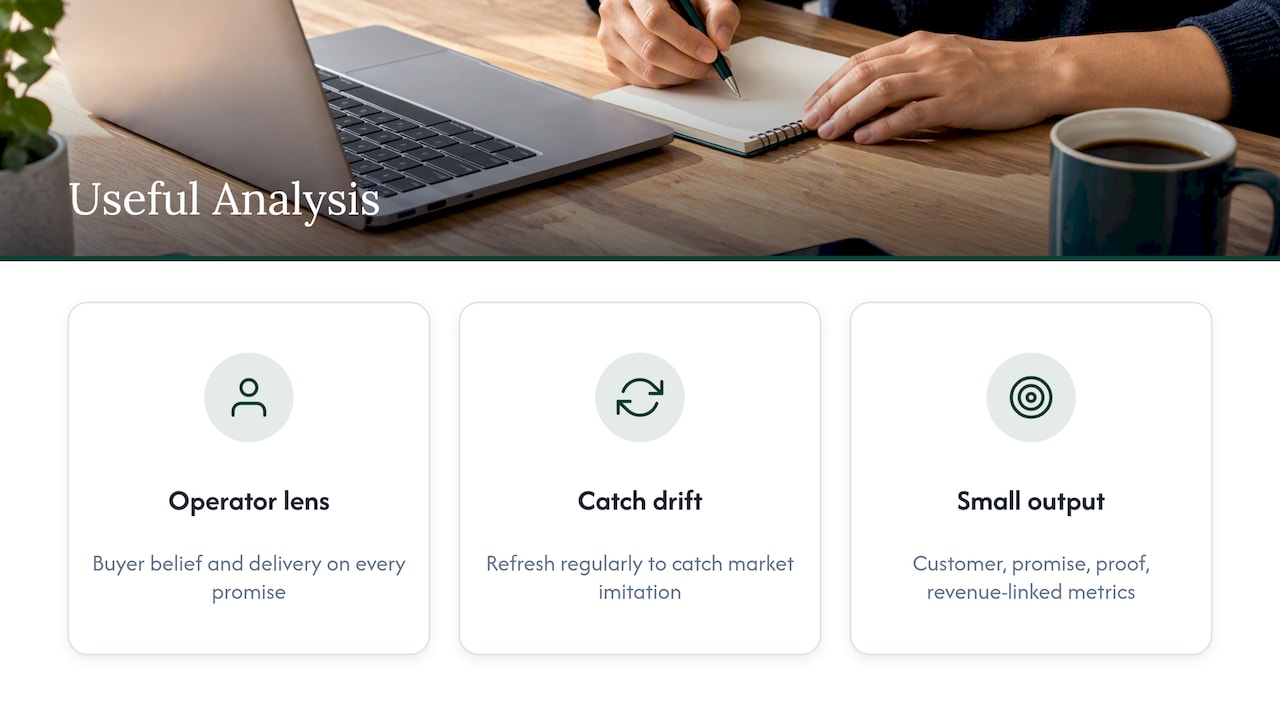
Two things separate useful work from busywork. First, an operator’s lens: ask what a buyer must believe to sign, and whether your team can deliver on it every time. Brand-building and exit experience teach you quickly that a promise the business cannot keep is worse than no promise. Second, drift: left alone, companies slide toward looking like whoever is next to them in the market. A competitive analysis, refreshed regularly, is the cheapest way to catch that early.
So we keep the output small. One customer, one promise, the proof to back it, and the metrics that tie it to revenue. Everything else is a footnote.
— Quincy
Working with us on competitive positioning
If you would rather not run this alone, we help founders, executive teams and marketing teams turn competitive findings into positioning and a go-to-market plan that product, marketing and sales all use. You can see the full range of brand strategy, positioning and growth advisory services or, if you want these ideas in front of your leadership team, look at our speaking options.
Common mistakes to avoid
- Comparing only direct rivals. Your real alternative may be doing nothing.
- Copying the leader. Differentiation that is a copy is not differentiation.
- Scoring on gut feel. Link every cell to evidence.
- Skipping customers. Competitor websites tell you what they want to be seen as, not why buyers chose them.
- Ending with description. If a row has no implication, delete it or finish the thought.
- Never refreshing. Assign an owner and a review date for the decision-critical fields.
FAQ
What is the difference between a SWOT analysis and a competitive analysis?
A competitive analysis gathers and compares evidence about your market and rivals. A SWOT sorts internal strengths and weaknesses and external opportunities and threats into four boxes. SWOT can summarize what you found, but it cannot replace the research or customer validation.
How is a competitive analysis used in advertising?
It shows which associations competitors own, where their claims lack proof and which audiences or buying moments they ignore. You can then choose whether to defend a position, challenge a rival’s claim or build a new one. Test the creative before scaling, because effects vary by industry and by what competitors are running.
What is a competitive analysis matrix?
It is a side-by-side table that scores each competitor on the same criteria, such as target customer, offer, pricing signal, value proposition, proof, channels, reviews and customer experience. Each cell should link to evidence. The final column should state what the finding means for your brand.
How many competitors should I include?
Start with a wide list across direct, indirect, tertiary and aspirational types, then narrow to the five to eight most strategically relevant for deeper study. More than that usually adds noise rather than insight.
How often should I update it?
Treat it as a living document. Refresh decision-critical fields, such as pricing, messaging and AI search visibility, on a fixed cadence, quarterly for most teams, and sooner after a major competitor move or a change in your own offer.
Sources
- Competitor Brand Analysis: How to Conduct One (2026), Shopify
- Competitive Analysis: How to Do It + Free Template, Shopify
- Competitor Brand Analysis, Firesmith OPEN Process Framework
- Integrated Brand Analysis and Strategy, MDPI
- Consumer Memory and Competitive Interference: The Case of Auto Insurance Advertising, Stanford GSB
- How brands win visibility in AI search, Semrush AI Visibility Index 2026