B2B Customer Interview Questions and a Script That Works
The best B2B customer interview questions ask about the past, not the future. You ask what happened the last time the problem showed up, who was involved, what it cost and what they did about it. You never ask whether they would buy your idea. Below is a full script in the order you would run it, with the reasoning behind each block, so your interviews produce evidence you can use for positioning, messaging and go-to-market decisions.
This guide is for founders, marketing leaders and executives who need to hear buyers in their own words. It is not for hiring managers building a job-interview list.
TL;DR
- Decide what you need to learn before you write a single question, and narrow your list to three to five core questions.
- Ask about specific past events (“walk me through the last time”), never opinions about the future or your product.
- Cover six blocks in order: opening, role and success, the last event, current workarounds, the buying process, and the close.
- In B2B the user is often not the buyer, so ask who else decides, who owns budget and what approval looks like.
- Treat answers that contradict your assumptions as the most valuable result, then feed them into positioning and messaging.
Table of Contents
- Start with what you need to learn
- Who to interview and how long to plan
- The B2B customer interview script, block by block
- Adapting questions by stakeholder
- Mistakes that skew B2B interviews
- Turning answers into decisions
- From interviews to positioning
- Our perspective
- FAQ
- Sources
Start with what you need to learn
Most weak interviews fail before they begin. The team has a list of questions but no decision the interview is meant to inform. Harvard Business School’s startup guide advises writing out what you want to learn from and about the customer, not the specific answer you hope to hear, and then narrowing a longer list to three to five specific questions the interview is built around.
A practical way to do that:
- Name the decision. Are you choosing a segment, rewriting positioning, deciding what to build, or finding out why deals stall? Each needs different questions.
- List your assumptions. Write down what you believe about who has the problem, how often, how they cope, who pays and who approves.
- Mark the riskiest ones. If you are wrong about them, the strategy fails. Those get the interview time.
- Write the answer you hope to hear. The investor James Wang suggests then redesigning the question so that answer becomes impossible to give. Instead of “would you use this?”, ask “walk me through the last time this problem cost you money.”
That last step is the single best defense against leading questions, and it takes five minutes.
Who to interview and how long to plan
In B2B, one account contains several people with different views: the person who feels the problem daily, the manager who is judged on the result, the budget owner and sometimes procurement or legal. Plan to interview at least two of these roles per account type, and keep them as separate conversations so one person’s view does not shape another’s.
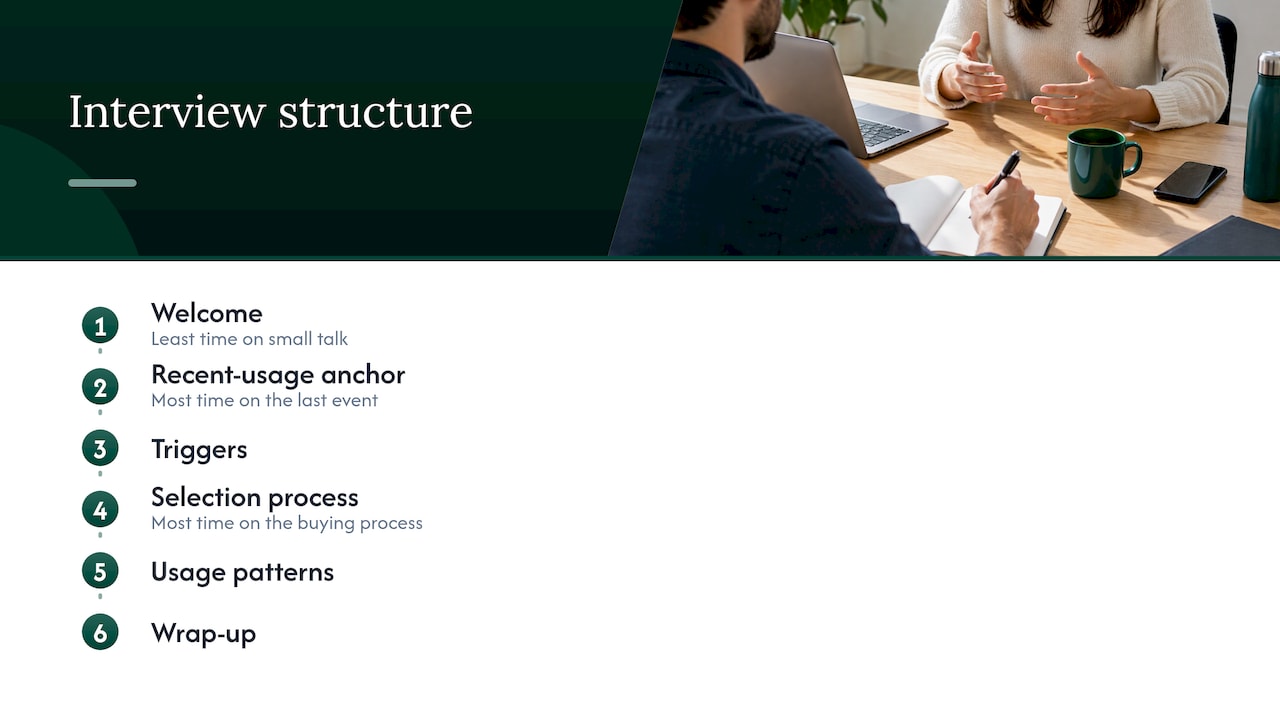
For length, a 30-minute structure is enough for most conversations. Ash Maurya’s version splits it roughly into a short welcome, a recent-usage anchor, triggers, the selection process, usage patterns and a brief wrap-up. You can adapt those proportions: spend the most time on the last event and the buying process, and the least on small talk.
If you are interviewing your own customers, include people who bought, people who almost bought and people who left. Our guide to B2B customer research methods shows how interviews fit with other inputs, and our piece on win-loss analysis covers the buyers who chose someone else.
The B2B customer interview script, block by block
Use the wording below as a starting point. Say it in your own voice and let the person’s answers decide which follow-ups to ask.
1. Opening (2 to 3 minutes)
The opening sets the frame: you are here to learn, not to sell. Tell the person you are trying to understand how they work today, that nothing will be pitched, and ask permission to talk through a recent example. Ask for permission to take notes or record.
A script that works:
“Thanks for making time. I’m trying to understand how teams like yours handle [area]. I’m not selling anything today. Would it be okay if we walk through a recent example? And is it all right if I take notes?”
Skip the elevator pitch. Describing your solution before the customer describes the problem is the quickest way to bias everything that follows. Lean B2B’s guidance on interview structure is blunt: don’t sell or explain what you plan to build during customer-development interviews.
2. Role, responsibilities and success (5 minutes)
You need context before the story, and you need the customer’s own vocabulary. That vocabulary later becomes your messaging.
- How would you describe your role?
- What does a typical week look like?
- What are you responsible for, and how is your work judged?
- What does success look like for you this year?
- Who is on your team, and where does [the problem area] show up in your work?
The answer to “how is your work judged” matters most. It tells you which metric the buyer will defend in a budget meeting, and your positioning needs to connect to it.
3. The last time it happened (8 to 10 minutes)
This block is the heart of the interview. Stay on one specific, recent event rather than a general pattern, because people describe their ideal behavior when asked about habits and their real behavior when asked about last Tuesday.
- Walk me through the last time this came up. What kicked it off?
- Who was involved, and what did each person do?
- What did you try first?
- What did it cost in time, delay, rework or risk?
- How often does this happen, and how bad was this time compared with a typical one?
Probe with “what happened next?”, “can you show me?” and “why was that?” Avoid “do you think”, “would you” and “don’t you find”. If the customer drifts into opinions about the future, bring them back: “Let’s stay with that specific time.”
The trigger question deserves special attention. A problem that has existed for years without action is background friction. A problem that surfaced because of a new hire, a compliance change, a new segment or a board request has urgency, and that urgency tells you when your buyers actually move.
4. Current solutions and workarounds (5 minutes)
Your competition is rarely only other vendors. It is also spreadsheets, internal processes, an agency or consultant, or doing nothing. Ask:
- How do you handle this today? Which tools, spreadsheets or people are involved?
- What is the current workaround, and who maintains it?
- What is still frustrating about it?
- Have you looked at other approaches? What happened?
- What would have to be true for you to change how you do this?
A workaround that consumes staff time or budget is a strong signal the pain is real, because the customer is already paying to cope with it. A workaround nobody can describe usually means the problem is not a priority. This block is also where positioning gets sharper: you learn what you are really compared against. If you want to take that further, our competitive analysis framework turns those answers into a map you can act on.
5. Buying process and decision-makers (5 to 8 minutes)
B2B decisions rarely belong to one person, so this block protects you from building for a user who cannot buy. Ask about process, not about willingness to pay in the abstract.
- Who else would need to be involved in a decision like this?
- Who owns the budget, and what budget would it come from?
- What happened the last time your company bought something similar?
- What would approval look like, and how long did it take?
- Are there written decision criteria, and who created them?
- Does procurement, security or legal review apply?
- What would most likely stop this from getting approved?
HubSpot’s discovery-call guidance covers much of this ground: who else chooses the vendor, whether decision criteria exist and who wrote them, and whether procurement or legal reviews apply.
Why avoid “would you pay for this?” It measures intent without any decision behind it: no budget approval, no procurement, no cost of switching. The last purchase tells you what actually happens. If you want to map the people involved, a tool for running stakeholder alignment meetings shows how one owner and one decision record keep a group on the same page, which is the same discipline you are checking for in the customer’s buying committee.
We go deeper on why this matters for messaging in why corporate positioning must win the buying committee.
6. Close (3 minutes)
End with openings, not a pitch.
- Is there anything important I haven’t asked about?
- Who sees this problem differently from you?
- Would it be all right if I send you a short summary so you can correct anything I got wrong?
- Who else should I talk to, such as the budget owner or the person who runs the process day to day?
Maurya recommends every interview end with three elements: a 30-second summary of their story, permission to follow up in a couple of weeks, and an introduction to more people like them. The summary check catches misunderstandings while the person is still on the call, and the referral request is how you build a pipeline of interviews without recruiting from scratch.
Adapting questions by stakeholder
Keep the same structure and shift the emphasis.
| Role | Spend the most time on | Sample question |
|---|---|---|
| End user | The last event and workarounds | “Walk me through the last time you did this. What was frustrating?” |
| Manager | Success measures and trade-offs | “How is your team’s result measured, and what gets in the way?” |
| Budget owner | Priorities and approval | “What else is competing for this budget, and what would block it?” |
| Executive sponsor | Why now and consequences | “What happens if this waits another six months?” |
| Procurement or legal | Requirements and process | “What reviews does a purchase like this go through?” |
One caution: an end user who loves the idea is not a buyer. Always ask who signs and what approval looks like, and treat enthusiasm without authority as a data point about the user, not about the deal.
Mistakes that skew B2B interviews
- Pitching early. Once you describe your solution, people respond to it politely instead of describing their reality.
- Asking about the future. “Would you use…” and “how much would you pay…” produce flattering fiction.
- Interviewing only friendly accounts. Include people who said no and people who churned.
- Talking too much. If you are speaking more than a quarter of the time, you are teaching, not learning.
- Treating one loud voice as a pattern. Look for the same story from several people in the same role before you change strategy.
- Letting synthetic answers stand in for real ones. Simulated respondents cannot give you a last-time story. We explain why in why synthetic customer research cannot replace market judgment.
Turning answers into decisions
Immediately after each call, write down the facts (what happened, who, what it cost), the customer’s exact phrases and any surprises. Then compare against the assumptions you listed at the start.
Expect contradictions. Dr. Jack McGourty argues that when customers describe triggers that don’t match your journey map, the process is working as intended, because the goal is an accurate picture, even when that means dropping what you thought you knew.
After eight to twelve interviews in one segment, you should be able to answer four things in a sentence each:
- Who feels the problem and who decides?
- What triggers action?
- What do they use today, and what does it cost them?
- Which words do they use to describe the outcome they want?
Those four answers feed directly into your ideal customer profile, your positioning and your go-to-market plan. If the interviews reveal friction after the sale as well, the moment of truth in the customer journey is where to look next.
From interviews to positioning
Interviews give you raw material. The work is deciding what it means for how you present the company: which buyer you lead with, which problem you name first, which alternative you position against and which proof the buying committee will need. When product, marketing and sales each hear different things, the brand drifts and the market compares you on price.
If you want an outside operator to run that work with you, we offer brand strategy, positioning and go-to-market advisory, with customer experience and founder and executive advisory alongside. Our approach, delivered through The Branded Agency, connects brand strategy to measurable performance, so what customers tell you ends up in the decisions your product, marketing and sales teams make.
Our perspective
Brand is not a marketing tool. It is a business strategy, and it starts with what buyers actually say, not what the leadership team assumes.
We have seen the same pattern in organizations of every size: product describes one customer, marketing speaks to another and sales sells to a third. Interviews are the cheapest way to close that gap, but only when the questions are built to test assumptions rather than collect compliments.
Our work draws on an operator’s perspective, shaped by building brands and by an exit, and by a footprint that includes over 200 international retail locations. That is why we push every interview finding toward a decision: a positioning choice, a message, a change to the sales conversation. Frameworks like The Golden Spiral™ and Brand-Backed Performance™ exist to tie those decisions to measurable outcomes, not to produce a deck that sits on a shelf.
If you do one thing after reading this, write down the answer you hope to hear, then change the question until that answer is impossible. Everything else follows.
Quincy
FAQ
How many customers should I interview?
Start with eight to twelve per segment and stop when you hear the same stories repeatedly. If different roles in the same account tell conflicting stories, add interviews for those roles instead of adding more of the same one.
Should I record the interview?
Yes, with permission, which you ask for in the opening. Recording lets you stay present and keep the customer’s exact phrases, which are far more useful for messaging than your paraphrase.
Is there a difference between a customer interview script and a survey?
A survey tells you how many people chose an option. An interview tells you why, in their words and in the order events happened. Use interviews first to learn what to ask, then surveys to size what you found.
When should I talk about my product?
At the end, if at all, and only after the customer has described the problem, the workaround and the buying process. Holding product details back until then keeps your description from shaping their answers.
Sources
- Customer Interviewing Techniques That Uncover Your Users’ Unmet Needs (Harvard Business School Startup Guide)
- The Questions You’re Not Asking (Mimosa Ventures)
- The 30-Minute Customer Discovery (Ash Maurya)
- How to Structure Customer Development Interviews (Lean B2B)
- Discovery call questions that reveal real pain points (HubSpot)
- The Assumption Inventory (InnovateThrive)
- Stakeholder Alignment Meetings: One Owner, One Decision Record