
Customer Segmentation Framework for CMOs: Link Brand to Sales
A customer segmentation framework organizes customers into a small set of measurable groups that marketing and sales can target to prioritize spend and tailor offers. The payoff is clarity: you know which groups to pursue, what to say to them, and where to stop wasting budget. For the framework to work, each segment has to be measurable, substantial enough to matter, and actionable by the teams who touch the customer.
TL;DR:
- Pair firmographic or demographic filters with behavioral or technographic signals, because company size and industry alone rarely reveal buying intent.
- Aim for four to seven distinct segments; larger sets can overwhelm teams, while algorithmic models commonly produce about four in practice.
- A rollout lasting six to nine months starts with data preparation, tests one or two segments in months three and four, then scales winners.
- A good segment must be measurable, substantial, reachable, distinct in response, and actionable; test pilot results and refresh definitions quarterly.
Table of Contents
- What customer segmentation is and why a framework matters
- Segmentation models and when each one fits
- How to build a customer segmentation framework step by step
- Turning segments into a working program
- How to tell if your segments are actually good
- Common pitfalls and how to avoid them
- Where brand strategy fits into segmentation work
- When segmentation needs outside help
- How we help you turn segments into revenue
- FAQ
- Sources
What customer segmentation is and why a framework matters
Segmentation splits a customer base into groups that share traits relevant to how they buy, what they need, or how they respond to offers. Without a structure around it, segmentation turns into a one-off slide deck that nobody revisits. A framework turns it into a repeatable process tied to business outcomes: customer acquisition cost, lifetime value, and retention.
The connection to those metrics is direct. When you know which segment drives the most repeat revenue, you can shift acquisition spend toward lookalikes of that group instead of spreading it evenly. When you know which segment churns fastest, you can build a retention play aimed specifically at them instead of a generic win-back email.
Certain moments make segmentation urgent rather than optional. A product launch needs segmentation to decide which group to target first. Stagnating growth often means the current targeting is too broad or aimed at the wrong group. Entry into a new market requires fresh segmentation because old assumptions about buyer behavior rarely transfer, a theme we cover in more depth when prioritizing which markets to enter.
Before running any analysis, define the business objectives the segmentation needs to serve:
- Increase revenue from existing accounts or acquire new logos faster
- Reduce churn in a specific product line or customer tier
- Support a market entry or product launch with a defined initial audience
- Align marketing spend with the segments that produce the highest lifetime value
Skipping this step is the most common reason segmentation projects stall. Teams build detailed segments with no decision attached to them, and the output sits in a report instead of changing a campaign.
Segmentation models and when each one fits
Most segmentation frameworks pull from a handful of established models, and the right choice depends on what decision you are trying to inform. Few companies use just one. The strongest frameworks layer two or three models to capture both who the customer is and how they behave.
- Demographic: groups by age, income, job title, or company size; useful for broad market sizing and initial targeting, drawn from CRM fields and firmographic data providers.
- Geographic: groups by region, climate, or urban versus rural location; useful for logistics-sensitive or regulated products, drawn from billing and shipping data.
- Behavioral: groups by purchase frequency, product usage, or browsing patterns; useful for retention and upsell plays, drawn from first-party analytics and product telemetry.
- Psychographic: groups by values, motivations, or lifestyle; useful for brand positioning and messaging, drawn from surveys and qualitative interviews.
- Technographic: groups by the tools and platforms a customer already uses; useful for B2B software targeting, drawn from intent data and integration logs.
- RFM (recency, frequency, monetary): groups by how recently, how often, and how much a customer spends; useful for prioritizing retention and loyalty spend, drawn from transaction history.
Firmographic segmentation, a subset of demographic segmentation common in B2B, groups companies by industry, headcount, and revenue band. It works well as a first filter before layering in behavioral or technographic data, because firmographics alone rarely predict buying intent.
Layering matters more than picking the single best model. A B2B software company might combine firmographic segmentation (company size, industry) with technographic signals (which tools a prospect already runs) to prioritize accounts most likely to adopt an integration-heavy product. A retail brand might combine RFM with psychographic insight from customer interviews to figure out why a high-value segment buys the way it does, not just that it does. The data sources you already have, CRM records, analytics platforms, survey tools, often dictate which combination is realistic to build first.
How to build a customer segmentation framework step by step
This playbook works whether you run it internally or hand it to a data and analytics partner. Each step produces an output the next step depends on, so skipping ahead tends to produce segments nobody trusts.
- Define the objective and success metrics. Tie the project to a specific business goal, such as reducing churn by a target percentage or increasing average deal size, before touching any data.
- Pick the population and scope. Decide whether you are segmenting current customers, prospects, or both, and set channel constraints (for example, only customers reachable by email or in-app messaging).
- Inventory and prepare the data. Pull together CRM records, transaction history, product usage logs, and survey responses, and run consent and privacy checks before any analysis begins.
- Engineer features and choose a modeling approach. Decide between simpler rule-based methods like RFM and statistical clustering; the CGAP Customer Segmentation Toolkit lays out a six-step process that starts with hypotheses before jumping into algorithms.
- Identify and name segments. Attach names that describe a need or behavior rather than a demographic label alone, since “Budget-Conscious Renewers” gives a sales team more to work with than “Segment 3.”
- Build personas and playbooks. Translate each segment into a one-page profile with specific campaigns, product nudges, and sales talk tracks, a step Forrester’s customer segmentation profile templates are built to support.
- Operationalize the segments. Push segment tags into your CRM or customer data platform, build campaign templates around them, and assign ownership so segments do not go stale after the first quarter.
- Pilot, measure, and iterate. Launch a small test against one or two segments, track the impact against the metrics from step one, and refine before rolling out broadly.
Algorithmic approaches have become the default for larger datasets. A systematic review of algorithmic customer segmentation found that our AI SEO platform case study illustrates how complex data pipelines and model interpretability enable effective segmentation, with K-means clustering as the most widely used method, typically producing around four segments and relying on a mix of evaluation metrics rather than a single score. That matches practical experience: four to seven segments is usually the range that stays both distinct and manageable.
Pro Tip: Name each segment after the behavior or need it represents, not the data field that created it. Teams act faster on “Price-Sensitive Switchers” than on “Cluster 2.”
Persona work benefits from mapping the actual customer journey alongside the segment definition, which is where structured journey exercises like customer experience mapping pay off: a segment profile without a journey attached tends to produce campaigns that miss the moment a customer is actually ready to act.
Turning segments into a working program
A segmentation project only pays off once it survives contact with campaign calendars, sales quotas, and quarterly planning. That takes a roadmap, not just a model.
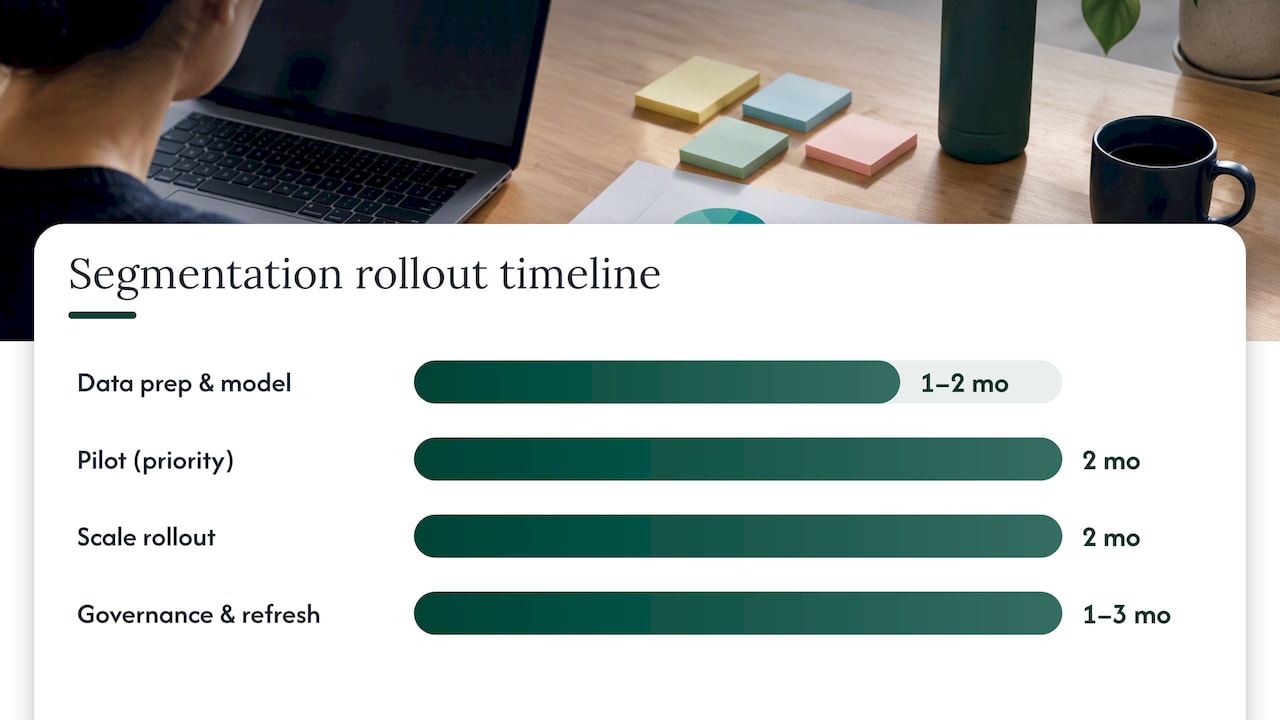
A workable timeline runs six to nine months. The first one to two months cover data prep and model building. Months three and four run a pilot against one or two priority segments with a clear measurement plan attached. Months five and six scale the winning approach across the remaining segments, and the final stretch locks in governance: who owns segment definitions, how often they get refreshed, and who signs off on changes.
Clear ownership prevents the most common failure mode, where segments live in an analytics team’s spreadsheet and never reach the people running campaigns:
- Analytics owns the model, the data pipeline, and segment refresh cadence.
- Marketing owns campaign design and messaging for each segment.
- Sales owns talk tracks and account prioritization tied to segment membership, which is where aligning sales and marketing around a shared definition of a segment avoids the usual finger-pointing.
- Product owns in-app nudges and feature flags tied to behavioral segments.
On the technology side, the real decision is usually between a customer data platform and relying on existing CRM segmentation fields. A CDP earns its cost when you need real-time identification, such as triggering a message the moment a customer’s behavior shifts. A CRM-based approach, refreshed in batch weekly or monthly, is often enough for B2B sales motions where the buying cycle is already slow. Whichever you pick, the measurement plan and governance rules matter more than the tool: someone needs to own data quality checks and periodic privacy review, not just the dashboard.
How to tell if your segments are actually good
A segment that looks clean in a spreadsheet can still fail in the market. Two sets of criteria catch that: Kotler’s marketing-side checklist and the technical metrics data teams use to test cluster quality.
Kotler’s MSAA criteria ask whether a segment is:
- Measurable: you can quantify its size and value with the data you already have.
- Substantial: it is large enough to justify a dedicated campaign or product change.
- Accessible: you can actually reach it through an existing channel.
- Differentiable: it responds differently to offers than other segments do.
- Actionable: a specific team can build a program around it with current resources.
On the technical side, practitioners commonly use silhouette score and the Davies-Bouldin index to check how distinct and well-separated clusters are, and the adjusted Rand index to test whether segments stay stable when you rerun the model on new data. A systematic review of algorithmic segmentation methods covering 172 articles found that studies commonly rely on exactly this mix of metrics rather than a single pass or fail score, and argued for evaluation frameworks that combine technical measures with organizational outcomes like stakeholder usefulness and ROI.
A validation approach that pairs technical clustering with interpretability tools can produce measurably better business results. Research combining PCA, DBSCAN, and SHAP-based interpretability for retail customer segmentation reported strong validation scores alongside an ROI uplift on targeted retention offers in the applied dataset, reinforcing that interpretable segments translate more directly into campaigns a team will actually run.
Business-side validation closes the loop: run an A/B test against a pilot segment, ask the sales and marketing teams actually using the segment whether it changed how they prioritize work, and review segment performance on a fixed cadence (quarterly is typical) rather than letting it run unexamined for a year.
Common pitfalls and how to avoid them
Most segmentation projects fail in predictable ways, and most of the fixes are straightforward if you plan for them upfront.
- Too many segments. Twelve or fifteen segments sound thorough but overwhelm the teams meant to act on them; the CGAP toolkit recommends creating a moderate number of segments in most cases.
- Relying on firmographics alone. Company size and industry predict very little about actual buying behavior without a behavioral or technographic layer added.
- No identification rules. A segment that cannot be tagged in the CRM or CDP never gets used, no matter how insightful the analysis.
- Skipping qualitative validation. Algorithmic output needs a reality check, and synthetic data cannot substitute for real market judgment when it comes to confirming that a segment reflects how customers actually think.
- Weak privacy guardrails. Consent tracking, data minimization, and explainability are not afterthoughts. Research on ethical-by-design segmentation systems found that privacy-preserving analytics and fairness auditing meaningfully increase customer trust and acceptance of personalization, not just compliance coverage.
Where brand strategy fits into segmentation work
Segmentation tells you which groups exist. Brand strategy tells you which ones to prioritize and why a given group should choose you over the alternative in front of them. That is the gap an approach called Brand-Backed Performance™ can close: connecting the analytical output of segmentation to a positioning decision that sales and marketing can execute against.
A typical engagement can start with a diagnostic that maps existing segments against where brand clarity is weakest, usually the point where a prospect compares you to a competitor and cannot tell the difference. From there, two or three segments where a sharper position produces faster revenue movement are prioritized, and a playbook is built: messaging, sales talk tracks, and campaign sequencing tied to each priority segment. Category entry point thinking plays a role here too, since mapping where customers enter the buying journey often reveals which segment is worth activating first.
The deliverable is not a report. It is a prioritized set of segments with a positioning statement and an activation plan attached, which is the difference between a segmentation exercise that sits in a drive and one that shows up in next quarter’s pipeline.
When segmentation needs outside help
Segmentation is simple to describe and hard to execute well. I’d hire outside help when the data lives in three disconnected systems, when the last internal attempt produced a report nobody acted on, or when a market entry needs fast, defensible targeting with no room for a slow internal pilot. A consulting engagement typically compresses months of trial and error into a diagnostic, a prioritized segment set, and a playbook ready to run. An in-house pilot works fine when the data is already clean and one team owns the full handoff from analysis to campaign. If neither condition holds, start with a narrow pilot before committing to a full rebuild.
— Quincy
How we help you turn segments into revenue
We connect the analytical side of segmentation to the positioning and go-to-market decisions that actually move revenue, through Brand Strategy, Growth and Go-to-Market Strategy, and Customer Experience work.
An initial engagement typically starts with a diagnostic of your current segments and brand clarity, followed by a prioritized roadmap and a pilot built around the one or two segments most likely to move revenue fastest. If a workshop format fits your team better, our speaking and workshop sessions can kick off that alignment with your leadership team directly. For the full range of services, including the frameworks we use to connect segmentation to measurable growth, visit Quincysamycia.
FAQ
What are the four types of customer segmentation?
The four most commonly cited types are demographic, geographic, behavioral, and psychographic segmentation. Many frameworks add technographic and RFM (recency, frequency, monetary) as additional layers, especially in B2B and transaction-heavy businesses, and most practical programs combine two or more types rather than relying on just one.
What are the six steps of customer segmentation?
The CGAP Customer Segmentation Toolkit outlines six steps: define objectives, pick the population, develop hypotheses, conduct research, analyze the data, and refine the segments. Following this order prevents the common mistake of jumping straight into data analysis before deciding what business question the segmentation needs to answer.
What are the five criteria for effective segmentation?
Kotler’s MSAA criteria define an effective segment as measurable, substantial, accessible, differentiable, and actionable. A segment that fails any one of these, for example one that is distinct but too small to justify a dedicated campaign, usually gets merged into a broader group or dropped.
What are the five customer segments?
There is no universal set of five segments; the right number and labels depend on your data and objective, though research reviewing 172 studies on algorithmic segmentation found that four segments is a common outcome, and the CGAP toolkit recommends a typical range of four to seven. Treat any generic “five segments” list as a starting template to adapt, not a standard to copy directly.
Sources
- Ethical-by-Design Business Intelligence (EDBI) framework for ethical AI in customer segmentation
- The Customer Segmentation Profile Templates | Forrester
- Customer Segmentation Toolkit
- How can algorithms help in segmenting users and customers? A systematic review and research agenda for algorithmic customer segmentation