
Founder Storytelling: Build a Story That Drives Growth
Founder storytelling works when it is treated as brand strategy, not as an origin anecdote. A good founder story says what you offer, to whom, and why you are different, and then the same story shows up in your pitch, your website and your first sales call. If those three tell different stories, the problem is not your writing. It is positioning drift, and that is what we fix with founders and leadership teams.
This guide shows what a founder story must contain, how it is built, which examples are worth studying, and how to turn one story into versions for customers, investors and recruits without losing consistency.
TL;DR
- A founder story is a positioning tool: it should capture what you offer, to whom, and why you are different, with the customer as the hero.
- Research on founder stories links them to perceived brand authenticity, especially when the founder’s motive matches the buyer’s own values.
- Use five beats: the opening moment, the stakes, the early build, the turn, and where the company is now, backed by one proving fact.
- Keep one core narrative and change the emphasis for customers, investors and talent.
- Build the story from customer research and carry it into your deck, website, sales conversations and onboarding.
Table of Contents
- What founder storytelling actually is
- Why it works: what the research says
- The five beats of a founder story
- Examples worth studying
- Mistakes that weaken a founder story
- One core story, several versions
- Connect the story to your go-to-market plan
- Where we can help
- Our perspective
- FAQ
- Sources
What founder storytelling actually is
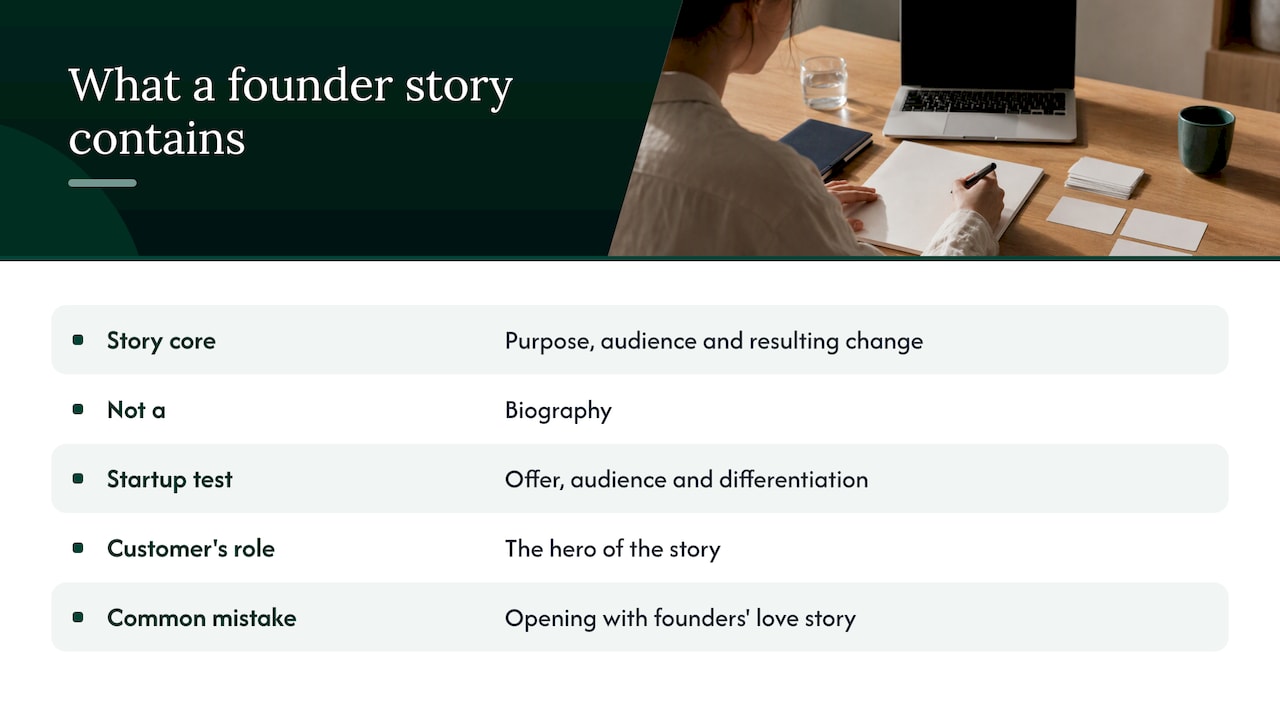
Founder storytelling is the practice of telling why the company exists, who it is for and what changes because it exists, through the experience of the person who started it. It is not a biography. It is the shortest honest path from a real problem to what you sell.
Fortune’s startup guidance gives a useful test: a great startup story succinctly captures what you offer, to whom, and why you are different. The same piece names the most common mistake, which is opening with the founders’ love story instead of the customer, who should be the hero.
That definition matters for the reader of this article. If you are a founder, the story is how people decide whether to trust you. If you lead a marketing team, it is the narrative every channel has to repeat. If you are an executive trying to stand apart from competitors, it is the part of your positioning that rivals cannot copy, because it is tied to a real person and a real decision.
Why it works: what the research says
The evidence is stronger than the marketing folklore around it.
Authenticity. Marketing researchers at Boise State found across three studies that founder stories built around self-transcendence values, meaning concern for others rather than personal gain, enhance perceived brand authenticity. The effect was weaker after a company merger, which is a reminder that a story has to be updated when the company changes. An earlier study by the same team found that founder stories raise perceived authenticity when consumers see a match between their own values and the founder’s stated motive for starting the business.
Why stories persuade. The same research argues that narrative processing suppresses counter-arguing. People listening to a story argue with it less than they argue with a claim.
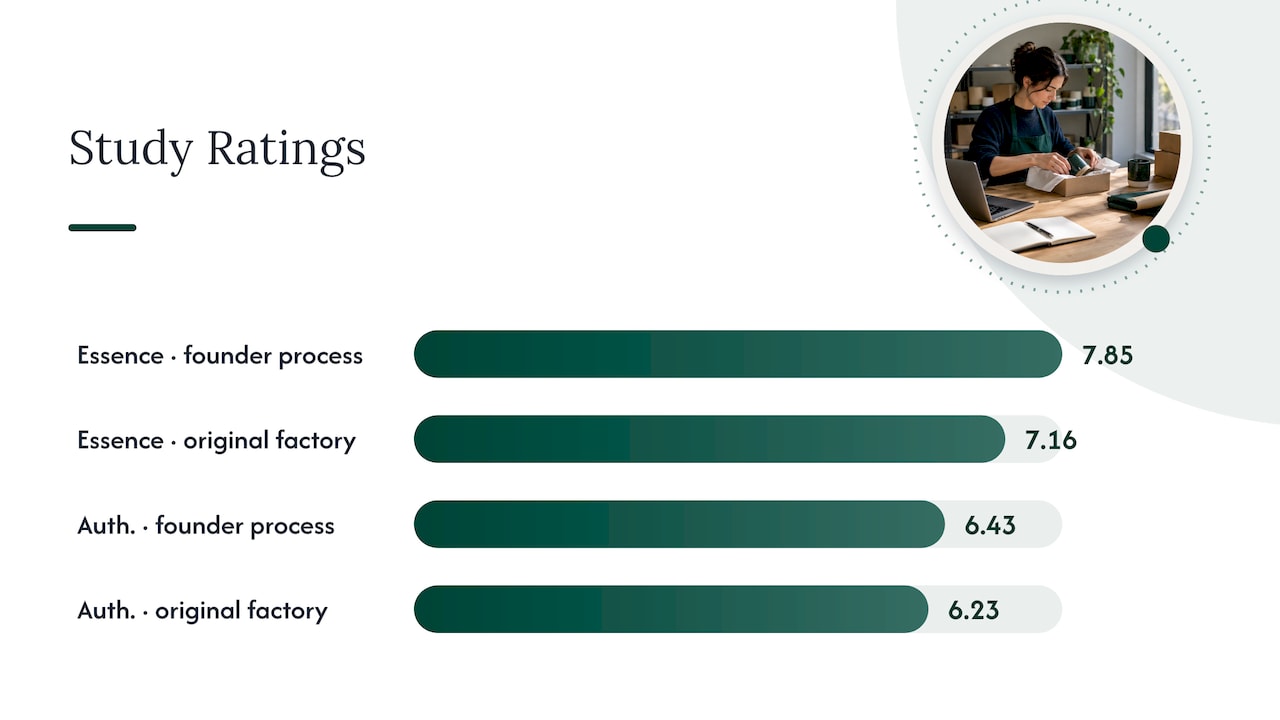
Origin and process. A Kellogg School of Management study with 505 participants found that products made using a founder’s original process were rated higher on essence (7.85 versus 7.16) and authenticity (6.43 versus 6.23) than products made at the original factory, according to the Kellogg research summary. What buyers value is the link to the founder’s way of doing things.
Who pays attention. A June 2022 survey of 750 U.S. adults by the Northeast Dairy Innovation Center found that the 20% of respondents who buy dairy outside large chain grocers put much more weight on a brand’s story and professional branding than the typical dairy shopper. It is one category, but it shows that story matters most to buyers who are choosing something other than the default.
Competing with larger rivals. ScaleVP’s founder brand playbook says founder branding is a reliable way to compete against bigger companies, because they cannot access a founder’s unique ideas and story. It also notes that LinkedIn gives ten times the promotional attention to people’s posts than to company posts.
Harvard Business School’s Working Knowledge reports on a study of five online-investing startups in which recounting the founding story was a key symbolic activity that conveyed authenticity and market need. The most successful executives in that study reshaped their founding stories to fit each new stage of the company. Your story is not fixed. It is maintained.
The five beats of a founder story
Most strong founder stories share a structure. Women Can Startup’s guide recommends five beats: the opening moment, the stakes, the early build, the turn, and where the company is now, with one proving fact at the end. It suggests 600 to 1,000 words written, or a two-minute answer when spoken. Here is how to work each beat.
- The opening moment. A specific, relatable problem, not a market size. Name the person, the situation and what went wrong. Vestd’s advice on founding stories is to start with a specific problem and tell it in plain English.
- The stakes. Why the problem mattered enough to act on. This is where human motivation appears. Tie it to a value your buyer shares, since the research above shows that a motive match is what makes the story ring true.
- The early build. What you tried first, including what failed. Skipping setbacks is one of the mistakes the same guide lists, because it makes the story sound like a press release.
- The turn. The insight that changed your approach. This is the heart of your positioning: the belief about the market that competitors do not hold.
- Where you are now. One fact that proves it worked: a customer result, a retention figure, a number of locations. End on the fact, not on a vision paragraph.
A second framing comes from FoundFounders, which describes effective stories as problem, struggle, breakthrough and present conviction. The two structures are the same arc with different labels. Pick one and keep it.
A quick worked example
Suppose a founder built a scheduling tool after watching her clinic’s front desk lose appointments to no-shows. Her story, in five lines:
- Opening: a front desk manager spent two hours a day calling patients who never answered.
- Stakes: each empty slot cost the clinic revenue and delayed care for patients on the waitlist.
- Early build: a text-reminder spreadsheet that worked for one clinic and broke at five.
- Turn: reminders fail when patients cannot reschedule in one tap, so the product is built around rescheduling, not reminding.
- Now: the one proving fact, such as the reduction in no-shows at a named customer.
Notice what the story does. It names the customer, the pain and the difference. That is the Fortune test, passed in five lines.
Examples worth studying
Founder stories are most useful when you can see the mechanics. Three that are commonly cited:
- Duolingo. Vestd describes how co-founder Luis von Ahn wanted to make language education free and accessible after realizing how expensive it was. The mission is one sentence, and the product decisions follow from it.
- Notion. The same article recounts that Notion nearly ran out of money in 2017, rebuilt its product and came back stronger. The obstacle makes the success believable.
- Salesforce. ScaleVP’s playbook points to Marc Benioff’s early stories, which described cloud hosting as turning on a light switch and drew on his Oracle background, as an example covering all three story categories: the customer’s pains, a transformative shift and the founder’s journey. It also notes that Salesforce popularized the phrase “on-premise software,” which put incumbents in a semantic corner.
The pattern is that each story has one clear idea, a human reason and a visible cost. None leads with the founder’s résumé.
Mistakes that weaken a founder story
- Leading with the founders. Fortune’s most common mistake: the love story comes before the customer. Open with the customer’s problem.
- Starting with market size. Women Can Startup lists this among its mistakes. Size is a slide, not a story.
- Exaggerating the problem. FoundFounders warns that people invest in capability, not desperation. A problem inflated until it feels unrelatable loses the listener.
- Taking all the credit. The same source notes that the Stripe story is told as “we” rather than one person deciding everything.
- Ending on vision. Close with a fact the listener can check.
- Writing in press-release voice. Tell it in first person, plain words.
- Never updating it. The Boise State finding that the effect weakens after a merger, and the HBS finding that successful executives adapt their stories, both point to the same discipline: revisit the story at each stage.
One core story, several versions
The story you tell a customer is not the one you tell an investor. First Round Review’s interview with MakerBot’s Bre Pettis says a startup’s story must be a shapeshifter, with different versions for money, talent and first customers, all stemming from one central narrative about why you do what you do, why it solves an important problem and what change it makes possible.
In practice:
| Audience | Emphasize | Leave in the background |
|---|---|---|
| Customers | The pain they recognize, direct benefits, a result | Funding, market size |
| Investors | Market size, defensibility, founder-market fit | Day-to-day features |
| Talent | Mission, culture, leadership style | Pricing, competitors |
| Partners and press | Shared values, one surprising opening fact | Internal process |
The split follows Founderspedia’s guide to founder stories, which also quotes a venture investor’s rule of thumb that about 80% of the narrative stays the same while the emphasis changes. The Fortune article adds why the “why you are different” part deserves care: it should describe who the team is, what it values and what it believes, because that shapes culture, hiring and product decisions as well as how others talk about the company.
Connect the story to your go-to-market plan
This is where most founder storytelling fails. The story gets written for an About page and never reaches the sales deck. A usable sequence:
- Start from customer research. Interview prospects, customers and lost deals. Modern Startup Stack’s messaging guide argues that this is how you learn how buyers describe their own pain.
- Write the venture hypothesis. Stanford GSB frames it as five questions: who the customer is, what pain you solve, how you solve it, how you go to market and how you make money. Your story should answer the first three directly.
- Choose three to four supporting messages and a tone before writing public copy, so the pitch, landing page and first sales conversation say the same thing.
- Choose your story categories. ScaleVP suggests three: the customer’s pains, a transformative shift and the founder’s journey. Rotate them, anchored in the same core.
- Hand it on. One GTM guide recommends building the story into marketing materials and the sales playbook, updating it regularly and eventually handing it to sales development reps and employees.
If you want the story to work as an asset after you stop telling it yourself, read our guides on founder-led branding as a revenue engine, founder brand strategy and aligning sales and marketing. For short-form formats, our brand storytelling framework shows how to compress the story for social video. As the founder steps back from every conversation, explicit decision rights keep the story intact.
For a broader view of why narrative lifts engagement across channels, see how storytelling boosts brand engagement in marketing more generally.
Where we can help
A founder story is only as useful as the positioning underneath it. We work with startup founders, executive teams and marketing teams on brand strategy, brand positioning, growth and go-to-market strategy and founder and executive advisory, with the aim of connecting the story to measurable business performance. If your pitch, website and sales conversations tell three different stories, start with our brand strategy and growth services.
If you need the story delivered to a room, we also offer keynote speaking on brand strategy and growth.
Our perspective
We do not treat founder storytelling as a writing exercise. We treat it as the most visible expression of a positioning decision. When a story feels weak, the cause is almost always upstream: the company has not settled who it is for or why it is different, so the founder improvises a new answer in every meeting.
Our approach comes from an operator’s perspective, shaped by real brand building and exit experience, and by work across more than 200 international retail locations. The lesson from that work is that brand is a core business strategy, not a marketing layer. The story has to line up with product, marketing and sales, or it drifts, and drift is what pushes buyers into comparing you on price.
That is why our methods, including The Golden Spiral™ and Brand-Backed Performance™, tie positioning to customer experience and to outcomes you can measure. We would rather give you a shorter story that every team member can repeat than a beautiful one that lives only on an About page.
Quincy
FAQ
Can you give me some examples of founder stories?
Duolingo, Notion and Salesforce are widely discussed. Duolingo’s story rests on a mission to make language learning free, Notion’s on nearly running out of money in 2017 before rebuilding, and Salesforce’s on a shift from on-premise software to the cloud. Each is described in the sources above.
How long should a founder story be?
One guide recommends 600 to 1,000 words in writing and about two minutes when spoken. Write the long version once, then cut it to a two-minute answer and a single sentence, so you have a version for every setting.
Where should a founder story appear?
In your pitch deck, website, sales conversations, onboarding and content, with the same core in each. The emphasis changes by audience, but the problem, the turn and the proving fact stay the same.
What is the difference between a founder story and a brand story?
A founder story explains why the company began and what its founder believes. A brand story is the wider narrative about the customer’s problem and the change you create. The founder story is one proof point inside the brand story, which is why both need to come from the same positioning.
Sources
- How founders can tell a great startup story, Fortune
- It’s About Our Values: How Founder’s Stories Influence Perceived Brand Authenticity, Boise State University
- It Rings True: How Company Founder’s Stories Enhance Perceived Authenticity, Boise State University
- We Prefer Authentic Products. But What Conveys Authenticity?, Kellogg Insight
- Marketing and Branding for Small Dairy Processors, Northeast Dairy Innovation Center
- Founder brand playbook, ScaleVP
- Why Your Company Wants to be a Cognitive Referent, Harvard Business School Working Knowledge
- How to Write a Founder Story People Actually Read, Women Can Startup
- Telling your founding story without the hype, Vestd
- How to Write a Founder Story, FoundFounders
- The Man Behind MakerBot on Finding the Stories That Build Your Brand, First Round Review
- How to Craft a Founder Story That Attracts Investors, Talent and Customers, Founderspedia
- Brand Messaging Framework for Founders Before Product Launch, Modern Startup Stack
- How to Use Storytelling to Be a Better Founder, Stanford Graduate School of Business
- Storytelling as startup GTM, Jonathan Rintala
- The power of storytelling: boost brand engagement in 2026