
Ideal Customer Profile Framework: Six Steps From Data To Rep Actions
An ideal customer profile framework is an account-level filter that tells your team which companies are most likely to buy, stay, and expand, and it only works when it is specific enough to produce the same target list every time. Start by pulling your top closed-won accounts, then run the five-question diagnostic, build from data and interviews, score, operationalize, and review quarterly.
TL;DR:
- Start with 20–30 closed won accounts that combine revenue, retention, adoption, and speed to value, then interview at least 10 top customers.
- Define company type, geography, problem, urgency triggers, and explicit exclusions as searchable CRM traits; otherwise, sales and marketing may build different target lists.
- Keep fit separate from timing: funding rounds, executive changes, hiring, and active research should reprioritize accounts that already qualify, never change ICP membership.
- Before launch, score closed won and closed lost accounts, decay stale timing signals, and confirm your strongest customers reach the highest action tier.
- Review win rates, conversion, sales cycle, retention, and expansion quarterly; revise the profile sooner if product scope, pricing, or market conditions change.
Table of Contents
- What is an ICP and why does it matter for go-to-market alignment?
- What are the five questions that test whether your ICP is specific enough?
- How do you build an ICP in six steps?
- How do you separate fit from timing?
- How do you score the ICP and turn it into rep actions?
- How do you know whether your ICP is working?
- ICP vs buyer persona: which comes first?
- Why should consultants add brand signals to the ICP?
- How can we help you turn your ICP into positioning and pipeline?
- FAQ
- Sources
What is an ICP and why does it matter for go-to-market alignment?
An ICP describes a type of company, not a person. A buyer persona describes an individual inside that company. Confusing the two is how teams end up with a beautiful persona deck and no shared answer to a simple question: which accounts should we chase this quarter?
Forrester frames the ICP as shared infrastructure: a well-crafted profile focuses effort on best-fit accounts with a strong propensity to buy and aligns teams across departments and the customer lifecycle. When each function keeps its own version of the target market, marketing generates leads sales won’t touch, and product builds for customers nobody is selling to.
Salesforce breaks an ICP into account-level components, and the useful way to think about them is as three families of traits:
- Firmographic: industry, employee range, revenue band, stage, and geography.
- Technographic: the tools and systems a company runs, which signal both need and compatibility.
- Buying process: who is involved, how decisions get made, and what evidence they require.
When these are written down and shared, the practical payoff is concentration of effort. Reps spend time on accounts that resemble your best customers, which tends to lower acquisition cost, shorten sales cycles, and improve retention. Messaging also sharpens, because everyone is talking to the same kind of company about the same kind of problem.
What are the five questions that test whether your ICP is specific enough?
a16z’s framework says a practical ICP should answer five questions. Treat them as a diagnostic: if you can’t answer one with a measurable range or attribute, the profile isn’t finished.
- What type of company is it, described by employee or revenue range, business type, and industry?
- Where is it located or served?
- What business problem can you solve unusually well?
- What observable conditions make that problem urgent?
- Which companies are explicitly not a fit?
The test is repeatability. Broad descriptions such as “enterprises and midsize companies that use computers” fail it, because sales and marketing would each pull a different list. A good answer lets two people independently find the same accounts and deliver the same high-relevance message.
The fifth question deserves extra attention. An anti-ICP lists the exclusions: budgets too small for your pricing, operating conditions you can’t support, weak problem urgency, or traits that correlate with churn. Without disqualifiers, a profile expands until it covers everyone, and then it filters no one.
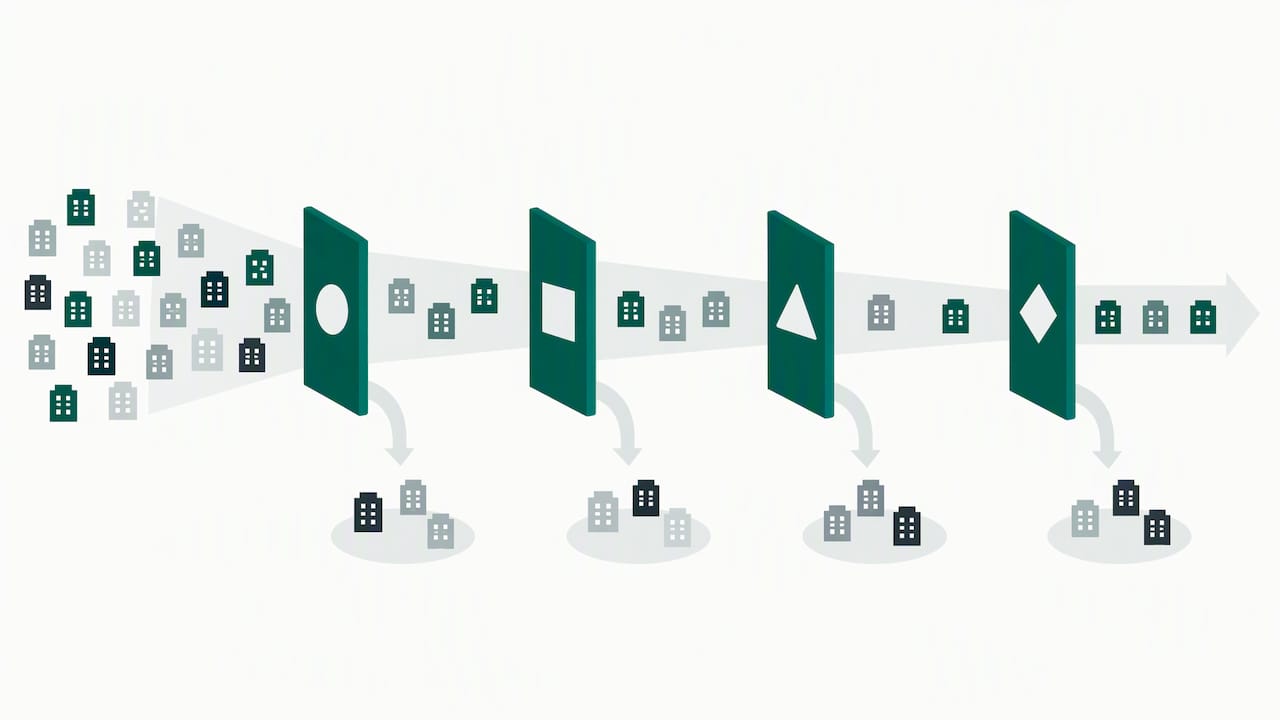
Pro Tip: Write each answer as something a CRM filter could check, such as “a defined employee range” or “runs a specific tool,” and rewrite any answer that needs an adjective like “growing” or “innovative.”
How do you build an ICP in six steps?
HubSpot’s template lays out a six-step sequence that works well as a first draft. Here is how we run it with teams.
- Identify evidence accounts. Start with closed-won customers that combine revenue, retention, adoption, and speed-to-value. HubSpot suggests reviewing the top 20 to 30 accounts by revenue, retention, and product engagement. Revenue alone misleads: a big account that churned in a year is evidence of what to avoid.
- Analyze CRM patterns. Export those accounts and look at industry, employee count, revenue range, tech stack, and engagement metrics. To standardize industry labels across messy records, the SEC’s SIC code list gives you a consistent taxonomy to filter on.
- Interview at least 10 top accounts. Use a standardized approach such as Forrester’s buyer persona interview guide so answers can be compared. Ask why they bought and what nearly stopped them. Customer language is often more useful for positioning than your internal descriptions.
- Compare trait families. Line up firmographic, technographic, behavioral, and buying-process traits and look for patterns that repeat across accounts, not one-off coincidences.
- Document the ICP and anti-ICP. Record measurable attributes and explicit disqualifiers in one shared page.
- Test and iterate. Run the profile against a target-account list and early pipeline results, then adjust.
Two habits keep this honest:
- Separate what you observed from what you hoped. If only a few accounts share a trait, it is a hypothesis, not a criterion.
- Keep the document short enough that a new rep can use it on day one.
How do you separate fit from timing?
Fit answers “who belongs on our list.” Timing answers “who should we call this week.” Mixing them is a common mistake, because a funding announcement makes an account feel hot even when it was never a fit.
SalesIntel’s layered approach makes the distinction clearly: firmographics describe who could be a fit, while triggers prioritize who is likely to buy now. Fit traits change slowly and live in the ICP. Timing signals change constantly and should only re-rank accounts that already qualify.
Fit covers firmographic traits, technographic or capability fit, problem and value fit, and buying-process fit. Timing signals worth capturing include:
- Funding: a new round that creates budget and growth pressure.
- Leadership change: a new executive who reviews tools and strategy.
- Hiring: open roles that reveal a priority or a gap.
- Tool replacement: a company outgrowing a system or evaluating competitors.
- Category research: active research into your type of solution.
- Deadlines: a launch or contract date that creates urgency.
Most of these map to ordinary CRM or enrichment fields: a “last funding date,” a “recent executive hire” flag, a “current tool” field, an “intent topic” field. Market-entry moves are a timing signal too. CyberTech Acceleration describes this well in its guide to US market entry for French cybersecurity companies, where a company’s expansion window changes when it is ready to buy.
The rule to hold: signals move accounts up or down your list, never in or out of the ICP itself.
How do you score the ICP and turn it into rep actions?
A scoring model converts the profile into a ranked list. Keep it simple enough that people trust it. Say you weight four dimensions on a 100-point scale (illustrative weights, tune them to your data):
- Firmographic fit: assign a weight based on your data.
- Technographic and capability fit: assign a weight based on your data.
- Problem and buying-process fit: assign a weight based on your data.
- Timing signals: assign a weight based on your data.
Timing signals should decay. A recent funding round may deserve its full points, while an older one may deserve close to none. Build a decay rule into the field, for example halving the score after a set number of days, so stale signals stop inflating the list.
Then define tiers with a clear action attached to each:
- A tier: high fit and active timing. Immediate, personalized outreach from a rep.
- B tier: strong fit without a current trigger. A nurture sequence and periodic signal checks.
- C tier: partial fit. Monitor only, with no rep time spent.
The non-negotiable rule is that every ICP attribute maps to a searchable CRM filter. If “operates a specific tool” can’t be queried, it can’t be scored, and a list nobody can reproduce can’t be measured later. Disqualifiers become negative filters that remove an account before scoring begins.
Pro Tip: Score your existing closed-won and closed-lost accounts with the new model before launch. If your best customers don’t land in A tier, fix the weights before any rep sees the list.
How do you know whether your ICP is working?
Judge the ICP by downstream outcomes, not by how tidy the document looks. HubSpot’s guidance is to track these and review them quarterly:
- Qualified-account rate: the share of targeted accounts that qualify.
- Meeting-to-opportunity conversion: whether first conversations turn into real pipeline.
- Win rate: the clearest single measure of fit.
- Sales-cycle length: shorter cycles suggest sharper targeting.
- Engagement by priority segment: whether A tier responds more than C tier.
- Delivery success, retention, and expansion: whether customers stay and grow.
- Revenue and margin quality: whether the deals are worth having.
The pattern matters more than any single number. If win rate falls inside A tier, your fit attributes probably don’t match who actually succeeds. If A tier engages well but cycles run long, the buying-process traits may be missing. If retention weakens, the anti-ICP is incomplete.
For the quarterly review, bring sales leadership, marketing, product, and customer success to one meeting. Check the metrics above, review closed-lost reasons, compare current wins to the profile, and revise when product scope, pricing, or market conditions have shifted. An ICP is a living model, and a quarter is a reasonable rhythm for updating it.
ICP vs buyer persona: which comes first?
Build the ICP first. As Salesforce notes, you decide which organizations are worth pursuing, then map the people inside them. The ICP is account-level and the buyer persona is individual-level, so the persona only makes sense once you know whose company you are targeting.
Inside each ICP account, map the buying committee:
- Economic buyer: controls budget and wants a clear return.
- Champion: pushes internally and needs ammunition to sell your case.
- User: lives with the product daily and cares about workflow.
- Blocker: raises objections, often around risk or switching cost.
- Approver: signs off, usually after legal, security, or finance review.
For each role, capture goals, objections, evidence requirements, and decision criteria. The messaging shift is concrete: to an economic buyer you lead with margin and growth outcomes, to a champion you hand over a internal business case, and to a blocker you address the specific risk they raise before they raise it.
Why should consultants add brand signals to the ICP?
Here is where I’d push back on the standard advice. Most ICP templates stop at firmographics, and for consultative offers that leaves out the thing that actually creates demand. a16z makes the same point for consulting businesses: don’t define the ICP only by industry or company size. Add executive-level conditions that create credible need, such as positioning confusion, go-to-market misalignment, inconsistent customer experience, or a growth transition.
Those conditions are fit signals. A company with a sizable headcount and a sales team telling inconsistent stories is a better prospect than a similar-sized company with a settled message. The interviews should capture this too. When customers explain why they bought and what nearly stopped them, their exact words are raw material for positioning and messaging, often better than anything written in a conference room.
The mistake I see most is treating the ICP as a sales-ops artifact. It is a brand decision: who you choose to serve defines what you stand for.
— Quincy
How can we help you turn your ICP into positioning and pipeline?
Building the profile is the first half. The second half is making your positioning, messaging, and go-to-market motion reflect it, so the accounts you’ve chosen recognize themselves in what you say. That is the work we do with founders and go-to-market teams:
- Brand strategy and positioning: sharpening what you stand for and why the right accounts should pick you.
- Growth and go-to-market strategy: aligning product, marketing, and sales around the same prioritized accounts.
- Customer experience mapping: finding where the buyer journey drifts from the promise.
- Workshops and executive advisory: working sessions that settle the ICP, the anti-ICP, and the messaging that follows.
Our goal in an engagement is clarity, a prioritized list of accounts, aligned messaging, and growth you can measure. If your team is debating who the ideal customer really is, book an exploratory conversation with us and we’ll start from your closed-won data.
FAQ
What should be included in a customer profile?
Include measurable company traits (industry, employee or revenue range, geography), the technologies they use, the problem you solve for them, the conditions that make it urgent, and the buying process. Add an anti-ICP listing the accounts you exclude, so the profile stays specific.
How do you define an ICP?
Start with your best closed-won accounts, meaning those that combine revenue, retention, and fast time to value. HubSpot recommends analyzing CRM patterns, interviewing at least 10 top accounts, and documenting measurable attributes plus exclusions. Then test the result against a target-account list.
How do you find your ICP?
Look for repeating traits among customers who succeeded, using CRM exports and customer interviews. Compare firmographic, technographic, behavioral, and buying-process patterns, and treat any trait that appears in only a few accounts as a hypothesis to test.
How often should you update your ICP?
Review it quarterly, and revise sooner when your product scope, pricing, or market conditions change. HubSpot and a16z both treat the ICP as a living model rather than a document you finish once.