Jobs to Be Done vs. Personas: Which One Should Drive Your Strategy?
Jobs to be done (JTBD) explains why a customer buys: the situation, the struggle and the progress they want. A persona describes who that customer is: role, attitudes and behavior. For positioning and go-to-market decisions, start with the job, because it tells you what to build and what to promise. Then use personas to decide how to say it and to whom. Teams that treat this as an either/or choice usually end up with a brand that drifts or a message that sounds like everyone else’s.
TL;DR
- A persona answers “who is the customer?” A job answers “what are they trying to get done, and what pushed them to act?”
- Use jobs for decisions: positioning, product priorities, what to say first. Use personas for communication: tone, channels, sales enablement.
- Demographics and roles are weak predictors of why someone buys. The same person hires different products in different situations.
- The two are compatible. Attach each persona to the jobs it cares about, and add that persona’s own success criteria.
- A JTBD interview with recent buyers is the fastest way to find the real job. Do it before you finalize a position.
Table of Contents
- What each tool actually is
- Why demographics alone mislead
- A worked example: one persona, two jobs
- What each one gives you
- When to use which
- How to combine them without a six-month project
- Running a jobs-to-be-done interview
- Common mistakes
- Where we can help
- Our perspective
- FAQ
- Sources
What each tool actually is
A persona is a profile of a type of customer. According to Nielsen Norman Group, a well-built one includes demographic details such as age and income, personal details such as a name and biography, attitudes and pain points, goals and motivations, and behaviors. The demographic and personal details are there to build empathy and make the persona memorable. Most teams keep it to a small set: User Interviews notes that most teams use two or three one-page personas to segment their users.
A job is a different unit. The JTBD framework says customers “hire” a product to make progress in a specific circumstance. NN/g describes a job as typically a single sentence stating what the user must accomplish and in what context, along with functional success criteria (the objective requirements) and emotional ones, including how the person wants to be seen by others.
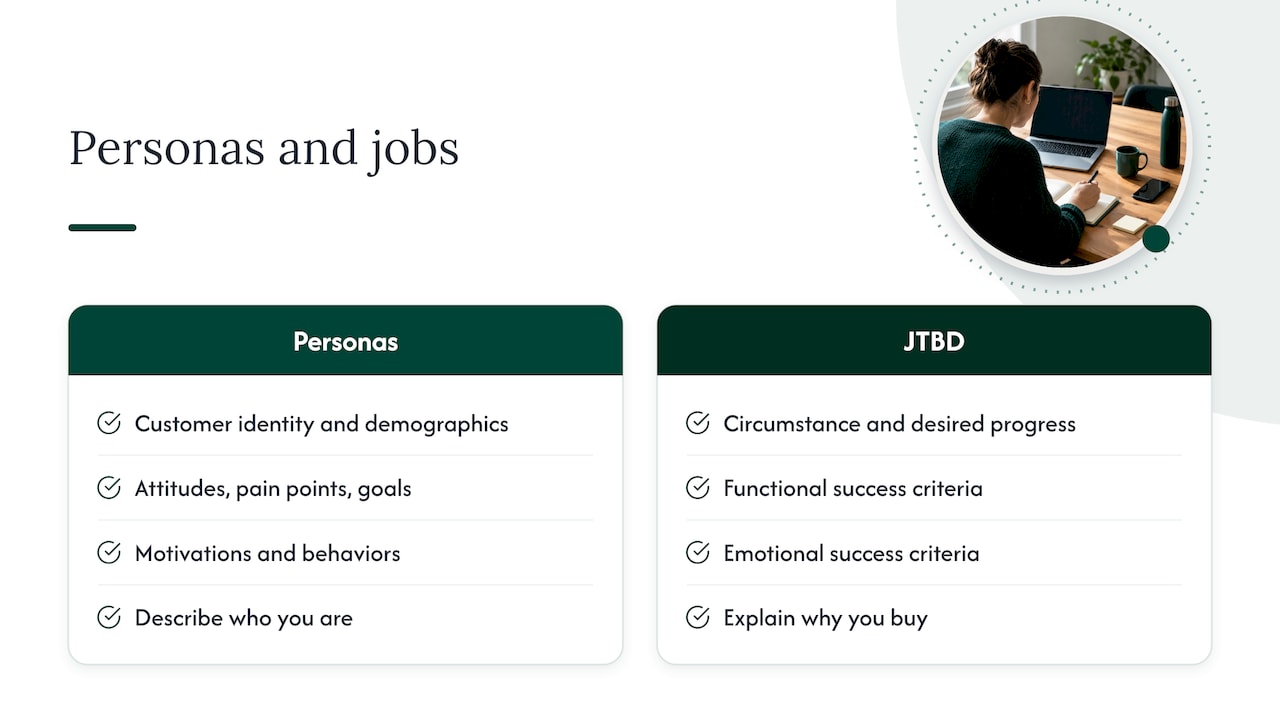
The cleanest way to hold the difference comes from JTBD practitioner Claire Menke, in a Jobs-to-be-Done Radio transcript: personas describe who you are, while jobs explain why you buy. Her example is that someone who loves learning can still resent being sent to traffic school. Same person, different situation, different motivation.
Why demographics alone mislead
If you have ever written a persona called “Growth-Stage Gina, VP of Marketing, 38,” you know the risk. Gina tells your team how to talk to a buyer, but she does not tell you why that buyer is looking at you this quarter.
Dovetail makes the point with two 40-year-old product managers at similar companies: they can have completely different jobs depending on their organizational context and the decision in front of them. Going the other way, a 35-year-old executive and a 22-year-old freelancer may hire the same product for the same job.
This is the core reason the job usually beats the persona for strategic choices. Menke adds that persona research grew out of media buying and targeting. It is a correlational tool that tells you who tends to buy. The job is the causal mechanism: it explains why a specific person decided to act.
A worked example: one persona, two jobs
Take a founder of a 15-person B2B software company. Call her the “startup founder” persona. She is time-poor, skeptical of agencies and reads investor newsletters.
Now look at two situations in which she might come to you:
- After a lost deal. A prospect chose a competitor that “looked more established.” Her job: help me look like the obvious choice when buyers compare vendors side by side.
- Before a funding round. An investor asked her to explain, in one sentence, why her company wins. Her job: help me tell a story investors repeat without me in the room.
Same persona, same title, same newsletters. But the first job points to positioning against alternatives and proof on the sales page. The second points to a narrative and a market category. If you only had the persona, you would write one message. With the jobs, you write two, and you know which to lead with for each audience.
The reverse also holds. Jeff Gothelf’s hardware store example shows a hobbyist and a serious carpenter both needing holes in walls, but for different end goals. Knowing only the job would not tell you whether to build a lighter drill or partner with a handyman service. Knowing only the persona would not tell you what they are trying to accomplish. You need both views to choose well.
What each one gives you
| Jobs to be done | Personas | |
|---|---|---|
| Core question | What is the customer trying to accomplish, and why now? | Who is the customer? |
| Typical output | A job statement with circumstance, motivation and desired outcome | A one-page profile with goals, attitudes, behaviors and demographics |
| Strongest for | Positioning, product priorities, switching behavior, unmet needs | Messaging tone, channel choice, UX, sales enablement |
| Stability | Changes with the situation | Relatively stable |
| Main risk | Becoming too abstract | Sliding into demographic stereotypes |
| Builds empathy? | Less naturally | Yes, through a named, human profile |
The two risks in that table come from a 2026 product-team analysis, which also frames JTBD as a compass for discovering situational struggles and personas as a map that humanizes the audience for marketing and UX.
NN/g also points out that JTBD alone does not promote empathy the way a persona does, and that personas help you prioritize among different user groups. That is a fair reading: a job statement is a sharp tool for strategy, but a sales team will not rally around a sentence the way they rally around a recognizable buyer.
When to use which
A simple rule from prodmgmt.world: use personas for communication and storytelling, and JTBD for decisions, prioritization and success metrics. Personas struggle when asked to decide which problem deserves investment or to define success metrics.
In practice, for the audience reading this page:
Reach for jobs when you are:
- Repositioning an offer that has stalled or is getting compared on price.
- Deciding what to put first on the homepage, in the pitch deck or in the product roadmap.
- Trying to understand why customers switch to you or away from you.
- Entering a new segment where you do not yet know the buyer.
Reach for personas when you are:
- Briefing a content, paid or sales team on tone, channels and objections.
- Aligning marketing and sales on the handful of buyer types that matter.
- Designing onboarding or UX for distinct groups with different capabilities.
Use both when the same job shows up across very different buyers. A 2026 analysis gives the example of wealth management: a day trader and a cautious pensioner hire it for the same functional job, yet the interaction style and service scripts must differ sharply for each.
If your team already has an ideal customer profile, that is a close cousin of the persona: it tells sales who to pursue. Our ideal customer profile framework walks through turning data into rep actions, and it pairs well with the jobs you discover below.
How to combine them without a six-month project
NN/g’s guidance is practical: the two are compatible. If you already have jobs, have each persona reference the relevant jobs plus that persona’s unique functional or emotional success criteria. If you have thin personas, rewrite their goals as job statements by asking what the user is trying to accomplish and what counts as success.
A workable sequence for a small team:
- Interview recent buyers to find the real jobs (details in the next section).
- Write each job as a statement: situation, motivation, desired outcome. UX Magazine shows the shape: a job statement for the task, plus an outcome statement for what the user expects.
- Cluster buyers by the job, then see which personas cluster around each. Menke notes teams can start from either end: personas first to find jobs, or jobs first to derive personas.
- Trim personas to two lines: role plus context. The prodmgmt.world approach keeps them as a communication artifact and requires each roadmap item to link to a job statement backed by evidence.
- Turn the winning job into a position. Our piece on JTBD positioning shows how a customer job becomes a clear market position, and the positioning frameworks article shows how to test it in a 60 to 90 minute workshop.
If you do not yet have personas and need a starting point for them, a guide on creating buyer personas for marketing covers the basics.
Expect some friction. Menke describes a three-to-four-month struggle reconciling the frameworks inside her team, and says that struggle is what produced real buy-in. Do not paper over disagreements between sales and product about who the buyer is. They are the useful part.
Running a jobs-to-be-done interview
The interview is where JTBD earns its keep. Bob Moesta, who worked with Clayton Christensen on the original concept, teaches the method in a Business of Software session: interview recent buyers about the events leading up to the purchase, reconstruct the timeline, ask what changed, and push past vague words by asking for specific examples.
Who to interview
Talk to people who bought recently, and some who chose an alternative or did nothing. LogRocket advises interviewing soon after purchase while memory is fresh. Five to eight conversations will usually show you patterns, though you should keep going until new interviews stop surprising you.
The four forces to listen for
The switch interview is built around four forces. Pushes (frustration with the status quo) and pulls (the appeal of something new) promote change. Habits and anxieties resist it. A good position speaks to all four: it amplifies the push, makes the pull concrete, and lowers the anxiety.
Questions that work
Harvard Business School Online lists seven open-ended questions aimed at the job a product was hired to do. Among them: when the customer first thought about buying, what challenge they were trying to solve, what other options they considered, and who was involved in the decision. Adapted for a B2B buyer:
- “Take me back to the day you first decided something had to change. What was happening?”
- “What were you using before, and when did it start to feel wrong?”
- “What else did you consider, including doing nothing or doing it in-house?”
- “What nearly stopped you?”
- “Who else had to be convinced?”
- “When did you first feel it was working?”
The last two track the timeline Dovetail describes: when the customer sought a solution, what prompted switching, what almost stopped them and when the solution first seemed to work. Norton Design Lab’s guide adds a useful discipline: ask what people have done, not what they would want, because hypotheticals produce guesses.
For wider context on picking research methods that change decisions, see our guide to B2B customer research methods, and for pre-launch work, go-to-market research.
Common mistakes
- Writing jobs as features. “Needs a dashboard” is a solution. “Show my board where growth is coming from before Monday’s meeting” is a job.
- Making personas decide strategy. A profile cannot tell you which problem deserves investment. Keep it to communication.
- Staying abstract. If a job statement could describe any competitor’s customer, it is too broad to position against.
- Skipping buyer contact. Neither artifact replaces talking to customers. Persona decks go stale and job statements built from guesses are just opinions with better formatting.
Where we can help
If you are a founder or leader trying to turn this into a position your product, marketing and sales teams all repeat, that is the work we do through brand strategy and positioning engagements. We connect positioning, marketing, product and sales so the message that wins in an interview is the one that shows up in the pitch, on the site and in the product. Quincy has built brands across more than 200 international retail locations, and brings that operator’s view to each engagement.
Our perspective
Most brand problems we see described are not messaging problems. They are drift: product says one thing, marketing another, sales a third. And the market responds by comparing you on price, because nothing in your story tells buyers why you are different.
That is why we treat the job as the anchor. A job gives the whole company one answer to a single question: what progress are we selling? Personas then help each team deliver that answer in a voice the buyer recognizes. Alone, a persona gives you a nicer audience description. Alone, a job gives you strategy with no face.
Brand is a core business strategy, not a coat of paint, and the useful test is whether it changes decisions: what you build next, who you pitch, what you stop saying. Our approach is designed to tie positioning, product, marketing and sales together through iterative frameworks, so clarity shows up as measurable growth rather than a nicer deck.
If you are choosing between the two tools, choose the job first, then dress it in personas.
Quincy
FAQ
Can jobs to be done replace personas?
Not entirely, and you rarely need it to. NN/g finds that the two are compatible, and that well-built personas already contain the goal information a job captures, plus behavioral and attitudinal detail. Use jobs for strategic decisions and keep lightweight personas for communication.
Is JTBD better for B2B than personas?
For positioning and prioritization, usually yes, because B2B buyers act in a situation (a lost deal, a board request, a failed rollout) more than as a demographic type. Personas still help sales and marketing speak to different roles in the buying group, so most B2B teams end up using both.
How many jobs interviews do I need?
There is no fixed number. Start with a handful of recent buyers and keep going until new conversations stop revealing new pushes, pulls or anxieties. Include at least a few people who chose an alternative.
Where do I start if I have neither?
Start with the interviews. Talk to recent buyers, write the jobs you hear, and then cluster the buyers into two or three personas around those jobs. You get both artifacts from one round of research, and the personas rest on evidence rather than assumption.
Sources
- Personas vs. Jobs-to-Be-Done, Nielsen Norman Group
- Jobs-to-be-Done and Personas with Claire Menke
- Jobs-to-Be-Done Theory: Framework, Examples, and More, Dovetail
- Reconciling Jobs To Be Done and Personas, Jeff Gothelf
- User Personas for UX, Product and Design Teams, User Interviews
- Is Jobs-to-Be-Done or Personas Better for Product Teams
- User Personas vs Jobs-to-be-Done, prodmgmt.world
- Understanding users by going beyond personas, UX Magazine
- Bob Moesta: Understanding Your Customer Jobs-to-be-Done, Business of Software
- How UX teams can use the Jobs-to-be-Done framework, LogRocket
- 7 Questions to Ask for an Insightful User Interview, Harvard Business School Online