
PMF vs. GTM: What Each Means and Which Comes First
Product-market fit (PMF) answers one question: does a defined group of customers want your product enough to keep using it? Go-to-market (GTM) answers a different one: can you reach those customers, convert them and keep them in a way that is repeatable and profitable? PMF is about the product and the market. GTM is about the system that connects them. Most stalled startups confuse the two, fix the wrong one and burn cash doing it.
This guide separates the two, shows the signals that tell them apart, and gives you a way to diagnose which one is holding your growth back. It is written for founders, marketing leaders and executives who need to decide where the next dollar and the next quarter go.
TL;DR
- PMF means the right customers want and keep using your product. GTM fit means you can find, win and retain them at a cost that works.
- They are not strictly sequential. PMF usually shows up first, but your GTM choices (message, channel, price) keep shaping and testing it.
- PMF evidence lives in retention and customer value. GTM evidence lives in acquisition cost, payback and sales repeatability.
- When growth stalls, test message, channel and buyer before you rebuild the product, and check that product, marketing and sales describe the company the same way.
- Positioning is the hinge between the two. If it is unclear, both PMF and GTM readings are distorted.
Table of Contents
- The difference in one table
- What product-market fit actually is
- What go-to-market is, and what GTM fit adds
- Which comes first?
- Signals that separate the two
- How to diagnose which one you lack
- Where positioning sits between the two
- From fit to scalable growth
- Our view: brand is the thread that holds both together
- Work through it with an advisor
- FAQ
- Sources
The difference in one table
| Product-market fit | Go-to-market fit | |
|---|---|---|
| Core question | Do the right customers want this and keep using it? | Can we reach, convert and retain them repeatably and profitably? |
| Focus | Product, problem, market | Message, channel, pricing, sales, customer success |
| Typical evidence | Retention, usage, customer value, “very disappointed” survey answers | Acquisition cost, payback, LTV:CAC, sales cycle consistency |
| Failure looks like | Customers try it and leave | Customers would love it, but you cannot reach or close them economically |
| Owner | Product and founders | Marketing, sales, customer success, with product |
The Growth Marketing Alliance puts the split simply: PMF is about filling a gap in the market, GTM fit is about selling and marketing the product the right way for its prospects. Blackbird partner Tom Humphrey describes it similarly: PMF is a product meeting real market demand, while GTM fit is delivering that product to the opportunity quickly and efficiently.
What product-market fit actually is
The phrase was popularized by Marc Andreessen in 2007, who described the moment when customers buy the product as fast as you can make it. The Product Marketing Alliance summarizes it as a good market combined with a product that satisfies that market, through its features and pricing.
Two parts matter in practice:
- A specific market. “Everyone with a budget” is not a market. PMF is always fit with a defined customer who has a defined problem.
- Behavior, not opinion. Compliments, pilots and signed letters of intent are not fit. Customers who return, expand and tell others are.
How to measure it
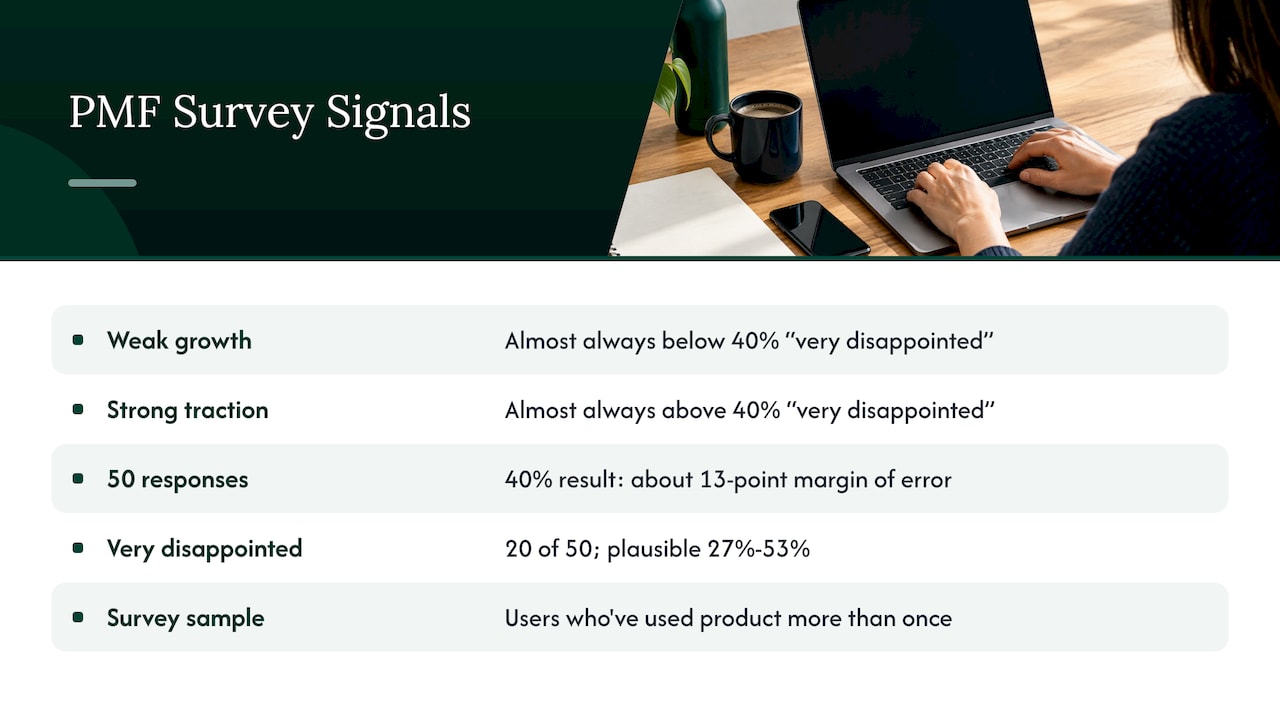
The most cited quick test is the Sean Ellis survey question: how would you feel if you could no longer use this product? Benchmarking nearly 100 startups, Ellis found that companies struggling to grow almost always scored below 40% “very disappointed,” while companies with strong traction almost always exceeded it, as MeasuringU reports.
Treat that number as a signal, not a verdict. MeasuringU notes that the 40% line rests on the originator’s judgment, and that with 50 responses a 40% result carries a margin of error of about 13 points. A worked example: if 20 of 50 users say “very disappointed,” your true figure could plausibly sit anywhere from roughly 27% to 53%. Survey only people who have used the product more than once, and read the result next to behavior.
The behavioral signal to watch is the retention curve. A cohort curve that flattens instead of sliding toward zero means a group of customers keeps getting value, a point PMRead’s 2026 guide calls its most reliable PMF indicator. The shape of the curve matters more than any single retention percentage.
What go-to-market is, and what GTM fit adds
A go-to-market strategy is more than a launch plan. Harvard Business School Online describes it as a detailed plan for reaching target customers effectively and efficiently. Effectiveness is how quickly you reach and convert them. Efficiency is how profitable that effort is. It covers distribution channels, messaging and marketing tactics, and the estimated cost of acquiring a customer.
In a working company, GTM spans the whole customer relationship: marketing reaches people, sales closes them, and customer success retains and grows them. It also recurs. You revisit it when you add a product, enter a new segment or geography, or need to reset a motion that has stopped working.
GTM fit is the point where that system works repeatably. The Growth Marketing Alliance says reaching it involves defining your ideal customer profile and buyer personas, aligning sales and marketing, and formalizing pricing so you can scale without guessing. If you want the full planning view, our guide to B2B go-to-market walks through building the plan.
Which comes first?
The tidy answer is PMF, then GTM fit, then growth. Stage 2 Capital’s science of scaling framework lays it out that way: PMF is generating customer success consistently, GTM fit is generating it consistently and scalably, and growth comes after both.
The messy truth is that the two feed each other. You cannot learn whether customers want a product without putting it in front of them, and how you put it in front of them (the message, the price, the channel) changes who responds. Andreessen Horowitz’s discussion of product-market-sales fit frames the goal as the right market, product and sales strategy together. In that conversation, Jyoti Bansal suggests exploring broadly first to find where the pain is greatest, then working out which sales motion can scale and whether the product supports it. The same discussion points out that a complex product may not suit a freemium motion, which shows how product design and go-to-market choices constrain each other.
A practical reading for founders:
- Early on, work on PMF with a narrow customer. Pick one segment and one problem. Use direct, hands-on selling to learn.
- Once a segment keeps and loves the product, work on GTM fit. Turn what you learned into a repeatable motion: who to target, what to say, how to price, who sells.
- Keep both under review. New segments and new products reopen PMF questions. New channels reopen GTM questions.
Our go-to-market framework for founders shows how to compress step two into a 90-day working plan.
Signals that separate the two
The most useful distinction is where the evidence shows up. Stage 2 Capital ties the PMF stage to retention, GTM fit to payback, and scaling to revenue growth, cash position, efficiency and burn.
Signs of PMF
- Cohort retention flattens rather than decaying to zero.
- Customers use the product without being chased.
- A clear majority of engaged users would be very disappointed to lose it.
- Referrals and repeat purchases happen on their own.
Signs of GTM fit
- You can describe your ideal customer, and sales wins match that description.
- Sales cycles and deal sizes are predictable enough to forecast.
- Pricing holds without heavy discounting.
- Unit economics work. Mark Roberge’s framework, reported by SaaStr, uses an LTV:CAC ratio above 3 and a payback period under 12 months as go-to-market-fit economics. LTV:CAC compares what a customer is worth over their lifetime to what it cost to win them.
Signals that fool you
- A narrow segment inflates the survey. PMRead cautions that a small segment can clear the 40% mark well before the broader market agrees.
- Revenue growth can hide a leaky model. Roberge warns in the same SaaStr talk that scaling too early can mean scaling a cash bleeder. Sales process, pricing, demand generation and compensation all move LTV:CAC.
- Big-logo pilots. A few enthusiastic early adopters say little about whether the broader market can be reached at a workable cost.
How to diagnose which one you lack
When growth stalls, founders usually blame the product. Work through the questions in this order instead.
1. Do customers who get the product keep it? If retention is poor even among customers who were onboarded well, you have a PMF problem. Go back to the segment, the problem and the product.
2. Do the customers who stay look alike? If yes, you have a clear segment and the issue is probably GTM: you are not reaching that segment, or not speaking to it. If no, the customer definition is too broad, which muddies both PMF and GTM.
3. Is the message landing? Founder Sajith Pai suggests that when motion-to-market fit is weak, test the message first, then the channel, then the persona, and only then consider changing the product. It is cheaper to rewrite a pitch than to rebuild a roadmap.
4. Do your own teams tell the same story? Product leader April Dunford, in a summary of her positioning advice, points to customer confusion, prospects asking you to re-explain the pitch, and different functions describing the company differently as clues to a positioning or alignment problem. She also notes that internal misalignment is more common than a true positioning flaw. If sales, marketing and product each tell a different story, no channel will fix it.
5. Do the economics work at small scale? If you win and keep customers but each one costs more than it returns, you have PMF without GTM fit. Fix pricing, sales process or channel mix before adding spend.

Where positioning sits between the two
Positioning is the hinge. It decides who you say the product is for, what you compare it against and why it wins. Get it wrong and PMF data gets noisy because you attract the wrong users, and GTM spend leaks because the message does not match what the buyer is looking for.
Dunford’s method, as summarized in the same piece, starts with the alternatives customers consider, identifies what is different about your product, translates that into customer value, finds who cares most, and picks the market context that makes the value obvious. For teams, MarketingProfs recommends a shared positioning document covering competitive alternatives, differentiators, target segments, value propositions and market category, reviewed regularly as conditions change, so product and marketing work from a single source of truth.
If you want to put this into practice, see how to define and test go-to-market positioning, and how sales and marketing alignment turns a clear position into pipeline.
From fit to scalable growth
Once you have both fits, growth becomes a question of adding channels and capacity without breaking the economics. That is when a documented plan for organic marketing growth and a sequenced rollout earn their keep. Add one lever at a time, watch payback and retention after each, and expand only when both hold. Our startup growth strategy approach uses 12-week sprints for exactly this reason: short cycles show quickly whether a change helped.
Our view: brand is the thread that holds both together
We see PMF and GTM as two readings of the same business, and brand clarity as what makes both readings trustworthy.
A product can be good and a sales team can be capable, and growth still drifts, because product, marketing and sales are each describing a slightly different company. That drift makes PMF data muddy and GTM spend expensive. Our work starts with positioning: who you are for, what you are compared against, and why you win. Then we connect that to product, marketing and sales so everyone says and does the same thing.
We come at this as operators, informed by real-world brand building and exit experience, not by branding exercises that never touch revenue. The Branded Agency method ties brand strategy to measurable performance through frameworks such as The Golden Spiral™ and Brand-Backed Performance™, and it is iterative: you test, learn and tighten, which is what both PMF and GTM fit demand.
If your growth has stalled and you are not sure whether it is the product, the market or the motion, clarity on positioning is usually the fastest first step.
Quincy
Work through it with an advisor
If you are weighing whether to fix the product, the message or the motion, we can help you sort it out. We offer brand strategy, brand positioning, growth and go-to-market strategy, customer experience work, AI and marketing strategy, and founder and executive advisory, all built to connect brand to measurable business results. See our services and get in touch to talk through where your growth is stuck.

FAQ
Is go-to-market the same as market entry?
No. Market entry is the launch, while go-to-market covers the ongoing system for reaching, converting and retaining customers. Many teams stop planning after launch, yet helping customers adopt and renew, as Salesforce’s guide points out, matters just as much. You also revisit GTM when you add a product, segment or geography.
What is a good PMF score?
The common benchmark is more than 40% of surveyed users saying they would be “very disappointed” without your product. MeasuringU notes the threshold is built on the originator’s judgment and that small samples are noisy, so read it alongside retention. Survey active users, and gather enough responses to narrow the margin of error.
What is PMF in marketing?
For marketing, PMF means the product’s market is clear and your messaging reflects it. Martech.org describes achieving it as a whole revenue team effort, with marketing refining positioning and messaging from research and customer feedback and helping build an organization-wide ideal customer profile. Marketing does not create fit, but it can reveal it and amplify it.
Can I work on GTM before I have PMF?
Yes, in a limited way. Early selling is how you find fit, so you need some go-to-market activity from day one. What you should avoid is scaling spend before retention shows customers keep the product. Learn with a narrow segment first, then invest in a repeatable motion.
Sources
- How to Develop a Go-to-Market Strategy for Your Tech Venture, Harvard Business School Online
- Product-market fit vs go-to-market fit, Growth Marketing Alliance
- Product Market Fit: Definition, Metrics & Mistakes, Product Marketing Alliance
- WTF is GTMF + PLG?, Blackbird
- How to Find Product-Market-Sales Fit, Andreessen Horowitz
- When and how fast to scale your business, Stage 2 Capital
- Understanding Go-to-Market Fit, Stage 2 Capital
- A Step by Step Guide to Revenue Growth with Mark Roberge, SaaStr
- What Is the Product-Market Fit (PMF) Item?, MeasuringU
- How to Measure Product-Market Fit, PMRead
- The Busy Founder’s Guide to PMF, Sajith Pai
- Summary: April Dunford on product positioning, Lenny’s Newsletter
- How Positioning Can Align Product and Marketing Teams, MarketingProfs
- How marketing fuels the shift from problem-market fit to product-market fit, Martech.org
- Go to Market Strategy, Salesforce
- How to develop a marketing strategy for organic growth