
Positioning Audit: How to Run One and Use the Results
A positioning audit is a structured review of whether your brand holds a clear, differentiated and believable place in your buyer’s mind, and whether product, marketing and sales all describe that place the same way. You run it by comparing three things: what you intend to say, what your assets actually say, and what customers repeat back. The gaps between those three are the findings.
This guide walks through the audit in the order we run it: scope, competitive set, customer evidence, messaging check, synthesis, and a measurement baseline so you can tell later whether anything changed.
TL;DR
- A positioning audit compares your intended position, your actual messaging and customer perception, then names the gaps.
- Cover four things: the audience you serve, the category you claim, the alternatives buyers weigh, and the differentiation you can prove.
- Check every customer-facing asset, from the homepage to sales talk tracks, and log contradictions in a simple conflict list.
- Set a baseline before you change anything, so brand impact can be measured against business results.
- The output should be a decision and a plan, not a slide deck of observations.
Table of Contents
- What a positioning audit is, and what it should reveal
- Before you start: scope and questions
- Step 1: Audit the four pillars
- Step 2: Build the competitive audit
- Step 3: Gather customer evidence
- Step 4: Run the messaging audit
- Step 5: Synthesize into a position
- How to measure brand and track impact over time
- Common mistakes
- Our perspective
- Work with us on your positioning
- FAQ
- Sources
What a positioning audit is, and what it should reveal
A brand audit asks how your brand looks. A positioning audit asks a harder question: does the market understand why you are the right choice for a specific buyer, and do they believe it?
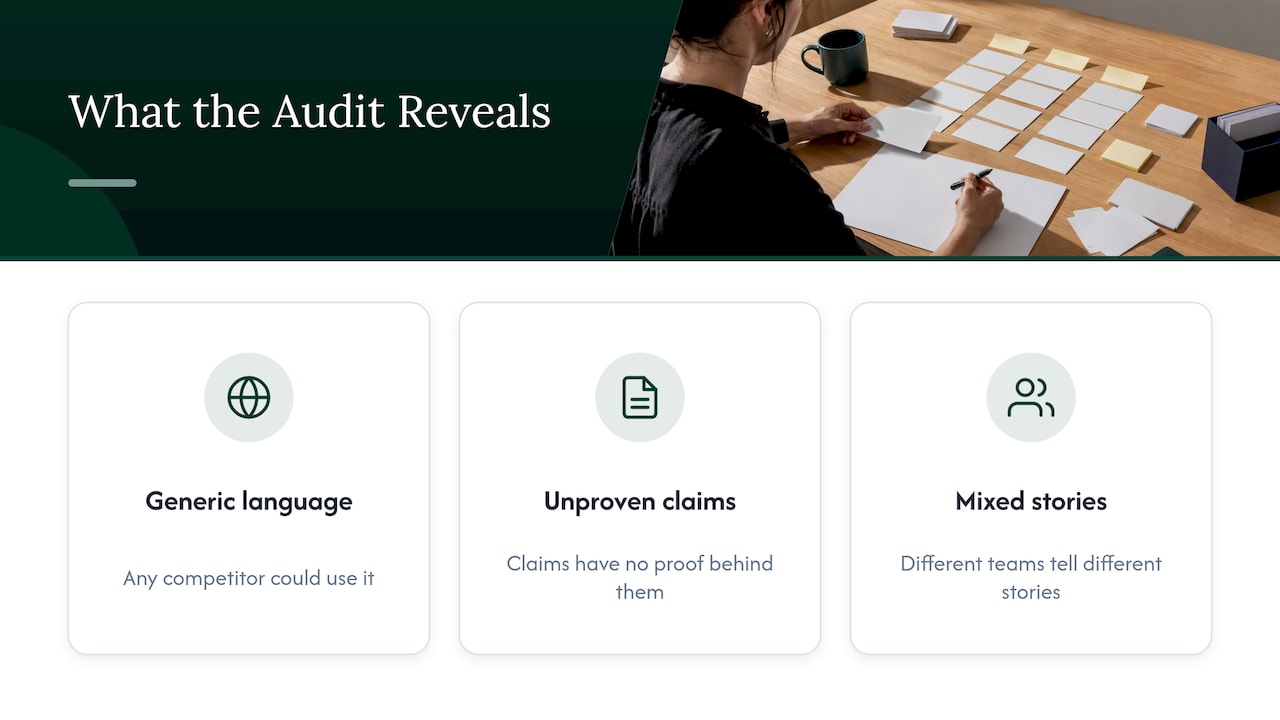
In practice it should reveal the distance between your internal intent and customer perception. It shows where you drift into generic language that any competitor could use, where your claims have no proof behind them, and where different teams tell different stories. A brand quarterly guide to digital brand audits frames the same idea: test whether your primary claims are distinct from competitors and whether customers actually believe and value them.
If you have ever heard a founder describe the company one way, a sales rep another, and a customer a third, you already know what the audit finds. Our view is that positioning is a decision about who you are for and what you will not be, which is why we wrote about positioning as a decision, not a tagline. The audit tells you whether that decision was ever made, and whether it stuck.
When to run one
The usual triggers are easy to recognize:
- Win rates are slipping or deals stall at price conversations.
- You are being compared on features and discounts instead of on fit.
- A new product, market or segment is about to launch.
- Leadership has changed, or a merger has put two stories side by side.
- Marketing, product and sales describe the customer differently.
If none of those apply, run it anyway once a year. Positioning drifts quietly, and the drift is cheaper to catch early.
Before you start: scope and questions
Decide what you are auditing and who will act on it. A good scope fits on half a page.
- The unit. A company, a product line or a single offer. Mixed scopes produce mixed findings.
- The buyer. Name the primary buyer and, in B2B, who else sits on the buying committee. We cover why that matters in why corporate positioning must win the buying committee.
- The decision it informs. For example: do we narrow to one segment, change how we price, or rewrite the sales story?
- The owner. One executive who can approve tradeoffs. Without one, audits end as reports.
Write your current positioning statement before looking at anything else. If nobody can write it in two sentences, that is your first finding.
Step 1: Audit the four pillars
Every positioning audit comes back to four questions. Score each one as clear, fuzzy or missing.
| Pillar | The question | Evidence to collect | Red flag |
|---|---|---|---|
| Audience | Who gets the most value, and who do we actually sell to? | CRM data, closed-won and closed-lost, customer interviews | The ideal customer is “anyone who needs growth” |
| Category | What do buyers think they are buying when they buy from us? | Search language, analyst and review-site framing, sales call recordings | We invent a category buyers never mention |
| Competitive alternatives | What would the buyer do if we did not exist? | Lost-deal reasons, buyer interviews, competitor sites | We list only direct rivals and ignore the spreadsheet or doing nothing |
| Differentiation | What do we do that alternatives do not, and can we prove it? | Case results, product facts, customer quotes | Claims such as “best in class” with no evidence |
The pillars depend on each other. A differentiator only matters to a specific audience, measured against a specific alternative. If you change one answer, recheck the others.
For a deeper look at the last pillar, see our practical guide to brand differentiation strategy.
Step 2: Build the competitive audit
The competitive audit is the part of the positioning audit that looks outward. It answers where the crowd sits so you can see where you are standing in it.
A competitive audit research guide from Qualz.ai recommends a set of 5 to 12 entities and 8 to 15 evaluation criteria. That range is a sensible working rule, and here is how we apply it:
- Define the set broadly. Include direct competitors, indirect ones, and substitutes such as internal workarounds or doing nothing. Buyers weigh all of them.
- Pick criteria that buyers use. Target audience, pricing model, core offer, onboarding or delivery experience, proof, and the tone of the positioning are typical. Add criteria from your own lost-deal notes.
- Use a consistent grid. Competitors as columns, criteria as rows. Fill each cell from what you can observe: their website, their pricing page, their reviews, their sales experience.
- Synthesize patterns. Mark what is table stakes, what is crowded, and what is open.
The open cells are not automatically opportunities. An empty position is only valuable if buyers care about it and you can credibly own it. We go through the method in more depth in our competitive brand analysis guide for leaders.
Check price signals too
Pricing is positioning in numbers. If you claim premium expertise but discount in every negotiation, buyers read the discount. Include price points, packaging and discount patterns in the grid. Our piece on how corporate pricing decisions shape brand positioning explains why this belongs in the audit.
Step 3: Gather customer evidence
Competitor websites tell you what rivals want to be seen as. Only customers tell you what you are seen as.
The highest-value inputs are:
- Interviews with recent wins. Ask what they were trying to fix, what else they considered, and how they would describe you to a colleague. Record the exact words.
- Interviews with recent losses. Ask who they chose and why. These are often more honest.
- Sales call recordings. Listen for the questions buyers ask first and the objections that repeat.
- Reviews and support tickets. They show the language customers use without prompting.
A handful of interviews on each side is enough to see patterns, though more sharpens the picture. Compare the customer language against your own. When customers describe you with a category or benefit you never use, your messaging is not meeting them where they are. We have seen the opposite problem too: teams that use internal jargon no buyer repeats, which we cover in why internal language weakens corporate brand positioning.
Step 4: Run the messaging audit
The messaging audit checks whether the position you intend is the position every team actually communicates. It is the part that checks alignment across product, marketing and sales.
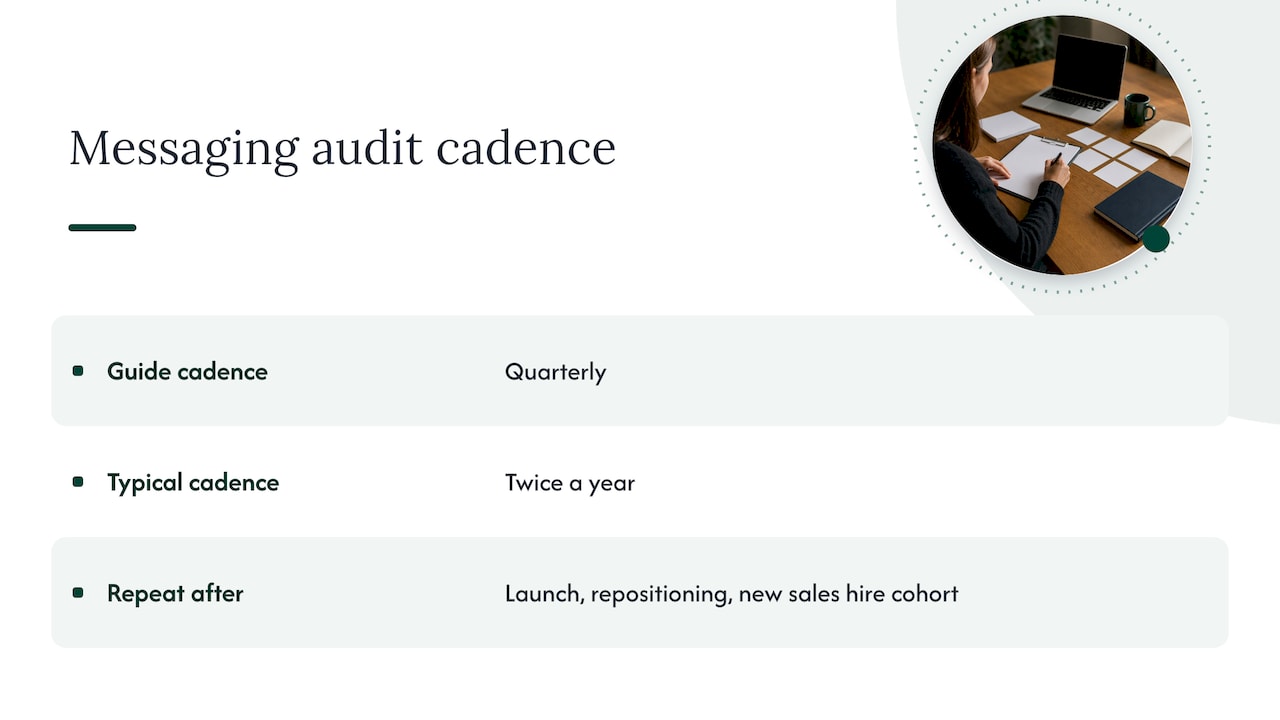
As Apollo’s guide to consistent outreach messaging describes it, the audit compares claims, value propositions and proof points across customer-facing assets to find contradictions and gaps. The same source suggests repeating it quarterly, and also after a product launch, a repositioning or a new sales hire cohort. For most companies, twice a year plus those triggers is plenty.
The asset checklist
Pull the real material, not the approved templates. Then review:
- Website homepage and pricing page: core value proposition, key claims and the customer language.
- Outbound sales emails and sequences: subject lines, opening hooks, proof points and calls to action.
- Sales talk tracks and demo scripts: how the pain is framed, which differentiators are stressed, and how objections are answered.
- Ads and nurture emails: headline claims, offer language and who they speak to.
- Customer onboarding and renewal messaging: whether the promise made in sales is the one delivered.
The conflict log
The output is deliberately simple: a log with three columns.
| Finding type | Example | Owner |
|---|---|---|
| Contradiction | Homepage says “for enterprise”; sales emails target small teams | Marketing lead and sales lead |
| Claim without proof | “Fastest results” appears in three assets with no data | Product marketing |
| Stage misalignment | Onboarding promises a different outcome than the demo | Customer success lead |
The Apollo guide also lists metrics for tracking message consistency, such as claim variance and message match across channels. Those are useful for outbound-heavy teams. For others, a simpler rule works: count the number of different ways your company is described across ten assets. Fewer is better.
Step 5: Synthesize into a position
The point of the audit is a decision. Take what you found and write:
- A positioning statement. Who it is for, the category, the alternative it beats, the differentiated value, and the proof. Two sentences, in customer language.
- A positioning map. Choose two axes that matter to buyers, plot yourself and the alternatives, and look for the position you can hold. Our positioning map examples show how teams choose axes that mean something.
- A tradeoff list. What you will stop saying, which segments you will stop chasing. If nothing is cut, nothing was decided. This is the reason many efforts stall, as we explain in why brand repositioning fails without executive tradeoffs.
Test the draft before you roll it out. A 60 to 90 minute positioning workshop with product, marketing and sales is often enough to pressure-test a position against real objections. If you want examples of what good statements look like, see our brand positioning examples.
How to measure brand and track impact over time
An audit gives you a snapshot. To know whether positioning work changed anything, you need a baseline and a small set of measures you will check on a schedule.
We organize measurement in three layers:
| Layer | What it tells you | Example measures |
|---|---|---|
| Perception | Do buyers see the position you intend? | Unaided and aided awareness in your target segment, whether buyers name you for the right category, how they describe you in their own words |
| Behavior | Are they choosing you for the right reasons? | Win rate against named alternatives, share of inbound that fits the target profile, sales cycle length, discount rate |
| Business | Is the position paying off? | Revenue per customer, retention, expansion, pipeline quality |
A few rules keep this honest:
- Baseline first. Record each measure before you change messaging. Without it, any later improvement is a guess.
- Measure the target segment. A brand survey of the general public tells a B2B company almost nothing.
- Pair perception with behavior. Awareness rising while win rates stay flat means you are known for the wrong thing.
- Change one thing at a time where you can. If you relaunch the website, pricing and sales deck in the same month, you cannot say which one moved the numbers.
- Review on a fixed rhythm. Quarterly for behavior and business measures, once or twice a year for perception.
The link between brand and business is rarely a single number. It is a pattern: clearer buyers, fewer discounts, shorter cycles, better-fit customers. Track the pattern.
Common mistakes
- Auditing only your own materials. You see what you said, not what was heard.
- Treating the audit as a design review. Logos and colors matter, but positioning problems are usually about choices, not visuals.
- Skipping the alternatives. If “do nothing” is your biggest competitor, you need to know.
- Collecting findings without owners. Every line in the conflict log needs a name and a date.
- Ending with a statement but no tradeoffs. A statement that costs nothing changes nothing.
Our perspective
We think of brand as a core business strategy, not a marketing layer. That changes what an audit is for. It is not a report on how the brand looks; it is a test of whether the company has made a clear choice and whether product, marketing and sales are carrying it out.
Our approach comes from an operator’s side: we have built brands and been through an exit, and we know what happens when a position is vague. Teams drift, buyers compare on price, and every function builds its own version of the story.
That is why we tie the audit to measurable performance. We want to see the position show up in win rates, deal quality and customer experience, not just in a cleaner deck. We work through iterative frameworks that connect positioning to product, marketing and sales, so the output is something the whole company can act on.
If your audit ends with a list of observations, it is unfinished. It should end with a decision, an owner and a way to measure whether the decision worked.
Quincy
Work with us on your positioning
If you would rather not run this alone, we help founders, executive teams and marketing teams audit their position, decide what to own, and align product, marketing and sales around it. Our work covers brand strategy, brand positioning, growth and go-to-market strategy, customer experience and founder and executive advisory.
See our brand strategy and positioning services or reach out through the site to talk about where your position stands today.
FAQ
What is the difference between a positioning audit and a brand audit?
A brand audit usually reviews the whole brand: identity, visuals, awareness and reputation. A positioning audit narrows to one question: does the market see a clear, differentiated and credible reason to choose you? The two overlap, but a positioning audit leads to decisions about audience, category and message.
What is a messaging audit?
It is a review of every customer-facing asset to find where claims, value propositions and proof points contradict each other or lack evidence. It sits inside a positioning audit as the alignment check. The output is a conflict log with owners, not a rewrite of everything.
How often should I run a positioning audit?
Run a full one once a year, and a lighter messaging check twice a year. Also run one after a product launch, a move into a new segment, a leadership change or a merger. Fast-moving markets justify shorter cycles.
What does a competitive audit include?
It defines a set of competitors, including indirect ones and substitutes such as doing nothing. It then scores each against criteria buyers use, like audience, pricing, offer, proof and tone. The patterns show what is table stakes, what is crowded and what is open.
How do I measure brand impact?
Set a baseline before you change anything, then track perception, buyer behavior and business results in your target segment. Watch win rate, discounting, sales cycle and retention alongside awareness and how buyers describe you. Review on a fixed schedule.
Sources
- Digital Brand Audit Template: Step-by-Step Guide
- Competitive Audit, Qualz.ai Research Guide
- How Do You Keep Outreach Messaging Consistent Across Teams?