
Founders: Pricing & Positioning, Quantify Value, Price, and Govern
Price is the loudest positioning signal your business sends, and it lands before your pitch deck, your website copy, or your sales rep ever does. A sound pricing and positioning strategy starts with choosing the market position you want, then reverse-engineering the price, tiers, and discount rules that reinforce it. Get the sequence backward, and you end up discounting your way out of the very position you spent a year building.
TL;DR:
- Pricing signals must align with market position to avoid undermining brand credibility and causing discounting spirals.
- The most effective pricing strategies depend on the company’s stage, differentiation, and target customer, with value-based and tiered models often fitting best.
- Clear understanding of the comparison set and customer value allows precise targeting of price positioning, while misalignment leads to lost revenue and market confusion.
- Regular governance, experimentation, and analysis of realized prices prevent value leakage and ensure prices stay consistent with strategic positioning.
- Avoid common mistakes such as inconsistent positioning claims, excessive tiers, and neglecting early market feedback, which erode market confidence over time.
Table of Contents
- What Is Price Positioning and Why Does It Matter?
- Common Pricing Strategies and When to Use Them
- How Pricing Shapes Customer Perception and Behavior
- Frameworks to Align Pricing With Positioning
- How Do You Set Price From a Positioning Decision?
- Pricing Governance, Testing, and Iteration
- Common Pricing and Positioning Mistakes to Avoid
- How The Branded Agency Applies This in Practice
- When Should You Prioritize Positioning Over a Quick Pricing Win?
- Get Hands-On Help Aligning Your Pricing and Positioning
- Sources
- FAQ
What Is Price Positioning and Why Does It Matter?
Price positioning is the deliberate use of price to signal where a product sits relative to alternatives on quality, exclusivity, or accessibility. It is one lever inside the broader marketing mix, alongside product, promotion, and distribution, but it is the one buyers process fastest. A shopper decides whether something is premium, budget, or mid-market within seconds of seeing a number, often before reading a single feature.
Price also does work that copy cannot. A $40,000 enterprise software contract tells a buyer this tool is built for serious operational stakes, regardless of what the landing page says. A $9 monthly plan tells a different buyer this is low commitment, low risk, try it and see. One interactive lesson on pricing as a positioning signal frames this as one of three positioning choices: be the cheapest, be the highest-quality option, or be the specialist. Each choice demands a different pricing discipline, and mixing them confuses buyers before they even get to features.
Alignment between price and position matters for three concrete business reasons:
- Conversion quality. Buyers self-select based on price signals, so a price that undersells your position attracts the wrong prospects and wastes sales cycles.
- Customer fit. Price filters for the customers who value what you actually deliver, reducing churn from mismatched expectations.
- Margin preservation. A price set below your true position invites discount pressure later, because the market anchors to that first number.
Get the position right and the price nearly writes itself. Get it wrong and every quarter becomes a fight to justify a number the market never agreed to.
Common Pricing Strategies and When to Use Them
Most pricing decisions come down to six recognizable strategies, each suited to a different stage of market maturity and a different confidence level in your differentiation.
- Value-based pricing ties price to the dollar value a customer receives, not to your costs. It works best when you can quantify a client outcome (hours saved, revenue generated, risk avoided) and when your product is meaningfully differentiated enough that comparison shopping does not dominate the conversation.
- Price skimming launches high and lowers over time, which suits genuinely novel products with limited early competition and buyers willing to pay for being first. Stripe’s guidance on new product pricing notes skimming signals premium positioning right out of the gate.
- Penetration pricing launches low to capture volume and market share fast, which fits categories where network effects or switching costs matter more than early margin. It signals a volume-first strategy, and it is hard to walk back later without upsetting your earliest, most price-sensitive customers.
- Cost-plus pricing adds a fixed margin on top of production cost. It is simple and defensible in commodity categories, but it says nothing about differentiation, and it tends to leave money on the table for anything genuinely valuable.
- Competitive pricing benchmarks against rivals and holds a deliberate spread above or below them. A useful way to think about this comes from a Cornell framework describing five price-positioning strategies: skim, match, surround, undercut, and penetrate, each a distinct stance relative to the competitive set.
- Tiering and usage-based pricing scales price with consumption or feature access, which fits products where value grows with usage and where self-serve buyers want to start small.
The signal that tells you which strategy fits: listen to how prospects react the first time they hear your number. If they say the price is lower than expected across multiple conversations, you are underpricing relative to your position. If you hear the same objection repeatedly at the same number, you have found the market’s ceiling.
How Pricing Shapes Customer Perception and Behavior
Buyers rarely evaluate price in isolation. They anchor to whatever comparison point sits nearest, which is why the comparison set you put yourself next to matters more than the number itself. Show your product beside enterprise software costing six figures, and $15,000 looks cheap. Show it beside a $200 tool, and the same price looks absurd.
Three psychological patterns show up constantly in pricing and positioning strategy work:
- Anchoring. The first price a buyer sees becomes the reference point for every price after it, which is why the order you present tiers in changes how each one gets perceived.
- Decoy framing. A deliberately unattractive tier makes the option next to it look like the obvious, sensible choice, nudging buyers toward the price you actually want them to pick.
- Odd pricing. Prices ending in .99 read as smaller and more calculated than round numbers, a well-documented retail habit, though the effect weakens sharply in B2B contexts where buyers are comparing total contract value, not shelf price.
Underpricing in B2B carries a specific credibility risk. A $500 enterprise consulting engagement does not read as a bargain. It reads as a signal that the service is not serious enough to trust with a real budget. One recurring pattern researchers and practitioners flag: founders systematically underprice relative to the value they deliver, treating early pricing as a fixed fact rather than a hypothesis to test upward.
Pro Tip: Before you finalize a number, write down the three products or services you expect buyers to mentally compare you against. If your price doesn’t make sense next to those three, no amount of copywriting will fix it.
Frameworks to Align Pricing With Positioning
Two frameworks do most of the heavy lifting when you need to translate an abstract position into a concrete number.
The price-value matrix plots your offering against alternatives on two axes: perceived value and price. Products that sit above the diagonal (high value, moderate price) look like a bargain and convert fast, but they often underprice their own worth. Products below the diagonal (high price, moderate value) invite scrutiny and objection. The exercise is diagnostic: plot your real competitors, plot yourself honestly, and see which quadrant you actually occupy versus the one your marketing claims.
A five-component positioning framework, described in detail in this market positioning breakdown, maps competitive alternatives, unique attributes, value, best-fit customers, and market category. Price is not a separate line item in this model. It is the output of the other four: once you know your alternatives, your unique attributes, and your best-fit customer, the price range that fits becomes obvious rather than arbitrary.
From there, most companies fall into one of three alignment models:
- Premium or high-touch. Price sits well above the comparison set, sales cycles are longer, and the product justifies the gap with dedicated support, customization, or proven outcomes.
- Volume or self-serve. Price sits at or below the comparison set, the buying process is largely frictionless, and growth comes from volume rather than deal size.
- Value-based or education-led. Price sits wherever the quantified outcome justifies, and the sales motion spends real time proving the math before asking for the number.
Each model demands different marketing behavior. A premium model that runs constant promotional discounts is fighting itself, and a self-serve model that requires a 45-minute sales call before revealing price is doing the same thing in reverse.
How Do You Set Price From a Positioning Decision?
Turning a positioning statement into an actual price list takes a specific sequence, not a guess dressed up as strategy, as outlined by experts who build AI-native companies with the leaders who own the market.
- Identify the real comparison set and your best-fit customer. Ask prospects directly what they were evaluating before they found you. The honest answer is often different from the competitors you assume you’re fighting.
- Quantify the dollar value of the outcome you deliver. If your product saves 10 hours a week for a team billed at $75 an hour, that is a concrete, defensible number to price against, not a feature list. This is the core move described in this pricing and positioning playbook: map the value gap first, then let the price follow.
- Design your tier architecture with three options and an anchor. Three tiers tend to outperform two or five because they give buyers a comparison without overwhelming them. Price the middle tier as the one most buyers should land on, and set the top tier significantly higher than the base tier to create upward pull without making the entry option feel like a trap.
- Define discounting rules and approval thresholds before you launch, not after your first big deal request. Decide now who can approve a 10% discount versus a 30% discount, and write it down.
- Launch small experiments and measure price acceptance. Track how often prospects push back on price at each stage of the funnel, then adjust the number based on real signal rather than internal opinion.
Pro Tip: Track the first pricing conversation in every sales call as its own data point. A pattern of “that’s less than I expected” across a segment is one of the clearest signs you’re underpriced for the position you’re claiming.
Pricing Governance, Testing, and Iteration
A price you set once and never revisit is a price slowly eroding under the weight of exceptions. The gap between what you publish and what you actually collect is called the discount waterfall, and it is where most positioning damage happens quietly, deal by deal, approval by approval.

Realized price, not list price, is the number that tells you whether your positioning is holding. A price waterfall analysis breaks down exactly where value leaks: sales discounts, volume rebates, payment term concessions, and end-of-quarter deals that never should have been approved. Left ungoverned, that leakage compounds, because every discounted deal becomes the anchor the next prospect expects.
Testing price changes responsibly means:
- Running cohort-based tests rather than changing price for everyone overnight, so you can compare acceptance rates across segments.
- Giving each test enough volume to read the result. A handful of deals will not tell you anything reliable about a 15% price increase.
- Reviewing pricing KPIs on a fixed cadence, not reactively. Realized price versus list price, win rate by tier, and discount frequency by sales rep are the three numbers worth checking monthly.
Governance is not bureaucracy for its own sake. It is the mechanism that keeps the number your positioning promised from quietly becoming a different number nobody approved.
Common Pricing and Positioning Mistakes to Avoid
Most pricing failures trace back to a handful of repeatable mistakes, not bad math.
- Claiming two incompatible positions at once, like marketing yourself as premium while running constant discount promotions. This creates the kind of cognitive dissonance that research on conflicting claims shows undermines buyer trust rather than expanding your appeal.
- Offering too many tiers or add-ons, which causes decision paralysis and pushes buyers toward the cheapest option out of confusion rather than genuine fit.
- Skipping governance until after a discounting habit forms, at which point realized price has already drifted well below what the position requires.
- Ignoring early pricing conversation signals, treating the first sales call’s reaction as a one-off instead of a pattern worth tracking across the funnel.
How The Branded Agency Applies This in Practice
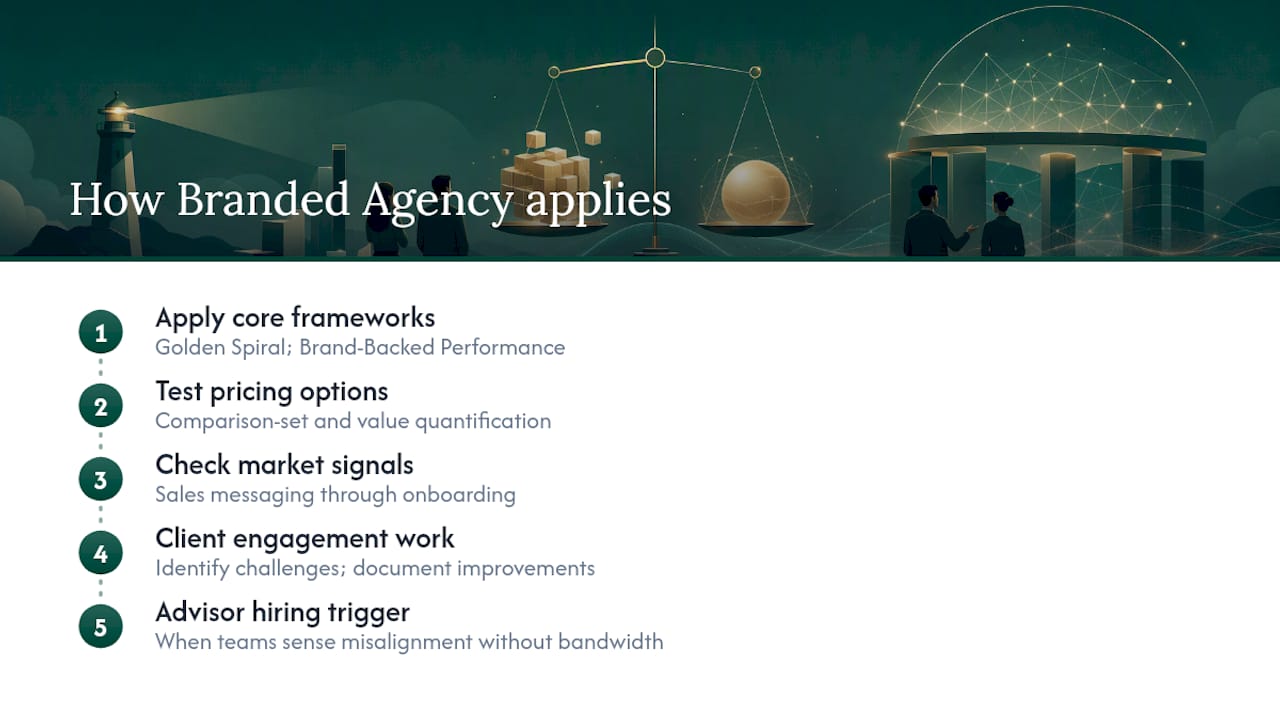
Translating a pricing decision into a durable market position is exactly the work Quincy Samycia built The Branded Agency around. The methodology runs on two connected frameworks: The Golden Spiral™, which maps how brand strategy compounds through product, marketing, and sales decisions over time, and Brand-Backed Performance™, which ties that strategy to measurable business outcomes rather than abstract brand exercises.
In practice, that means pricing decisions get tested against the same comparison-set and value-quantification steps outlined above, then checked for consistency against every other market-facing signal, from sales messaging to onboarding. Client engagements typically focus on identifying pricing challenges and helping clients develop disciplined pricing strategies, documenting improvements from initial confusion to more consistent pricing.
Hiring a dedicated pricing-positioning advisor tends to make sense at a specific inflection point: when internal teams already sense pricing and positioning are misaligned but lack the framework or the executive bandwidth to fix it without outside structure. Read more on the reasoning behind positioning as a decision rather than a tagline.
When Should You Prioritize Positioning Over a Quick Pricing Win?
Discounts help traction when you’re testing demand in a genuinely new segment. They harm you the moment they become routine, because routine discounts train the market to distrust your list price entirely. Committing to one clear position, and defending it with real discount governance, does more for sustainable growth than any single quarter’s discount ever will.
— Quincy
Get Hands-On Help Aligning Your Pricing and Positioning
If you’ve read this far and started mapping your own comparison set, you already know the harder part isn’t the framework. It’s the execution, the internal alignment meetings, and the discipline to hold a price once you’ve set it. Quincy Samycia works directly with founders and executive teams on exactly this problem, through brand strategy engagements, positioning audits, go-to-market alignment, and customer experience mapping that connect pricing decisions to the rest of the business rather than treating them as a finance-only exercise.
Services span Brand Strategy, Brand Positioning, Growth and Go-to-Market Strategy, Customer Experience, and Founder and Executive Advisory, all built around the same principle this article walks through: pick a position, quantify the value, then govern the number so it holds. For teams that want a live working session rather than a written framework, speaking and workshop engagements run through the same pricing and positioning exercises with executive audiences in the room. Readers who want the structured method behind the approach can also review The Golden Spiral™ and Brand-Backed Performance™ frameworks directly. The next step is simple: reach out through the site to book a discovery conversation about where your pricing and your positioning are currently pulling in different directions.
Sources
- Price Positioning Strategies
- Pricing strategies for new products: What to know | Stripe
- Marketing and Pricing Strategy: How to Price & Position to Win
- Pricing as a positioning signal interactive lesson
FAQ
What Are the 5 C’s of Pricing?
Definitions vary across sources, but the version used most often in pricing strategy work covers cost, customers, competition, channels, and company objectives, the factors that jointly determine where a price should land. It is less a fixed formula than a checklist for making sure no major input gets ignored.
What Are the 7 Pricing Strategies?
There isn’t one universally agreed list of seven, but the strategies covered most consistently across pricing guidance are value-based, skimming, penetration, cost-plus, competitive, tiered or usage-based, and dynamic pricing. Choosing among them depends on your market maturity, differentiation, and how easily you can adjust price after launch, as Stripe’s guidance on new product pricing explains.
Does the .99 Pricing Trick Actually Work?
Odd pricing endings like those just under round numbers do tend to make a price feel smaller in consumer retail contexts, a well-documented psychological effect. In B2B and higher-consideration purchases, though, the effect weakens considerably because buyers are evaluating total contract value and outcomes, not a quick shelf-price impression.
What Are the 5 Pricing Strategies With Examples?
A commonly cited framework describes skim (launch high, like early premium software), match (price in line with direct competitors), surround (bundle to out-value competitors at a similar price), undercut (price below the category to win on cost), and penetrate (price low to capture volume fast), as outlined in Cornell’s price positioning framework. Each fits a different competitive situation, from launching something genuinely new to entering a crowded, price-sensitive category.
How Does Quincy Samycia Help With Pricing and Positioning?
Quincy Samycia works with founders and executive teams through brand strategy consulting, positioning audits, and go-to-market alignment that connect pricing decisions to broader market positioning. Pricing for these engagements is available on request through the primary services page.