
Win the First 90 Days: Product Launch Strategy for 2026
A product launch strategy is the framework that connects positioning, messaging, and go-to-market decisions so a new product reaches the right buyers and starts generating revenue on schedule. Forrester’s research on connected go-to-market found that many launches fail because they are disjointed and product-first instead of customer-centric. Success means product, marketing, and sales moving from the same plan, with early adoption and measurable revenue signals as the proof.
TL;DR:
- Validation of messaging through prospect feedback is crucial before building the campaign to ensure market resonance.
- Clear ownership and structured decision-making are essential to prevent launch failure due to accountability gaps.
- Early post-launch monitoring of activation, error rates, and support volume helps identify issues quickly and enables rapid adjustments.
- Prioritize staged experiments over comprehensive checklists, focusing on fast validation and adaptability in a changing revenue landscape.
- Connecting positioning to measurable metrics through frameworks improves launch alignment and reduces risks tied to dependency visibility and decision clarity.
Table of Contents
- What separates a launch strategy from a launch plan
- Core components of an effective product launch strategy
- Pre-launch: a prioritized checklist and timeline
- GTM alignment: roles, decisions, and handoffs
- Launch day and the first 30 to 90 days
- Measuring results and preparing the next wave
- How brand-backed frameworks sharpen launch readiness
- What most launch teams get wrong for 2026
- Where Quincy Samycia fits into your launch
- Sources
- FAQ
What separates a launch strategy from a launch plan
A product launch strategy is the set of decisions about whom you’re selling to, what problem you solve better than the alternatives, and how the business will measure whether the launch worked. A launch plan is the execution layer underneath it: the calendar, the task owners, the assets, the dates. Confusing the two is why so many teams build detailed timelines before they’ve agreed on positioning, then wonder why sales and marketing are telling different stories to the same buyer.
Strategy comes first because it forces prioritization. Without it, teams default to launching everything to everyone, which spreads a limited budget too thin and mis-specifies who the buyer actually is. Salesforce’s go-to-market playbook points to poor execution, not lack of product-market fit, as a major reason startups fail even when the underlying product is sound.
A launch strategy should answer, before any plan is drafted:
- Who is the ideal buyer, and what triggers their search for a solution
- What outcome does the product deliver that the market can’t easily get elsewhere
- Which go-to-market motion (sales-led, product-led, or hybrid) fits how that buyer actually buys
- What “success” looks like in the first 30, 60, and 90 days after launch
Core components of an effective product launch strategy
Every strategy rests on a handful of decisions that everything else depends on. Skip one and the launch plan built on top of it will wobble.
- Positioning and messaging: Lead with the outcome the buyer gets, not the feature list. An outcome-led value proposition answers “what changes for me” before it answers “how does it work.”
- Target market and buyer decision map: Define the ideal customer profile and trace how that buyer actually evaluates and approves a purchase, including who else has to say yes.
- GTM motion: Choose between product-led growth, sales-led growth, or a hybrid based on deal size, buyer sophistication, and how much value the product delivers before a human ever gets involved.
- Pricing and packaging: Decide how pricing supports adoption, particularly if the model is usage-based, where revenue depends on people actually using features rather than just signing a contract.
- Enablement and operations: Line up the content, training, and analytics instrumentation sales and support need before day one, not after the first confused customer calls in.
- Leading metrics: Pick the handful of indicators, activation rate, time to first value, sales confidence, that will tell you within weeks whether the launch is working.
Pro Tip: Write your positioning statement as a single sentence a customer would say about themselves after buying, not a sentence your team would say about the product.
Pre-launch: a prioritized checklist and timeline
Most launch failures trace back to skipped validation, not bad execution on launch day itself. Working backward from your launch date, in priority order:
- Validate the message before you build the campaign. Run short surveys and message tests with a small cohort of real prospects to see which value proposition actually lands, rather than which one your team prefers internally.
- Run a beta or soft launch with defined exit criteria. Set the activation rate, feedback volume, or bug threshold that determines whether you’re ready for a full release, and write it down before the beta starts.
- Tier your launch investment. Not every feature or segment deserves a full campaign. Rank initiatives by revenue potential and readiness, and resource the top tier properly rather than spreading budget evenly.
- Check dependency visibility and handoff completeness. Product Marketing Alliance’s 5-lens framework recommends auditing shared assumptions, dependencies, decision readiness, handoffs, and the quality of your readiness reviews before committing to a date.
- Confirm technical and analytics readiness. Instrumentation, monitoring dashboards, and a rollback plan need to exist before launch day, not get improvised during it.
Pro Tip: Treat your beta exit criteria as a contract with the launch date: if the numbers don’t hit the threshold, the date moves, not the criteria.
GTM alignment: roles, decisions, and handoffs
Launches don’t fail because the plan was wrong. They fail because nobody was clearly accountable when the plan met reality. Before launch, assign a single launch owner and build a RACI matrix so everyone knows who decides, who executes, and who just needs to be informed.
- Name one launch owner with authority to make trade-off calls, not a committee.
- Hold structured readiness reviews that surface the top risks and the decisions still pending, rather than status updates that just restate progress.
- Build sales enablement material early and track sales confidence through direct check-ins as a leading indicator of whether reps can actually sell the thing on day one.
- Use a connected GTM approach, uniting product, marketing, sales, and customer success around the same plan and the same metrics, which Forrester’s connected GTM research ties directly to preventing wasted launch effort.
Readiness reviews work best when they force a decision rather than inviting a discussion. A one-page brief listing open risks, the decision needed, and the owner responsible does more than a thirty-slide status deck. For teams weighing whether trade-offs at the leadership level are getting resolved cleanly, a look at how executive alignment breaks down during repositioning is a useful gut check before launch, not after.
Launch day and the first 30 to 90 days
Launch day itself is short. What you do in the days and weeks after determines whether the launch sticks.
- Confirm the release, comms, and monitoring are live simultaneously. Product release, customer-facing announcements, and internal monitoring dashboards should go live within the same window, not staggered across days.
- Watch activation, error rates, and support volume in real time. A spike in support tickets or a drop in activation within the first 48 hours is your earliest signal something needs adjusting.
- Set threshold rules in advance. Decide beforehand what error rate or support spike triggers a pause versus a monitor-and-continue response, so the decision isn’t made under pressure.
- Run small experiments on messaging, onboarding, and pricing nudges. Early weeks are the best window to test which onboarding flow or pricing framing moves activation, while attention is highest.
Product Marketing Alliance’s research on launch readiness found that practitioners report many launches succeed only about half the time, which is why the first 90 days deserve as much planning attention as launch day itself.
Measuring results and preparing the next wave
The launch isn’t finished when the announcement goes out. It’s finished when you know whether it worked and what to do next.
- Map your KPIs to the goals you set before launch: activation and time to first value in the short term, retention and revenue in the medium term.
- Run a focused post-mortem within two weeks of launch, one that produces a short list of time-boxed actions rather than a long list of observations.
- Decide, based on the evidence, whether to relaunch to a new segment, expand the current one, or pivot the positioning before trying again.
- Feed what you learned about pricing resistance or feature confusion directly back into the product roadmap and packaging decisions, not just the next marketing calendar.
Product Marketing Alliance’s guidance for 2026 launches notes that usage-based pricing shifts the revenue imperative onto actual feature adoption, which makes this post-launch measurement work as important as anything that happened before launch day.
How brand-backed frameworks sharpen launch readiness
Positioning work only pays off if it’s tied to something measurable, which is the premise behind Quincy Samycia’s approach to brand strategy. The Golden Spiral™ and Brand-Backed Performance™ frameworks, detailed on the brand strategy frameworks page, connect positioning decisions to the metrics a launch actually needs to hit rather than treating brand as a separate exercise from growth.
Applied to launch readiness, that means running the same five checks the industry’s readiness framework recommends, but with an explicit link back to positioning:
- Are the team’s shared assumptions about the buyer written down, or just implied
- Is every dependency between product, marketing, and sales visible to the launch owner
- Are the pending decisions actually decidable with the information on hand
- Are handoffs between teams complete, with no orphaned tasks
- Does the readiness review surface risk clearly enough to act on it
Pro Tip: Run a fifteen-minute readiness audit against these five questions the week before launch. Anything with a vague answer is a risk, not a formality.
Quincy Samycia uses a methodology that connects positioning decisions to the metrics a launch needs to hit rather than treating brand separately from growth, and speaks on these frameworks through workshops and keynote engagements.
What most launch teams get wrong for 2026
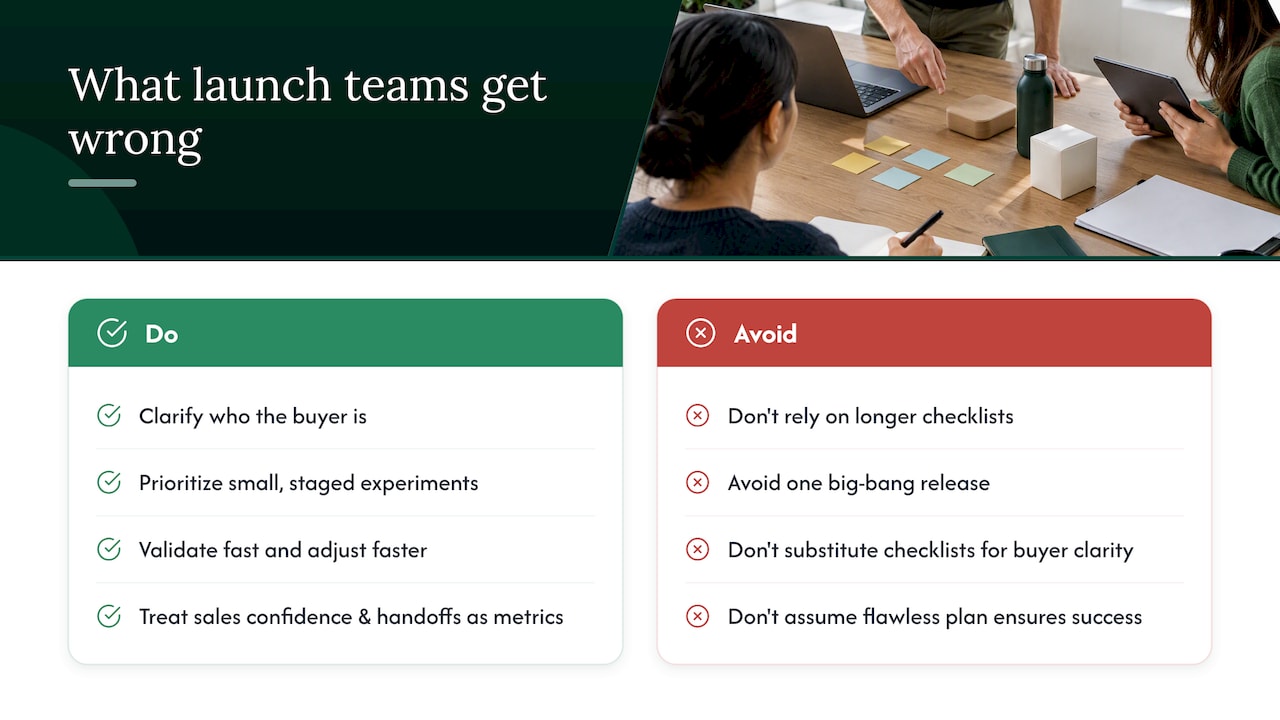
The instinct to build a longer, more detailed launch checklist is usually the wrong instinct. Runways are shorter, pricing is increasingly usage-based, and revenue now depends on adoption more than on signed contracts, which means the launches that win are the ones that validate fast and adjust faster, not the ones with the most exhaustive plan.
Stop treating a fifty-item checklist as a substitute for clarity on who the buyer is. Prioritize small, staged experiments over one big-bang release, and treat sales confidence and handoff completeness as real success metrics, not soft ones. A launch plan can be flawless and still fail if the team executing it was never truly aligned.
— Quincy
Where Quincy Samycia fits into your launch
If your launch strategy keeps stalling on positioning that shifts depending on who’s in the room, that’s an alignment problem, not a tactics problem. Quincy Samycia works with founders, executive teams, and marketing leaders to connect brand strategy directly to go-to-market execution, so positioning, messaging, and sales enablement come from the same source instead of three different ones.
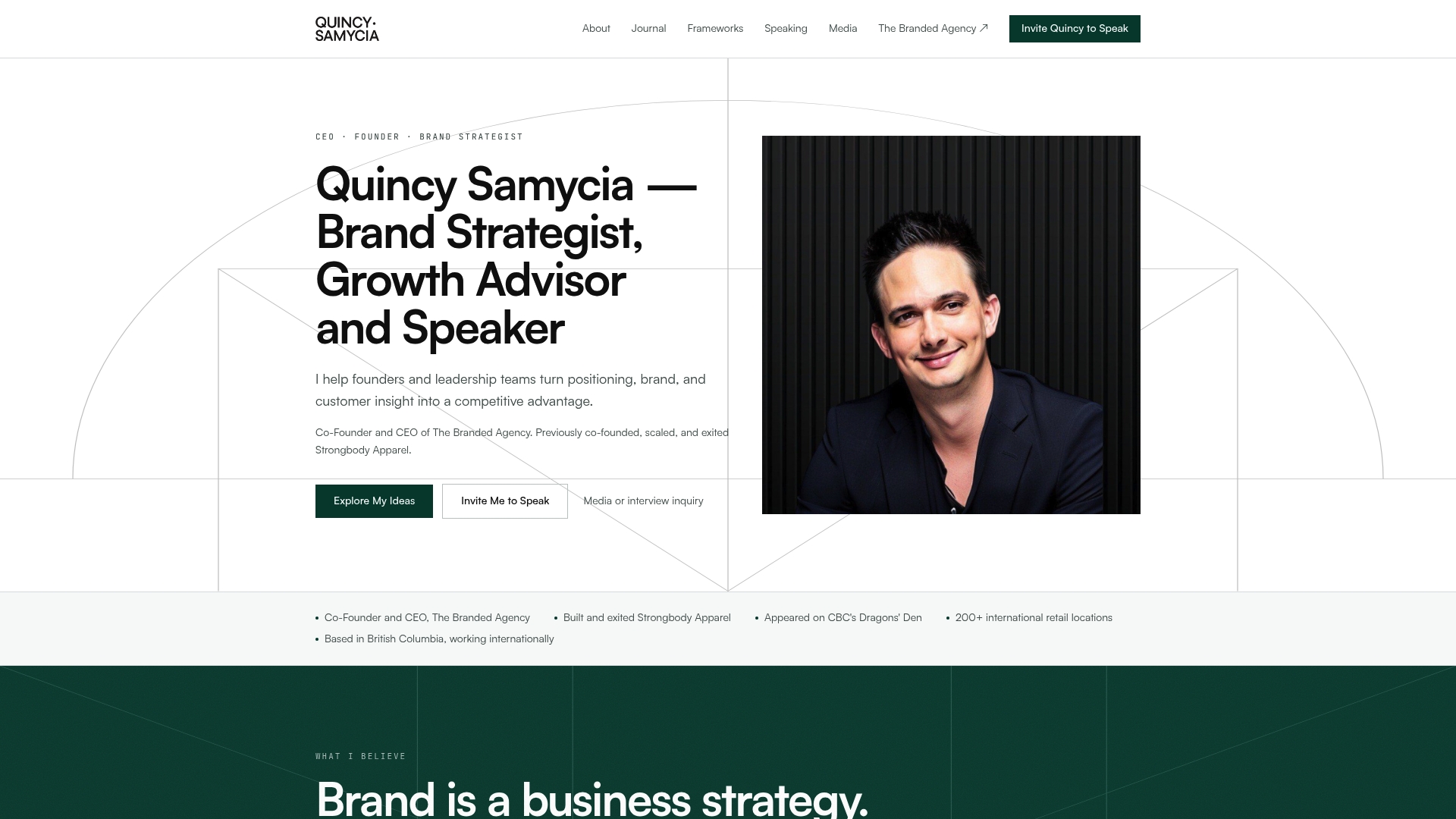
Engagements range from focused workshops that align a leadership team around one launch, to advisory retainers that carry a strategy through multiple launch cycles. Services include Brand Strategy, Brand Positioning, Growth and Go-to-Market Strategy, Customer Experience, and Founder and Executive Advisory, each built around the Golden Spiral™ and Brand-Backed Performance™ frameworks described on the frameworks page. Details about pricing for engagements are available on the client’s website.
Visit Quincysamycia to book a consultation and get your next launch aligned before the clock starts running.
Sources
- The GTM Strategy Playbook: Launch, Scale, and Dominate - Salesforce
- Forrester research on connected GTM
- The 5-lens framework for launch readiness - Product Marketing Alliance
FAQ
What is a product launch strategy?
A product launch strategy is the set of decisions about target buyer, positioning, go-to-market motion, and success metrics that guides everything a company does to bring a new product to market. It comes before the launch plan, which handles execution details like dates and task owners.
What is the difference between a launch strategy and a launch plan?
A launch strategy defines who you’re selling to, what problem you solve, and how you’ll measure success. A launch plan is the operational calendar, task list, and asset checklist built to execute that strategy.
Why do product launches fail?
Poor go-to-market execution, not lack of product-market fit, is a major driver of startup failure according to Salesforce’s GTM playbook research. Misaligned teams, skipped validation, and unclear ownership tend to cause more damage than any single tactical mistake.
What metrics should you track after a product launch?
Track activation rate and time to first value in the first weeks, then retention and revenue as medium-term indicators of whether the launch is working. Sales confidence and handoff completeness are also useful leading indicators of execution quality.
How long should a product launch take to plan?
Timelines vary by product complexity and GTM motion, but most teams work backward from the launch date through beta testing, message validation, and enablement prep. Product Marketing Alliance’s 2026 guidance recommends shorter, staged validation cycles over long, single-shot planning windows given compressed runways.