Protect Revenue: Leaders’ Rebrand Checklist With Owners, Risk, KPIs
A complete rebrand checklist covers strategy, legal clearance, identity systems, asset inventory, rollout sequencing, and post-launch measurement. Before touching a logo, run a brand audit to decide whether you need a refresh or a full rebrand. Budget both creative fees and operational rollout costs, expect anywhere from four weeks to eighteen months depending on scope, and treat measurement as a discipline that starts on launch day, not three months later.
TL;DR:
- A rebrand should be driven by strategic reasons such as market repositioning, mergers, or negative perception, not just aesthetic desires.
- Budget allocation must consider both creative work and significantly higher rollout costs, which can extend the timeline to 18 months or more.
- Preparing involves a comprehensive audit, clear goals, and governance structure, with legal clearance and stakeholder approval set before design begins.
- Rollout sequencing depends on risk, with phased, big-bang, or hybrid models, requiring thorough testing and real-time monitoring to prevent disruptions.
- Success measurement relies on tracking specific business metrics like search demand, conversion, and customer sentiment over a 90-day period, with rapid triage for any issues.
Table of Contents
- When Should a Business Rebrand?
- What Are the Different Levels of Rebranding?
- How Do You Prepare for a Rebrand Before Starting?
- The Core Rebrand Checklist: What to Update and Who Owns It
- How Do You Sequence a Rebrand Launch?
- How Do You Measure a Rebrand’s Success?
- Turning the Checklist Into a Program, Not a Project
- Executive Perspective: The Tradeoffs Nobody Names Out Loud
- How Quincy Samycia Helps Leadership Teams Execute a Rebrand
- Sources
- FAQ
When Should a Business Rebrand?
A rebrand earns its budget when there’s a real strategic driver behind it, not when leadership gets tired of the logo. The most common triggers are repositioning after a shift in target market, a merger or acquisition that forces two identities into one, consistently poor brand perception showing up in sales conversations, or a product mix that has outgrown the name you launched with.
The risk isn’t the rebrand itself. It’s doing one without a strategy underneath it. Companies that jump straight to a new logo lose brand recognition they spent years building, and they almost always underestimate what rollout actually costs. Gartner’s 2023 survey found A majority of CMOs said they lacked sufficient budget to fully execute their marketing strategy that year. A rebrand without a funded rollout plan is one of the fastest ways to land in that statistic.
Before committing, run this decision filter:
- Is the core business model changing, or just how it looks? That distinguishes a refresh from an evolution.
- Did the audit reveal confusion in the market, or just internal boredom with the visual identity?
- Can legal, sales, and product all execute the new brand on the same timeline?
- Is there a funded budget for rollout, not just for design?
If the answers point to a deeper problem than aesthetics, you’re likely looking at a restage or full rebrand, not a refresh.
What Are the Different Levels of Rebranding?
Rebrands come in four intensities, and picking the wrong one wastes both time and money. A refresh updates visual details, colors, typography, minor logo tweaks, without touching positioning. An evolution adjusts messaging and identity together but keeps the core name and market position intact. A restage repositions the brand for a new audience or category while often keeping the name. A full rebrand changes name, identity, and positioning simultaneously, the kind of move that follows a merger or a total business model shift.
Timelines and cost scale with intensity. According to Digital Polo’s rebranding guide, a refresh can take about four weeks, while a full rebrand often runs 9 to 18 months or longer. Cost ranges swing from roughly $5,000 for a light refresh to $5 million or more for enterprise-scale full rebrands.
Here’s the part most leadership teams miss:
- Creative fees are usually the smaller line item.
- Rollout, updating signage, contracts, software, packaging, partner listings, routinely costs more than the design work itself.
- Rollout costs can significantly increase the total program budget well beyond what the creative agency quoted.
Budget accordingly, or the finance team will find out the hard way in month four.
How Do You Prepare for a Rebrand Before Starting?
Skipping the prep phase is how rebrands turn into expensive redesigns with no strategic payoff. Frontify’s rebranding guide is blunt about this: a disciplined process starts with strategy and an audit, not identity work. Treating the logo as the project instead of the outcome is a leading cause of rebrand failure.
Three things need to happen before a single design concept gets approved:
- Run a full brand audit. Inventory every existing asset, pull analytics on current brand search volume and site traffic, gather sentiment data from support tickets and reviews, and talk to actual customers about how they perceive you today.
- Set measurable goals and real constraints. Three to five goals tied to business outcomes, revenue, conversion, retention, work better than vague aesthetic ambitions. Lock the budget and timeline now, before scope creep sets in.
- Establish governance. Name a single executive sponsor, a project owner who runs day-to-day decisions, a defined list of contributors, and a short approval chain. A RACI matrix (who’s Responsible, Accountable, Consulted, Informed) prevents the classic rebrand trap: everyone weighing in, nobody deciding.
Pro Tip: Set a hard rule that the sponsor gets final say on subjective calls, like color or tone, within a 48 hour decision window. Endless design committee debates are the single biggest timeline killer in rebrand projects.
Get this phase right, and every downstream decision, including how executive tradeoffs shape repositioning, gets easier to defend.
The Core Rebrand Checklist: What to Update and Who Owns It
This is the operational spine of the project, the list that turns strategy into shipped work. Organize it by category, assign an owner to each line, and sequence by risk: customer-facing, revenue-critical items go first.
1. Name and legal clearance
- Run a domain availability search across primary and defensive TLDs.
- Secure social handles before any public signal leaks.
- Clear trademark availability in every market you operate in, ideally before design work locks.
- Notify legal counsel to handle contracts, licensing agreements, and any regulatory filings tied to the name.
- Plan a two-stage announcement: a private heads-up to key partners and customers first, then the public reveal, with clear “what changed and why” messaging that protects the recognition equity you’ve already built.
2. Strategy and messaging
- Finalize the positioning statement and the three to five brand pillars that support it.
- Document proof points, real evidence backing each pillar claim.
- Build message architecture tailored to each audience: customers, investors, employees, partners.
3. Visual identity
- Develop the logo suite: primary mark, secondary mark, icon, favicon.
- Lock the color palette and typography system.
- Build iconography and imagery guidelines, plus motion principles if video or app animation is in scope.
- Run accessibility checks on contrast ratios and font legibility.
4. Guidelines and templates
- Centralize everything in one brand manual, not a PDF buried in someone’s inbox.
- Lock templates for decks, proposals, and social posts so teams can’t quietly revert to old assets.
- Build a component library and design tokens if you’re managing a digital product.
- Cloud-based brand management platforms reduce the odds of someone using a retired logo six months post-launch.
5. Digital assets
- Update every page of website content, then map redirects and canonical URLs so search equity doesn’t evaporate.
- Rebuild SEO mappings for renamed pages and products.
- Update app icons, email templates, and every analytics or tagging script tied to the old brand name.
6. Operational assets
- Reprint packaging and signage.
- Amend contracts, internal documentation, and business systems, CRM fields, invoice templates, everything with the old name baked in.
7. Third-party listings and partners
- Update marketplace listings and directory profiles.
- Renegotiate co-branding language in reseller and partner agreements.
Pro Tip: Prioritize by risk of customer confusion first. Website, billing systems, product UI, and app store listings go before internal templates or archived reports, every time. A checklist template, like the editable rebrand checklist from IntelligenceBank, helps track ownership and approval status across dozens of moving items without losing anything in a spreadsheet.
How Do You Sequence a Rebrand Launch?
Three rollout models exist, and the right one depends on how much risk you can absorb. A phased rollout updates high-visibility assets first, website, product UI, then works through lower-priority collateral over weeks or months, good for companies that can’t afford downtime. A big-bang rollout flips everything simultaneously on launch day, which creates maximum impact but leaves zero room for error. A hybrid model launches core brand assets, name, logo, primary messaging, all at once, while operational assets like signage and packaging catch up over the following weeks.
Before launch day, work through this final check:
- QA every updated asset against the brand guidelines.
- Confirm redirects resolve correctly and no 404s slipped through.
- Get legal sign-off on trademark and contract language.
- Train frontline staff and support teams on new terminology and talking points.
- Distribute the media kit to press and partners ahead of the public announcement.
On launch day itself, monitor site traffic, support ticket volume, and social mentions in real time. Set rollback triggers in advance, a broken checkout flow or a legal challenge to the name are the kind of issues that justify pausing the public rollout, not pushing through.
After launch, keep a defined monitoring cadence: a 2 week check on immediate technical issues, a 30 day review of customer sentiment and search performance, and a 90 day assessment of whether the new brand is actually moving the metrics you set back in the goal-setting phase.

How Do You Measure a Rebrand’s Success?
Track brand awareness, branded search demand, direct traffic, conversion rates, customer sentiment, churn, and pipeline quality. These seven metrics tell you whether the rebrand is working commercially, not just whether people like the new colors.
Set a reporting cadence and stick to it: check in at 2 weeks for technical and traffic anomalies, 30 days for early sentiment and search signal, 90 days for conversion and retention trends, and 6 months for the real verdict on whether pipeline quality improved. Tying goals to revenue, conversion, and retention instead of pure aesthetics is what separates a rebrand that pays for itself from one that just looks nice in a case study deck.
When something breaks, triage fast. Messaging confusion shows up in support tickets and sales call notes within the first two weeks. SEO traffic drops usually trace back to bad redirects or missed canonical tags, fixable within days if caught early. Operational mismatches, a sales deck still referencing the old name, get flagged by employees before customers ever notice, if you’ve built a feedback channel for it. Fix the highest-revenue-risk issue first, always.
Turning the Checklist Into a Program, Not a Project
A checklist tells you what to do. It doesn’t tell you what order matters most for your specific business, and that’s where most in-house teams get stuck. The Golden Spiral™ framework maps the checklist phases, audit, strategy, identity, rollout, measurement, into a sequence built around compounding clarity rather than a flat task list.
Brand-Backed Performance™ takes it further by tying each phase to a measurable business outcome, not just a design deliverable.
- Score every checklist item against two axes: customer-facing risk and revenue impact.
- Convert the highest-scoring items into Phase 1, assign an owner, and set a KPI before work starts.
- Push low-risk, low-visibility items, internal templates, archived documents, into later phases without guilt.
With more than 200 international retail locations built on this methodology, the pattern holds: teams that sequence by business impact finish rebrands faster and with fewer post-launch fires than teams working straight down an unranked checklist.
Executive Perspective: The Tradeoffs Nobody Names Out Loud
Every rebrand forces three tradeoffs leaders rarely say out loud: speed versus scale, brand equity versus differentiation, operations budget versus creative budget. Naming them early prevents them from becoming political fights in month three.
Governance is simple in theory and constantly ignored in practice. One sponsor. One decision window. Hard stops on scope creep. Most rebrand failures I see trace back to a missing sponsor or an approval chain nobody actually enforced, not a bad logo.
— Quincy
How Quincy Samycia Helps Leadership Teams Execute a Rebrand
A checklist gets you organized. Alignment across product, marketing, and sales is what gets you through it without losing momentum, or revenue, along the way. Quincy Samycia works with leadership teams on the strategy layer that sits underneath every item on this list: positioning audits, rollout sequencing, and executive workshops that force the tradeoff conversations before they turn into mid-project fights.
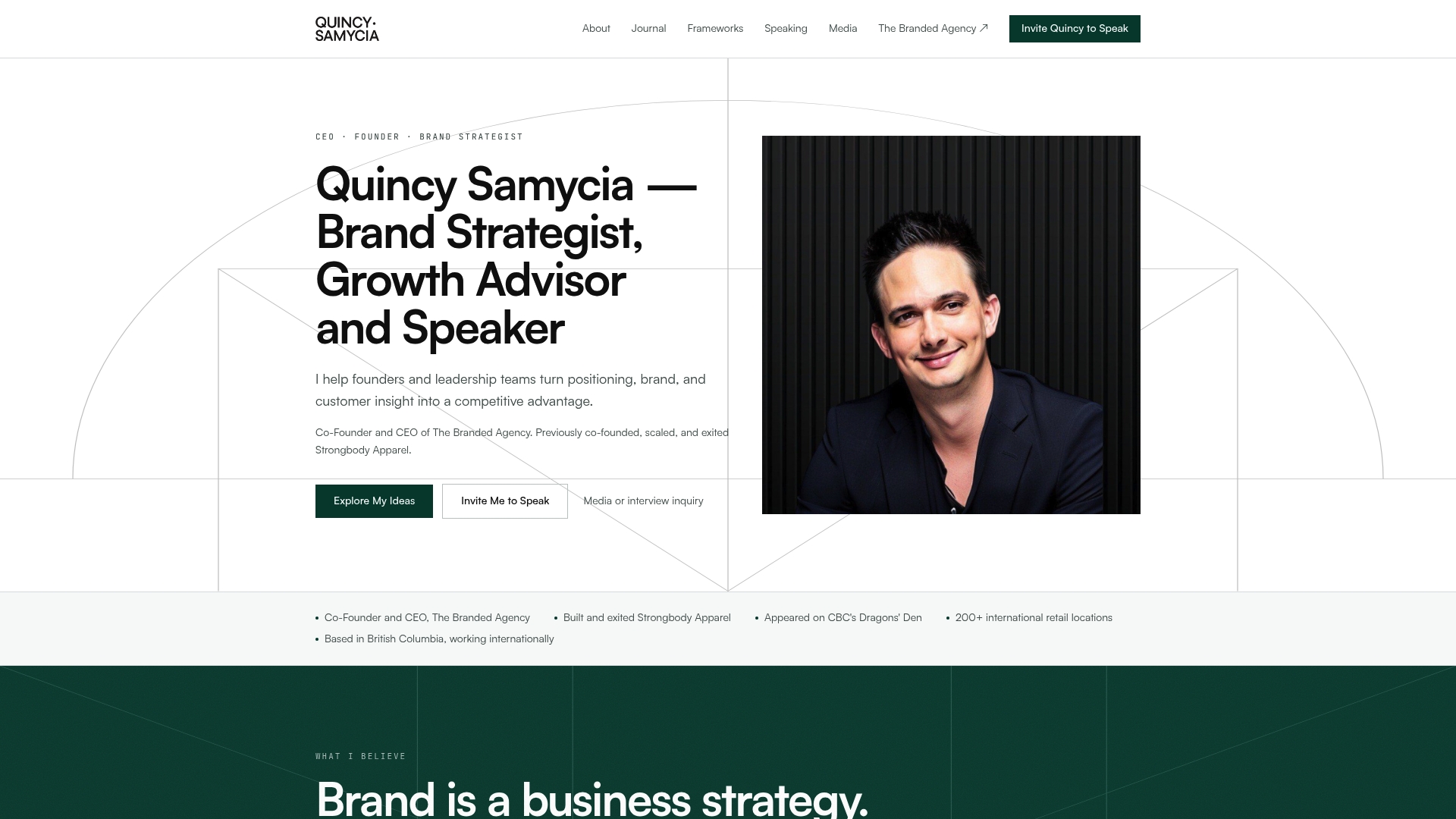
The outcome isn’t a prettier logo. It’s a prioritized rollout plan with KPIs attached to each phase, and a leadership team that agrees on what “done” actually means. If your team is deciding between a refresh and a full rebrand, or stuck on how to sequence sixty checklist items into something a project manager can run, the Brand Strategy Frameworks page breaks down how The Golden Spiral™ and Brand-Backed Performance™ turn this checklist into a phased program. For leadership teams that want the tradeoff conversation facilitated live, book a workshop or speaking engagement before the project kicks off, not after it stalls.
Sources
A few resources are worth bookmarking before you start assigning owners to checklist items:
- Gartner press release: 71% of CMOs believe they lack sufficient budget (2023)
- Rebranding Guide: When to Rebrand, How to Do It, What It Costs (2026) — Digital Polo Blog
- Frontify: Rebranding guide (2025)
- IntelligenceBank: Rebrand checklist template (2024)
FAQ
What Are the 5 C’s of Branding?
Definitions vary slightly by source, but the common version covers Company, Customer, Competitors, Collaborators, and Climate, the five forces a positioning audit needs to account for before locking a strategy. Running through each “C” during your brand audit phase surfaces most of the risks a rebrand checklist is designed to catch.
What Is the 3-7-27 Rule in Branding?
This rule holds that a brand impression forms in roughly 3 seconds, gets reinforced over about 7 touchpoints, and solidifies fully after multiple interactions. It’s a useful mental model for why rebrand rollout sequencing matters: a rushed, inconsistent rollout resets that trust-building clock instead of carrying equity forward.
What Are the 7 Pillars of Branding?
Most versions of this list include purpose, positioning, personality, perception, promise, product, and people, the human and strategic layers that sit above visual identity. A rebrand checklist should map to these pillars directly, since updating a logo without addressing purpose or positioning is what turns a rebrand into a surface-level redesign.
What Are the Key Elements of a Rebrand?
The key elements are strategy and positioning, legal and name clearance, visual identity, brand guidelines, digital and physical asset updates, a sequenced rollout plan, and post-launch measurement. Skipping any one of these, especially legal clearance or measurement, is where most rebrand budgets quietly overrun.
How Long Does a Full Rebrand Typically Take?
A full rebrand, one that changes name, identity, and positioning together, typically runs 9 to 18 months or longer, depending on organizational size and how many markets are affected. Lighter rebrand types move faster: a simple refresh can wrap in about four weeks.
Does Quincy Samycia Help With the Full Rebrand Process?
Yes. Quincy Samycia works with leadership teams on the strategy, governance, and rollout sequencing layers of a rebrand, using frameworks like The Golden Spiral™ and Brand-Backed Performance™ to turn checklist items into a phased, KPI-driven program.