
Revenue Team Alignment: A Practical Guide for B2B Leaders
Revenue team alignment means sales, marketing, customer success and RevOps work from the same goals, the same definitions and the same data, so that no team wins at the expense of the company. You get there in four moves: agree on one revenue plan, define the customer lifecycle in shared terms, design the handoffs between teams, and review a small set of joint metrics on a fixed rhythm. The rest of this guide shows how, and what to measure to know it is working.
TL;DR
- Alignment is a leadership decision about goals, definitions and accountability. It is not a team-building exercise or a tool purchase.
- Start with one operating plan for revenue. Marketing, sales and customer success goals should all trace back to it.
- Agree on lifecycle definitions (ideal customer, qualified lead, handoff criteria) and write them down as service-level agreements.
- RevOps is the connective layer for data, process and reporting. It works only when leaders give it the authority to set standards.
- Measure shared outcomes: pipeline quality, sales cycle length, win rate and retention, not each team’s activity counts.
Table of Contents
- What revenue team alignment actually means
- Why misalignment happens in the first place
- Who should be in the room
- A five-step plan to align your revenue teams
- Where RevOps fits
- How to tell if alignment is working
- Perspective: alignment starts with positioning
- Work with us on alignment
- Common mistakes to avoid
- A 90-day starting point
- FAQ
- Sources
What revenue team alignment actually means
Most companies already have a sales team, a marketing team and a customer success team. Each is busy and each has numbers to hit. The trouble starts when those numbers do not add up to the same result. Marketing celebrates lead volume while sales complains the leads are weak. Sales closes deals with customers who are a poor fit, and customer success inherits the churn.
Revenue team alignment is the strategic coordination of sales, marketing and RevOps toward unified goals, using shared processes and data. One B2B framework describes the payoff as less friction and more accountability, and describes the failure mode well: without alignment, teams optimize locally for departmental credit instead of contributing to the overall revenue engine.
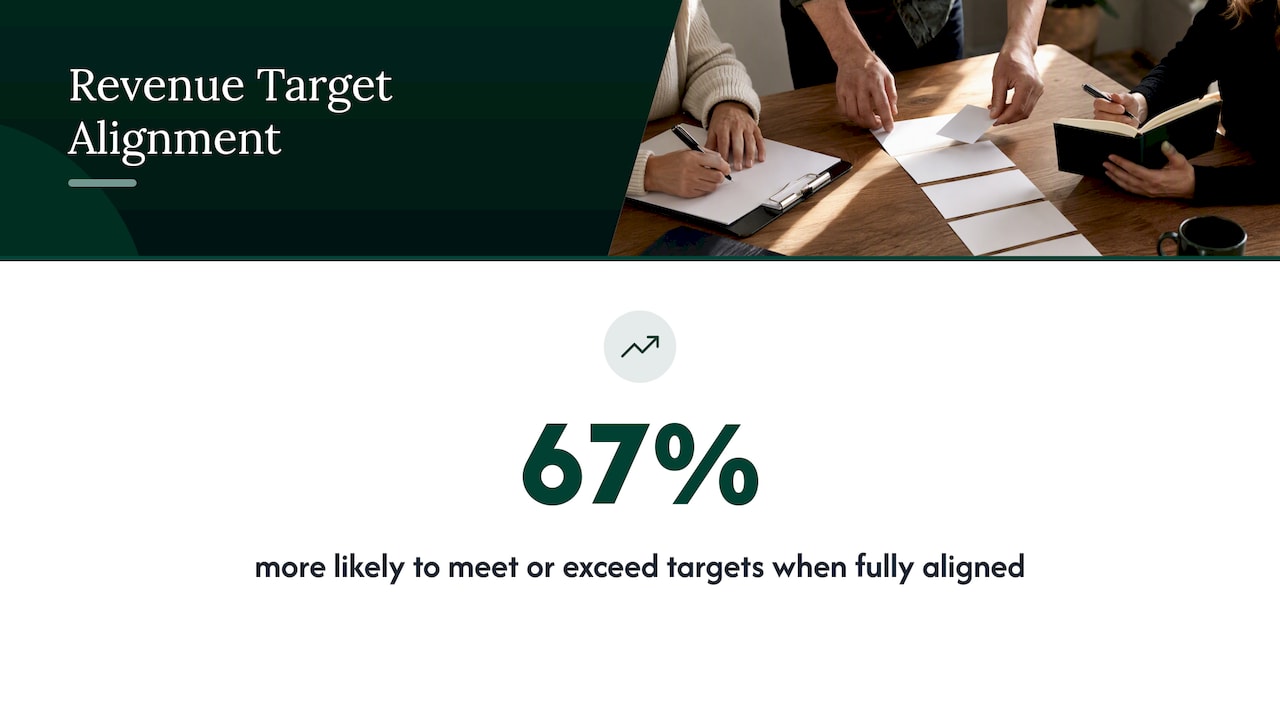
The commercial case is consistent across sources. A Forbes Communications Council piece argues that revenue alignment reduces friction and raises ROI by moving teams from siloed efforts to working in lockstep. A 2025 Crossbeam and Pavilion report found that teams reporting full alignment across functions are 67% more likely to meet or exceed revenue targets than misaligned ones.
Notice what this is not. It is not a monthly sales and marketing lunch. It is not a shared Slack channel. Those can help, but alignment is real only when the teams share targets, share definitions and are held jointly accountable for the same outcome.
Why misalignment happens in the first place
Misalignment is rarely a people problem. It is a structural one, and it usually has four causes.
Different scoreboards. Marketing is paid on leads or marketing-qualified pipeline, sales on closed revenue, customer success on renewals. Each is rational. Together they create three versions of success.
Different vocabulary. Ask three leaders what a “qualified lead” is and you may get three answers. When the definition is not written down, every handoff becomes an argument.
Different data. Each team trusts its own system. Reports do not reconcile, so meetings turn into debates about whose number is right.
Different customers in mind. Marketing targets a broad audience, sales chases whoever will sign, and the product is built for a third group. This is a positioning problem as much as an operations problem, and it is the one most RevOps programs never touch. We come back to it in our perspective below.
Forrester describes the customer side of this: buyers expect a consistent experience, but many teams treat the customer like a baton passed between departments instead of engaging them in a unified way. Your buyer feels every seam in your organization chart.
Who should be in the room
A workable alignment group includes the leaders of RevOps, sales and marketing, with representation from customer success, partnerships and product. Union Square Consulting suggests formalizing this as a Pipeline Council: go-to-market leaders from sales, marketing, customer success and RevOps who meet weekly or every other week to manage pipeline together.
Two points about who sits where:
- Seniority matters. Highspot’s guidance is that B2B go-to-market teams need to be empowered by senior leaders to define ownership, data standards, operating routines and shared measures. If the group has no authority to change compensation, systems or process, it will produce slides and nothing else.
- Product belongs in the conversation. Alignment that stops at sales and marketing misses the biggest driver of customer experience. If the people who build the product never see win and loss patterns, the company keeps selling something slightly different from what it makes.
A five-step plan to align your revenue teams
Step 1: Set one revenue plan
Revenue goals should come from an operating plan set by company leaders. In the model described in a go-to-market playbook from Clari and Drift, operations works with finance to build a master document that becomes the basis for marketing, sales and customer success goals for the year.
The practical test: can each team lead point to the line in the master plan that their own target comes from? If marketing’s goal and sales’ goal were set in separate planning cycles, they probably do not reconcile.
Step 2: Agree on the customer and the lifecycle
Write down, in plain language, the following:
- Ideal customer profile. Who you win with, keep and grow. Use real data on retention and expansion, not aspirations.
- Lifecycle stages. What makes someone a lead, a qualified opportunity, a customer and an expansion candidate.
- Entry and exit criteria for each stage, with an owner.
Shared definitions are the most common first fix. A published guide on lead qualification frameworks covers how qualification criteria, CRM fields and KPIs shift with deal size, which is a useful lens when you decide how strict your own stage gates should be.
A similar point holds for pipeline stages. If your deals live in a CRM, stage design for service business deals offers five criteria for what a stage should mean, which helps keep stages tied to buyer actions and not to rep opinion.
Customer segmentation is often the missing input here. Our piece on a customer segmentation framework for CMOs shows how to link brand choices to the segments sales actually closes.
Step 3: Tie incentives to the same outcome
Incentives are where alignment becomes real. A 2022 article in the Journal of Applied Analytics on revenue operations cites Avaya, where aligning incentives and KPIs with overall objectives was judged extremely important to hitting growth goals. The same article describes how iCIMS CEO Steve Lucas enforced revenue discipline by paying 20% higher commissions for engaging ideal customers and 20% lower for less-than-ideal ones.
You do not have to copy that structure. The principle is what transfers: if the comp plan rewards any closed deal, no definition of an ideal customer will survive contact with quota.
Step 4: Design the handoffs
The moments where a customer passes from one team to another are where revenue leaks. Gartner’s RevOps guide says teams coordinate by designing cross-functional workflows, integrating systems to automate processes, and supporting handoffs with service-level agreements.
A useful handoff agreement covers:
| Handoff | What the sending team commits to | What the receiving team commits to |
|---|---|---|
| Marketing to sales | Leads that meet the written qualification criteria, with source and engagement context | Follow-up within an agreed time, and a disposition reason on every lead |
| Sales to customer success | Deal context: why the customer bought, promises made, stakeholders, success criteria | A kickoff on a set timeline and feedback on any mismatch between sold and delivered |
| Customer success to sales or marketing | Expansion signals, references, usage insight | Follow-up on signals, and credit shared in reporting |
| All teams to product | Patterns in objections, losses and churn | A visible response on what is changing and what is not |
We go deeper on the mechanics in our article on turning brand clarity into revenue with a sales and marketing SLA. For the customer side of the handoff, see our view on making B2B customer experience a revenue discipline.
Highspot’s point about the execution phase is worth adding: clear handoffs need accountability checks, meaning someone reviews whether the agreement is being kept, not only whether it exists.
Step 5: Set a review rhythm
Pick a cadence and hold it. A weekly or biweekly pipeline review with all go-to-market leaders, a monthly review of lifecycle conversion and handoff quality, and a quarterly look at ICP, segmentation and the comp plan is enough for most B2B companies. Keep each meeting on one shared dashboard, not on four separate decks.
Where RevOps fits
Revenue operations is the function that keeps the agreements above running. Salesforce describes RevOps as a strategic framework that brings marketing, sales, customer success and finance under one umbrella to drive growth, and as the glue that prevents data silos so decisions can rest on shared information. Put plainly, RevOps owns the plumbing: the data model, the lifecycle stages in the CRM, the reporting definitions and the process documentation.
Gartner recommends designing infrastructure around a communal dataset, defining the critical data sources and workflows for end-to-end customer engagement. BCG adds that centralization makes it easier to standardize reporting and metrics.
The structure can evolve. According to Salesforce’s guidance on building a first RevOps team, it can start as individual operations leaders working together and grow into a centralized team reporting to a CRO, CFO or COO. Smaller companies should not wait for a full department. A single owner for definitions and reporting, with a mandate from the CEO, delivers most of the early benefit.
Two cautions about RevOps in practice:
- Tools do not create alignment. A shared CRM with three different definitions of “opportunity” is a shared mess. Fix definitions first, then configure the system.
- RevOps needs a customer anchor. If the function only optimizes process, it can make a poorly positioned offer move faster through the funnel. Pair it with clear positioning and customer research. Our guide to B2B customer research methods that change decisions is a good starting place.
How to tell if alignment is working
Pick shared measures that reflect company objectives, not departmental activity. The Crossbeam and Pavilion report links alignment with meeting revenue targets and shorter sales cycles, which gives you two outcome measures to watch.
A compact scorecard for leadership:
| Measure | What it tells you | Owner |
|---|---|---|
| Pipeline created from ICP accounts (share of total) | Whether targeting matches the agreed customer | Marketing and sales |
| Lead-to-opportunity conversion by source | Whether qualification criteria are real | Marketing and RevOps |
| Sales cycle length | Whether deals move without friction | Sales |
| Win rate by segment | Whether you are strongest where you claim to be | Sales and product |
| Time to first value after close | Whether the handoff is working | Customer success |
| Net revenue retention | Whether you win the right customers | Whole leadership team |
Funnel integration can pay off at scale. BCG reported in 2020 that companies prioritizing end-to-end funnel integration achieved up to 200% increases in digital marketing ROI, and that top B2B technology companies reported 10% to 20% gains in sales productivity and 30% lower go-to-market expenses from RevOps. Treat these as results from leading companies, not as a forecast for yours. Your own baseline, measured before you change anything, is the right yardstick.
Also run a qualitative check each quarter. Review a dozen recent wins and losses. Win-loss analysis is the fastest way to find out whether marketing’s promise, sales’ pitch and the delivered product line up, and it gives the council one concrete change to ship.
Perspective: alignment starts with positioning
We have worked on brand and growth with organizations across more than 200 international retail locations, and one pattern repeats. Teams are rarely misaligned because they do not communicate. They are misaligned because they were never given one clear answer to the question: who are we for, and why do we win?
When positioning is vague, marketing writes to one audience, sales sells to another, and product builds for a third. Adding meetings and dashboards on top of that gives you faster confusion. That is why we treat brand as a core business strategy and not a marketing task. Positioning is the shared reference that every handoff, every definition and every metric should trace back to.
Our approach is built to connect that positioning to product, marketing and sales through iterative frameworks, so the result is measurable performance and a better customer experience, not a deck. Our operator’s perspective, shaped by building brands and by exit experience, shows up in one habit: we ask what changes in the numbers, and who owns that change.
If your revenue teams keep arguing about lead quality, ideal customers or whose number is right, start with positioning, then build the operating model around it.
Quincy
Work with us on alignment
If you recognize your company in the misalignment patterns above, we can help you connect brand positioning, go-to-market strategy and customer experience to the way your sales, marketing and customer success teams operate. Our work covers brand strategy, positioning, growth and go-to-market strategy, customer experience and founder and executive advisory.
See how we work on the brand strategy and growth advisory page, or explore the brand strategy frameworks we use to tie positioning to performance. If you want an outside voice for your leadership offsite, there is also our speaking offer.
Common mistakes to avoid
- Starting with technology. Buying a platform before agreeing on definitions cements the confusion in software.
- Aligning only sales and marketing. Customer success holds the retention and expansion data that should shape your ideal customer profile.
- Treating alignment as a one-time project. Markets, products and buyers change, so definitions and agreements need a scheduled review.
- Skipping the revenue mix question. Not all revenue is equally valuable. We explain why in why revenue mix should be an executive growth decision.
- Keeping brand and performance separate. When brand metrics and performance marketing metrics sit in different reports, teams optimize different things. A one-page KPI map linking brand and performance marketing is a simple fix.
A 90-day starting point
You do not need a transformation program. A reasonable first quarter looks like this:
- Weeks 1 to 2: Name an executive sponsor and form the council. Gather current definitions of ideal customer, lead and opportunity from each team and compare them.
- Weeks 3 to 5: Agree on one set of definitions and one master revenue plan. Pull the last year of wins, losses and churn to check the ICP against evidence.
- Weeks 6 to 8: Write the handoff agreements, with response times and required information, and configure the CRM to match.
- Weeks 9 to 12: Launch the shared dashboard and review rhythm. Run a first win-loss review and choose one change to ship.
At the end of 90 days, compare your baseline metrics with the new numbers, and decide what the comp plan needs to change next.
FAQ
What is the difference between revenue team alignment and sales and marketing alignment?
Sales and marketing alignment covers two teams and one handoff. Revenue team alignment widens it to customer success, partnerships, product and RevOps, and covers the whole lifecycle from first touch to renewal and expansion. Most companies get more from the wider view because retention and expansion shape who the ideal customer really is.
How does revenue operations alignment help?
Revenue operations connects people, data and processes so every team sees a consistent, real-time view of the business, according to the Clari and Drift playbook. In practice it owns shared definitions, the data model and reporting. It works best when leaders give it authority to set those standards.
Who should own revenue team alignment?
The CEO or a senior executive should sponsor it, because it touches goals, compensation and systems that no single department controls. Day to day, RevOps or a named operations lead runs the standards and the meeting rhythm, while the go-to-market leaders stay jointly accountable for the results.
How long does it take to see results?
Definitions and handoff agreements can be in place within a quarter. Outcome metrics such as sales cycle length, win rate and retention move more slowly, since they depend on deal cycles. Measure your baseline first so you can see the change when it arrives.
Sources
- Revenue Team Alignment: B2B Framework, Abmatic AI
- Revenue Alignment: How Sales And Marketing Can Drive Growth Together, Forbes
- The Future of Revenue, Crossbeam and Pavilion, 2025
- Revenue Operations Is The Key To Winning Today’s B2B Adventure Race, Forrester
- Create Strategic Alignment with a Pipeline Council, Union Square Consulting
- How to Set Your B2B Go-To-Market Team Up for Success, Highspot
- The Go-to-Market Playbook for Revenue Teams, Clari and Drift
- Revenue Operations: A Systems Approach, Journal of Applied Analytics
- Revving Up Go-to-Market Operations in B2B, BCG
- RevOps Guide: Implementation, Gartner
- What Is Revenue Operations (RevOps)?, Salesforce
- The Right Way to Build Your First RevOps Team, Salesforce
- Lead Qualification Frameworks for B2B
- Pipeline Stage Design: 5 Criteria for Service Business Deals