Value Proposition Examples: 6 Patterns, Templates, and How to Test Them
A value proposition names your customer, states the exact outcome they get, and says what makes that outcome different from every other option. If you’re staring at a blank headline right now, start by writing one sentence: who this is for, what changes for them, and why you and not the alternative. Everything below gives you templates, real examples, and a way to test whether your version holds up.
TL;DR:
- A strong value proposition clearly names a specific target customer, states the outcome they will get, and highlights what makes that outcome unique or faster.
- It should be concise, ideally 8 to 15 words for the headline, with a supporting sentence that includes proof or mechanism of delivery.
- Testing with real customers through interviews and A/B experiments ensures the proposition resonates and accurately reflects customer language.
- Different business types benefit from tailored proof points, such as measurable results for SaaS, speed for delivery services, or emotional identity for brands like Nike.
- Alignment across product, marketing, and sales teams on the customer profile and measurable signals is crucial for the proposition’s effectiveness and longevity.
Table of Contents
- Value Proposition Examples Start With a Definition, Not a Slogan
- How to Write a Value Proposition Step by Step
- Value Proposition Formula Templates You Can Fill In Today
- Real Value Proposition Examples Grouped by Pattern
- Common Value Proposition Mistakes and How to Fix Them
- Testing a Value Proposition Before You Commit to It
- Fill-In Value Proposition Templates by Business Type
- Why Executive Alignment Decides Whether a Proposition Sticks
- The Judgment Call Most Value Proposition Advice Skips
- When a Strategist Does This Work for You
- Sources
- FAQ
Value Proposition Examples Start With a Definition, Not a Slogan
A value proposition is a single, buyer-facing statement that answers three questions at once: who you serve, what specific outcome they get, and why that outcome beats the alternatives. It’s not the same thing as a tagline, a unique selling proposition, or a mission statement, and mixing those up is where most drafts go wrong.
A tagline is memorable but often vague on purpose (“Just Do It” doesn’t tell you what Nike sells). A unique selling proposition (USP) is narrower, usually one differentiator (“we’re the only ones with overnight delivery”). A mission statement points inward, toward company purpose and values, and it’s written for employees and investors, not customers. A value proposition sits between all three: it’s specific enough to persuade a buyer in five seconds, but broad enough to cover your whole offer.
The practical definition has three parts. First, the target customer, named specifically enough that the wrong person self-selects out. Second, the primary outcome, stated as a result, not a feature. Third, the differentiator, the reason this outcome doesn’t happen anywhere else, or happens faster, cheaper, or with less risk.
Where it lives matters as much as what it says. Your homepage headline should carry the compressed version, ideally 8 to 15 words, built to be read in under five seconds. Directly beneath it, a supporting sentence of 20 to 30 words carries the proof: the mechanism, the specific number, or the concrete deliverable that makes the headline believable. Split it this way and you avoid the two most common failures: a headline so long nobody finishes it, or a headline so abstract nobody believes it.
One more boundary worth drawing early: this is never written for internal audiences. If your value proposition mentions your company culture, your founding story, or your five-year vision, that content belongs on an About page, not in the spot where a buyer decides whether to keep reading. Save the internal language for the mission statement. Save the customer language for this.
How to Write a Value Proposition Step by Step
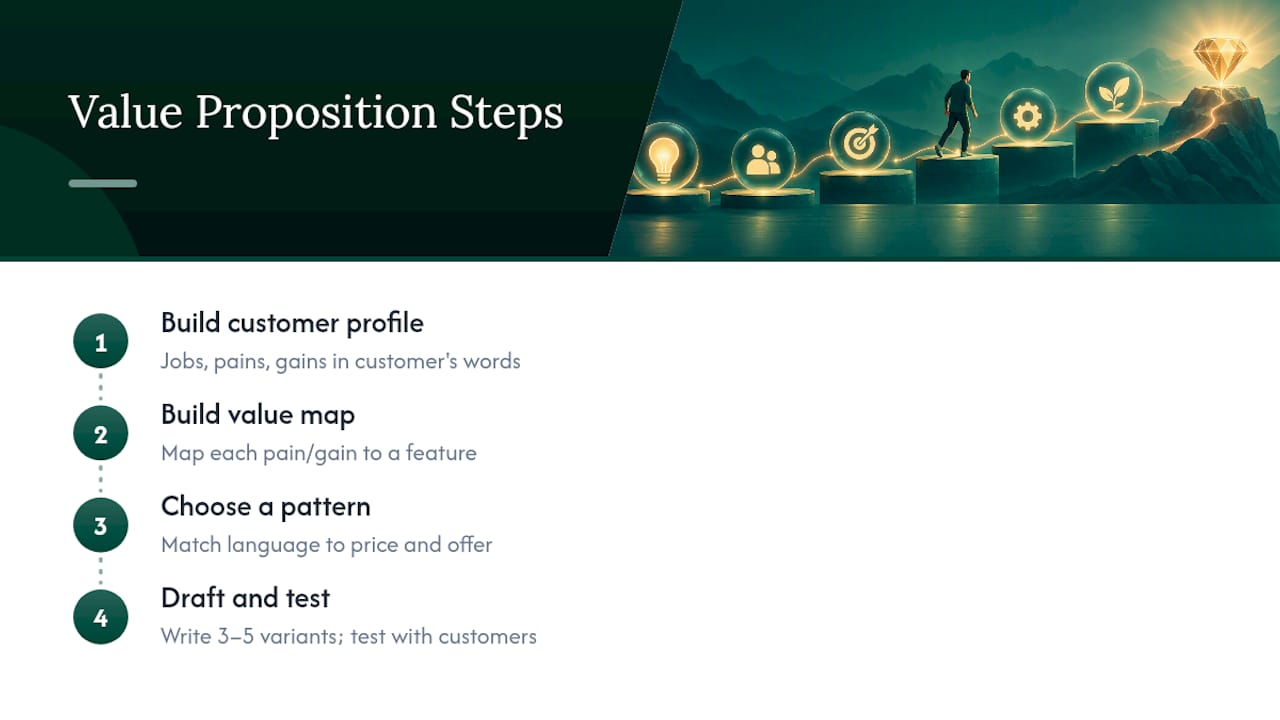
The fastest route to a proposition that actually converts runs through a four-step sequence: build a customer profile, map your value against it, pick a template, then test. Skipping the first two steps is why most drafts read like guesses.
1. Build a customer profile before you write anything. The Value Proposition Canvas from Strategyzer splits this into three buckets: jobs to be done (what the customer is actually trying to accomplish), pains (the friction, risk, or cost they’re trying to avoid), and gains (the outcomes they’re hoping for beyond the bare minimum). Write these down in the customer’s own words, not yours. If you sell project management software, the job isn’t “use software,” it’s “know whether the launch will ship on time without asking five people for a status update.”
2. Build a value map that answers each pain and gain directly. For every pain you listed, name the specific feature or process that relieves it. For every gain, name what creates it. This is where feature lists get filtered down to what actually matters. A scheduling tool might have twelve features, but if the customer’s real pain is double bookings, the value map should lead with conflict detection, not with the calendar’s color themes.
3. Choose a pattern that matches your offering and price point. Not every proposition should sound the same; sometimes, using creative styling and copy treatments can help your message stand out more effectively. A $9 monthly tool earns trust through concrete claims: number of integrations, specific time saved, a plain feature list. A $50,000 consulting engagement earns trust through aspirational, outcome-level language, because the buyer is purchasing judgment and outcomes, not a checklist. The American Marketing Association’s research on message abstraction backs this directly: match your language’s abstraction to the relative price of what you’re selling. Cheap and concrete. Expensive and aspirational, with the concrete proof living in the supporting sentence underneath.
4. Draft using a template, then test with real customers. Write three to five variants. Show them to people who match your customer profile, not your coworkers. Ask which one they’d click, and more importantly, ask them to explain what it means in their own words. If they can’t repeat it back accurately, the proposition isn’t done. This isn’t a one-time step. Strategyzer’s own guidance treats the customer profile and value map as tools you iterate against real evidence until you reach something closer to product-market fit, not a document you write once and forget.
Pro Tip: Run your draft past someone who has never seen your product and give them ten seconds. If they can’t tell you who it’s for and what changes for them, the words are working against you, not for you.
Sales teams use this same canvas structure to focus prospect conversations, tailoring the pitch to a specific buyer’s jobs, pains, and gains rather than reciting the same generic pitch to everyone. The value proposition and the sales conversation should be built from the same raw material.
Value Proposition Formula Templates You Can Fill In Today
You don’t need to invent structure from scratch. A handful of formulas have survived because they force you to include the parts that matter and cut the parts that don’t.
- Steve Blank’s XYZ formula: “We help [X] do [Y] by [Z].” It’s blunt on purpose. Fill in a specific customer, a specific outcome, and the mechanism that makes it happen. Weak version: “We help businesses grow.” Strong version: “We help early-stage founders find product-market fit by pairing customer interviews with weekly positioning sprints.”
- The classic positioning template (from Geoffrey Moore’s Crossing the Chasm): “For [target customer] who [statement of need], [product name] is a [product category] that [key benefit]. Unlike [primary competitive alternative], our product [key differentiator].” It’s longer, but it forces the comparison most drafts skip.
- Outcome + timeframe: “Get [specific result] in [specific timeframe].” Works well for tools and services where speed is the differentiator. Dropbox’s early framing leaned on this instinct: access your files from anywhere, instantly, without emailing them to yourself.
- Job-to-be-done framing: “When you need to [job], [product] lets you [outcome] without [pain].” This keeps the customer’s actual task front and center instead of your feature set.
- Proof-led template: “[Outcome], backed by [specific proof point].” Useful when you have a number worth leading with, a customer count, a time saved, a completion rate.
The choice between abstract and concrete language isn’t stylistic, it’s tied to price and complexity. The Elements of Value framework from Harvard Business Review organizes 30 distinct sources of customer value into a hierarchy, from functional basics like time savings and cost reduction up through emotional and life-changing elements like self-actualization and motivation. Higher-priced, more complex offers tend to draw on the elements higher in that hierarchy, aspiration, belonging, hope, while low-price, functional products lean on the base of the pyramid: saves time, reduces cost, avoids hassle. Neither register is better. The mismatch is what kills a proposition, when a $12 app talks like it’s changing your life, or a six-figure consulting engagement talks like a coupon.
Real Value Proposition Examples Grouped by Pattern
Strong propositions tend to fall into a handful of repeatable patterns. Studying them by pattern, instead of by industry, is what actually transfers to your own draft.
Outcome-focused. These lead with the result, not the process.
- Uber: “Tap the app, get a ride.” The outcome is the ride; the friction of hailing a cab, calling ahead, and carrying cash disappears entirely from the sentence. It works because it compresses a multi-step process into a single action the customer already understands.
- Nike: “Bring inspiration and innovation to every athlete in the world.” Nike’s proposition operates at the identity and aspiration level, not the shoe level, which tracks with the HBR framework: a premium, emotionally loaded category earns aspirational language rather than a features list.
Simplicity-focused. These lead with what’s been removed, not what’s been added.
- Grammarly: “Great writing, simplified.” Two words carry the whole pitch. It doesn’t explain grammar checking, tone detection, or plagiarism scanning in the headline, because the outcome (simplicity) matters more to the buyer than the mechanism.
- Apple: historically built around phrasing like “the experience is the product.” Apple’s propositions rarely mention specifications in the headline. The differentiator is ease and design coherence, backed by specs one layer down in the supporting copy, which is exactly the abstract-headline, concrete-support split the AMA research recommends for premium goods.
Consolidation-focused. These lead with fewer tools or steps, not more features.
- Shopify: “Everything you need to sell online.” The word “everything” is doing the consolidation work, telling a merchant they won’t need five separate vendors for payments, hosting, inventory, and checkout.
- Stripe: “Payments infrastructure for the internet.” Stripe doesn’t list features either. It positions itself as the underlying layer other builders don’t have to think about, which consolidates a messy, multi-vendor payments problem into one dependency.
Speed-focused. These lead with time saved or friction removed right now.
- Airbnb: early messaging centered on booking a place to stay faster and cheaper than a hotel, with the host relationship as the differentiator. The speed is in the booking; the differentiator is the access to spaces a hotel chain can’t offer.
- Dropbox: “Your stuff, anywhere.” The proposition isn’t about storage capacity, it’s about the friction of needing a file and not having it, solved instantly.
Risk-removal-focused. These lead with what the customer no longer has to worry about.
- Dollar Shave Club: “A great shave for a few bucks a month.” The risk being removed is overpaying and overthinking a mundane purchase. The proposition works because it names the exact frustration (razor prices, retail hassle) and closes it in one clause.
- Slack: “Where work happens.” It’s short to the point of being abstract, but the underlying risk it removes is fragmented communication across email and disconnected tools, a pain most office workers recognize immediately without needing it spelled out.
Identity-focused. These lead with who the customer becomes, not what they get.
- Nike belongs here too, differently: “every athlete” is a deliberate identity claim, not a demographic one. Anyone who runs, lifts, or plays recreationally gets invited into the word “athlete,” which widens the addressable customer far beyond competitive sports.
What transfers across every one of these examples is not the wording, it’s the structure. Each one names a specific audience (even implicitly), states one outcome, and either shows or implies why the alternative falls short. None of them try to say everything the product does. That restraint is the actual skill.
Common Value Proposition Mistakes and How to Fix Them
Most weak propositions fail for the same handful of reasons, and most of them are fixable in one editing pass.
- Vague benefit language. Words like “better,” “innovative,” or “seamless” describe nothing measurable. Fix: replace the adjective with a number, a timeframe, or a named outcome.
- A feature list disguised as a proposition. Listing what the product has instead of what changes for the buyer. Fix: for every feature, ask “so what happens for the customer,” and write that answer instead.
- An audience so broad it fits no one. “For businesses of all sizes” tells a specific buyer nothing about whether this was built for them. Fix: name the actual customer, even narrowly, “for solo consultants” beats “for professionals.”
- A headline that runs too long to scan. If it takes more than five seconds to read, most visitors won’t finish it. Fix: cut to 8 to 15 words, and move supporting detail to the sentence below it.
- Claims with no proof behind them. “The fastest” or “the most trusted” with nothing backing it up erodes trust fast. Management research on business-market propositions specifically warns against this kind of unsupported benefit assertion, recommending instead that you document performance on the few elements that matter most to the buyer.
Here are five before-and-after edits that show the fix in action:
- Before: “Innovative solutions for modern businesses.” After: “Cut invoice processing from three days to three hours.” (Replaced vague adjectives with a measurable outcome.)
- Before: “We offer a wide range of features to help you succeed.” After: “Automatically flag late invoices before they become late.” (Named one specific job instead of gesturing at many.)
- Before: “The best project management tool on the market.” After: “See every project’s real status without asking for an update.” (Removed the unsupported superlative, kept the concrete benefit.)
- Before: “Helping companies of all sizes grow their business.” After: “Built for agencies managing 10 to 50 client accounts.” (Narrowed the audience so the right buyer recognizes themselves.)
- Before: “A comprehensive platform with everything your team needs to collaborate effectively.” After: “One place for your team’s files, chat, and deadlines.” (Cut length, kept the consolidation benefit that matters.)
The five-second checklist before you publish anything: can a stranger name the audience, name the outcome, and repeat back the differentiator, all without rereading it? If any one of those three fails, it’s not ready.
Testing a Value Proposition Before You Commit to It
A draft is a hypothesis, not a finished statement. The Value Proposition Canvas is built specifically to be tested against customer evidence rather than trusted on instinct, and treating it that way is what separates propositions that convert from ones that just sound good in a meeting.
Structured customer interviews are the starting point. Sit down with people who match your target profile and ask open-ended questions about the job they’re trying to do, without mentioning your product. Compare what they say against your value map. Gaps between their language and yours are the first thing to fix.
From there, a few practical tests carry most of the weight:
- A/B test headline variants on your actual landing page and measure click-through or sign-up rate, not internal preference.
- Track micro-conversions, not just final purchases, scroll depth past the headline, time on page, and whether visitors click through to pricing.
- Run preference tests with small samples, showing two or three variants side by side and asking which one they’d trust more and why.
- Watch for recall, not just reaction, ask someone twenty minutes later to repeat the proposition back in their own words.
Beyond manual interviews, AI-guided exploratory conversations are becoming a practical option for surfacing the exact phrasing customers use to describe value, rather than the phrasing your team assumes they use. Research from the American Marketing Association points to large-scale AI-guided conversation as a way to mine that language faster than traditional interview cycles allow, particularly useful once you have a working draft and need volume, not just depth.
The metrics that actually indicate resonance aren’t limited to conversion lift, though that matters. Watch for recall (can they repeat it accurately), preference (which version they’d choose unprompted), and the qualitative reasons behind their choice. A proposition that lifts conversion by a small margin but that nobody can explain afterward is a weaker signal than one with a smaller lift and a clear, consistent reason behind every preference.
Pro Tip: Don’t just ask “which one do you like.” Ask “what would you tell a friend this does.” The gap between those two answers usually reveals which words are decoration and which ones are doing real work.
Fill-In Value Proposition Templates by Business Type
Different business models earn trust with different proof, but the fill-in structure stays consistent.
SaaS: “Manage [core task] without [common pain], starting at [price point].” Supporting line: name the specific integration, time saved, or automation that backs the claim.
Ecommerce: “[Product category] that [specific benefit], delivered in [timeframe].” Supporting line: return policy, materials, or a proof point like review count.
Service business: “We help [specific client type] achieve [outcome] without [the usual hassle].” Supporting line: process length, guarantee, or a specific deliverable.
B2B: “The [category] that [specific measurable outcome] for [named role or team].” Supporting line: integration partners, implementation time, or a documented result.
Run every draft through the same five-second test: audience named, outcome named, differentiator named. Adjust word choice for your brand’s voice, but never trade away clarity to sound more distinctive.
Why Executive Alignment Decides Whether a Proposition Sticks
Getting the wording right is the easy part. The harder decision, and the one most teams skip, is picking the right level of abstraction and getting every function to commit to it before it ships.
Brand clarity is a strategic choice, not a copywriting exercise, because it forces tradeoffs: a broader promise reaches more buyers but dilutes differentiation, while a narrow promise converts better but shrinks the addressable market. For consulting and other high-price offers, the right move is usually to accept more abstraction in the headline, aspiration and outcome, and push the concrete deliverables into the supporting sentence and the sales conversation, preserving both credibility and reach.

Three actions lock this in. First, get product, marketing, and sales to sign off on the same customer profile before anyone drafts copy, because a proposition that marketing loves and sales can’t sell in a room is a proposition that will quietly get rewritten by every rep anyway. Second, pick two or three measurable signals, recall, preference, or conversion lift, before testing starts, not after. Third, revisit the proposition on a fixed cycle instead of leaving it untouched for years; markets and customer language shift faster than most homepages do. Frameworks like The Golden Spiral™ exist specifically to tie this kind of positioning decision to measurable performance instead of leaving it as a matter of taste.
The Judgment Call Most Value Proposition Advice Skips
Most advice on this topic treats writing the proposition as the finish line. It isn’t. The examples in this piece all work because someone tested the language against a real customer’s actual words, not because a formula produced the right sentence on the first try.
The conventional advice oversells templates and undersells validation. A Steve Blank formula filled in with a guess is still a guess, just a structured one. What the research on customer value propositions consistently shows is that the winners document performance on a few elements that matter most, rather than asserting benefits nobody’s confirmed.
If you take one thing from this article, prioritize the customer profile over the headline. Get that right, and three mediocre headlines built from it will still outperform one brilliant headline built from assumptions. Positioning is a decision your whole team has to make together, not a line item marketing writes alone and hands down.
— Quincy
When a Strategist Does This Work for You
Everything above assumes you have the time to run interviews, draft variants, and test them yourself. Plenty of founders and teams don’t, and for consultative, high-price offers where the wrong proposition costs you months of misaligned sales conversations, that gap gets expensive fast.
Quincysamycia works as the alternative to guessing your way through this: rapid customer validation, a positioning decision your product, marketing, and sales teams actually align on, and frameworks like The Golden Spiral™ and Brand-Backed Performance™ built specifically to connect that positioning to measurable business outcomes, not just a nicer homepage headline. Services range from a full brand strategy and positioning engagement to a focused speaking or workshop session for teams that need executive alignment in a single room rather than a multi-month project. If your proposition has been rewritten by five different people and still doesn’t convert, the next step is to consider expert advice rather than another round of internal drafting.
Sources
The Value Proposition Canvas from Strategyzer supplies the customer profile and value map method behind the step-by-step process in this article, along with guidance on iterating drafts against real customer evidence.
Harvard Business Review’s Elements of Value framework organizes 30 sources of customer value into a hierarchy, useful for identifying which value elements a given offering actually delivers before writing the headline. HBR’s research on business-market propositions backs the case against feature lists and unsupported benefit claims.
- Value Proposition Canvas — Strategyzer
- The 30 Elements of Consumer Value: A Hierarchy — HBR
- What your marketing message should be for a comparatively inexpensive product — AMA
FAQ
What is an example of a value proposition?
Slack’s “Where work happens” is a compact example: it names an outcome (a single home for work communication) without listing features. A stronger, longer example is Steve Blank’s XYZ format filled in as “We help early-stage founders find product-market fit by pairing customer interviews with weekly positioning sprints.”
What are examples of strong value proposition patterns?
Strong propositions tend to fall into six repeatable patterns: outcome-focused (Uber), simplicity-focused (Grammarly), consolidation-focused (Shopify), speed-focused (Dropbox), risk-removal-focused (Dollar Shave Club), and identity-focused (Nike). Picking one pattern that matches your offering, rather than blending all six, is what keeps the statement sharp.
What is Nike’s value proposition?
Nike’s proposition centers on bringing “inspiration and innovation to every athlete in the world,” a deliberately aspirational, identity-level statement rather than a product feature list. It works because Nike sells at a price and emotional register where aspiration outperforms a specs sheet, consistent with the pricing-to-abstraction guidance from the AMA.
What is Domino’s value proposition?
Domino’s has historically built its proposition around delivery speed and order reliability rather than pizza quality alone, a classic speed-focused pattern that removes the customer’s fear of a late or wrong order. The lesson transfers regardless of category: when speed or reliability is the real differentiator, lead with that instead of the product description.
How long should a value proposition be?
The headline should run 8 to 15 words so it can be read in under five seconds, with a supporting sentence of 20 to 30 words underneath carrying the proof or mechanism. Anything longer in the headline usually means the differentiator hasn’t been narrowed down yet.
How do I know if my value proposition is working?
Test it against real prospects and track recall, preference, and conversion lift together, not conversion alone. If someone can repeat your proposition back accurately twenty minutes after seeing it and explain why they’d choose it, that’s a stronger signal than a small bump in click-through rate with no clear reason behind it.