B2B Win Loss Analysis: Ship One Change in 90 Days
Win-loss analysis systematically turns closed deals, wins, losses, and no-decisions alike, into repeatable market intelligence. Done right, it raises win rates and sharpens sales and product decisions. This is an operational guide for leaders who plan to run or commission a program, not a rundown of vendor tools.
TL;DR:
- Conducting consistent buyer interviews within 2 to 4 weeks after deal closure significantly improves the accuracy of identifying root causes for wins and losses.
- Gathering all deal evidence, including emails and call recordings, before interviewing helps uncover critical insights and reduces surface-level explanations.
- Coding interview transcripts into a fixed taxonomy allows teams to detect recurring patterns and prioritize actionable changes based on at least ten coded interviews per quarter.
- Turning insights into specific, owned actions, such as updating battlecards or messaging, ensures win-loss analysis directly improves sales performance.
- Running a small, focused program with clear ownership and a quarterly review cycle is sufficient to generate meaningful, ongoing market intelligence.
Table of Contents
- What Is Win-Loss Analysis?
- Why Win-Loss Analysis Matters for B2B Sales Performance
- When Should You Run Win-Loss Interviews?
- Building a Win-Loss Program Step by Step
- How to Conduct Win-Loss Interviews That Reveal Root Causes
- Turning Interview Data Into Counted, Actionable Signals
- From Insight to Action: Battlecards and the Quarterly Review
- Choosing Your Program Model: In-House, Outsourced, or Hybrid
- Bringing Brand Strategy Discipline to Win-Loss Work
- What I’ve Learned Watching Win-Loss Programs Succeed and Stall
- How an Advisor Can Speed Up Your Win-Loss Program
- Sources
What Is Win-Loss Analysis?
Win-loss analysis combines three inputs: buyer interviews, CRM and deal evidence, and the call recordings or email threads that documented the sale. Together they explain why a deal was won, lost, or stalled with no decision at all.
The CRM “loss reason” field alone rarely tells the truth. Reps often log “price” or “no budget” as a default, either because that’s what the buyer said on the surface or because it’s the fastest box to check before moving to the next opportunity. Neither excuse holds up under a real interview, where buyers tend to open up once the seller isn’t in the room.
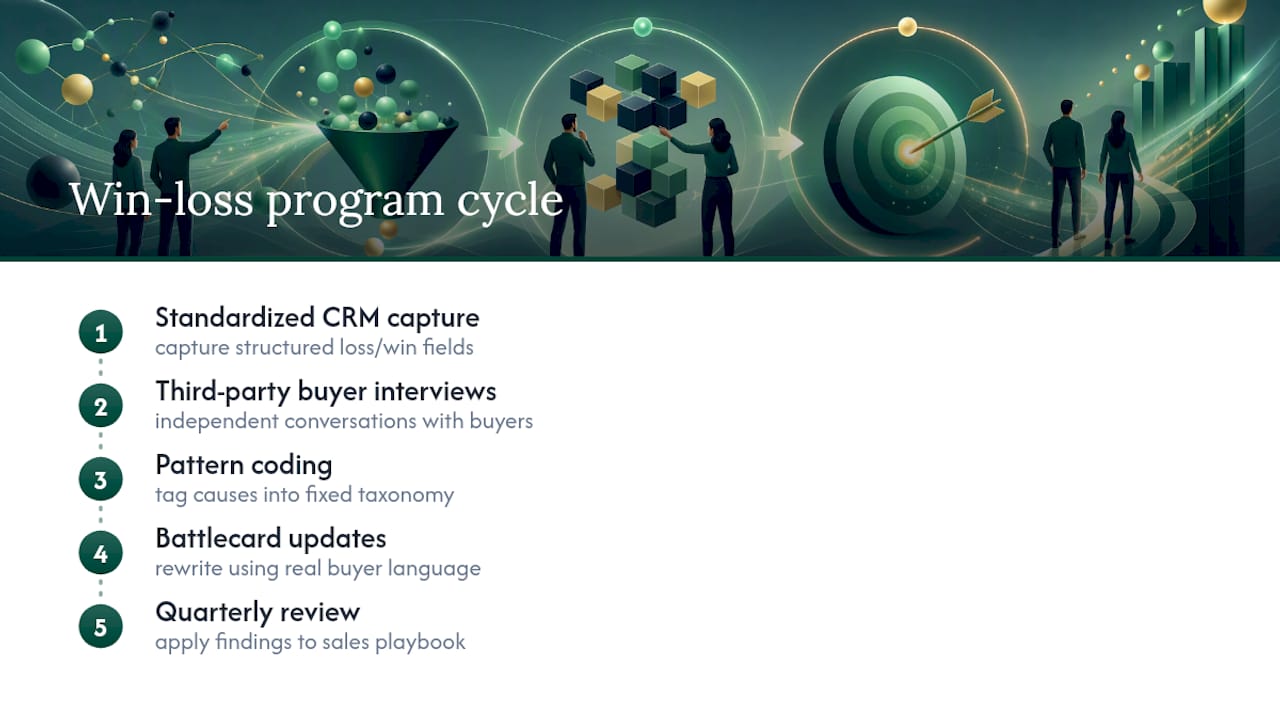
A functioning program produces a specific set of outputs: tagged loss and win causes sorted into a fixed taxonomy, updated battlecards built from real buyer language, and concrete changes to the sales playbook. A working win-loss program typically runs on five components: standardized CRM capture, third-party buyer interviews, pattern coding, battlecard updates, and a quarterly review. Skip any one of those and the program tends to drift into a pile of unread interview notes.
Why Win-Loss Analysis Matters for B2B Sales Performance
The business case is straightforward: teams that consistently interview buyers after a decision see measurably better outcomes than teams that don’t. Win rate is the headline metric, but it’s not the only one that moves. No-decision share, competitor head-to-head performance, and forecast accuracy all shift once you know why deals actually break down.
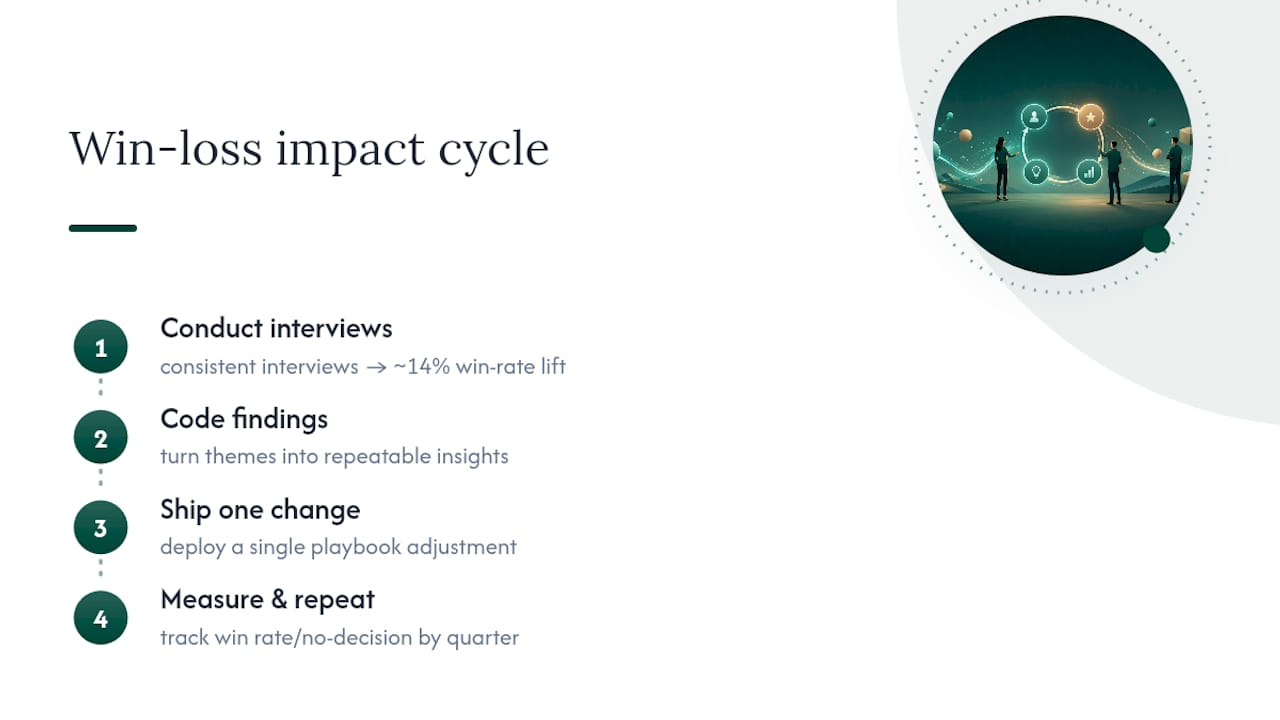
By the Numbers: Teams that consistently conduct win-loss interviews benefit from roughly a 14% lift in win rates compared to teams that rely on CRM notes alone.
That number deserves a caveat. It reflects teams that ran interviews consistently, not teams that did a one-off round after a bad quarter. A single batch of ten interviews won’t move your win rate on its own. The lift shows up when interviews feed a repeatable cycle: code the findings, ship one change, measure the next cohort, repeat.
Measure impact responsibly by tracking win rate and no-decision share over rolling quarters, not month to month, since deal cycles introduce noise that a single month can’t smooth out. Tie any specific playbook change to the metric it was meant to move, and give it at least one full sales cycle before judging it.
When Should You Run Win-Loss Interviews?
Timing determines whether the feedback you get is accurate or a hazy reconstruction. Gather deal evidence, calls, emails, CRM timeline, before you interview, and reach out to the buyer within about 2 to 4 weeks of the decision. Wait longer and buyers start rationalizing their choice or simply forget the specifics that mattered in the moment.
For sample size, aim for roughly 10 to 15 interviews per quarter to start seeing patterns that repeat rather than one-off anecdotes. Split the mix to include wins, losses, and no-decisions in a balanced proportion. Prioritize larger deals, deals involving a named competitor, and any deal where the sales team disagreed internally about the outcome. Those are the ones most likely to surface a finding worth acting on.
Building a Win-Loss Program Step by Step
A win-loss program is a five-step loop that repeats every quarter, not a one-time research project. Each pass should be tighter than the last as your taxonomy and interview script mature.
- Select the sample. Pull closed deals from the last quarter and weight the selection toward larger deals, competitive losses, and any deal that split opinion inside the sales team.
- Gather evidence first. Before scheduling a single interview, pull the CRM timeline, call recordings, and email threads for each deal. This step alone often surfaces half the story before you talk to the buyer.
- Conduct the interviews. Book a short call, ideally with someone outside the deal team, and ask open questions that let the buyer talk before you narrow in.
- Code and count. Tag each transcript against a fixed taxonomy and start counting once you’ve coded around ten interviews, rather than waiting for a statistical threshold that will never arrive in a program this size.
- Ship one change. Pick the single highest-value finding and turn it into one concrete update: a battlecard line, a discovery question, a pricing conversation script.
Ownership matters as much as the steps themselves. Someone, usually a sales enablement or product marketing lead, needs to own scheduling, coding, and the quarterly readout. Without a named owner, interviews happen sporadically and the findings never make it into a battlecard.
Pro Tip: Before you even book an interview, pull the deal’s full email thread and call recordings. Buyers will often confirm or contradict what you already suspected, and that lets you skip surface questions and go straight to the real probe.
Cadence is the other half of governance. Run the interview cycle continuously, but hold the review quarterly. That gives you enough coded interviews to spot a real pattern instead of reacting to a single loud data point from one deal.
How to Conduct Win-Loss Interviews That Reveal Root Causes
The single biggest interviewing mistake is accepting the first answer a buyer gives you. “Price” is almost always a surface answer, not a root cause. Laddering, following each answer with another “why,” uncovers the deeper driver, whether that’s a missing feature, a champion who left the company, or a competitor who simply built a better relationship earlier in the process.
A short sequence works better than a long questionnaire:
- Ask what the buyer was trying to solve when they started evaluating options.
- Ask who else they considered and what stood out about each one.
- When they mention “price” or “timing,” ask what would have needed to be true for the decision to go the other way.
- Ask what almost changed their mind, in either direction.
- Close by asking what they’d tell a colleague considering the same decision.
Who asks the questions matters. Buyers rarely tell the losing rep the real reason they walked away. Interviews run by a neutral third party consistently produce more candid feedback than interviews run by the seller, and response rates for a live third-party interview beat a post-loss survey by a wide margin.
Pro Tip: Keep the call to around 25 minutes and 10 questions or fewer. A short, focused conversation with a modest thank-you gift gets you a better transcript than a 45-minute interrogation buyers agree to once and never repeat.
Turning Interview Data Into Counted, Actionable Signals
Raw transcripts are anecdotes until you code them. A fixed taxonomy turns scattered quotes into something you can count, compare, and track over time. A workable starting taxonomy covers seven categories:
- Price and budget
- Product or feature gap
- Champion turnover or lost internal support
- Timing and internal priorities
- Perceived implementation risk
- Named competitor
- No-decision or status quo
Assign each interview one primary code and, where relevant, a secondary code. Two people coding the same transcript should land on the same primary tag most of the time. If they don’t, your categories are probably too vague and need tighter definitions before the next round.
Counts become meaningful faster than most teams expect. Once you’ve coded roughly ten interviews, patterns start to repeat rather than look random, and that’s a reasonable point to start reporting a top loss reason instead of waiting for a larger sample that a normal B2B sales cycle will never produce quickly.
By the Numbers: Programs that reach the 10 to 15 interviews per quarter range typically have enough volume to identify one dominant theme and two or three secondary ones worth tracking.
Your quarterly dashboard should show, at minimum, win rate by quarter, the top three coded loss reasons, head-to-head win rate against your most common named competitor, and no-decision share.
From Insight to Action: Battlecards and the Quarterly Review
An insight that never becomes a change is just an interesting story. The discipline that separates a real program from a research exercise is converting one finding at a time into an owned, dated, measurable action.
- Name the insight in one sentence. “Buyers choose Competitor X when our onboarding timeline isn’t addressed in the first call.”
- Assign an owner. Sales enablement, product marketing, or a sales manager, whoever can actually implement the fix.
- Set a timeline and a metric. Give the change 30 to 60 days and tie it to a specific number, like head-to-head win rate against that competitor.
The quarterly review itself should stay short: top three themes from the quarter’s coded interviews, the recommended action for each, the owner, and the status of last quarter’s changes. Resist the urge to relitigate individual deals in that meeting.
High-impact outputs tend to look the same across companies: an updated objection-handling script, a proof point pulled directly from a buyer quote, or a specific product ask routed to the roadmap team. Battlecards built from real buyer language and actual objection moments consistently outperform static feature-comparison sheets built from public competitor pages.
Choosing Your Program Model: In-House, Outsourced, or Hybrid
In-house interviewers know the product cold but often get guarded answers, since buyers hesitate to criticize a vendor to that vendor’s own employee. A neutral third-party interviewer, whether a contractor or an outside advisor, tends to get more candid answers at a higher cost per interview.
Most B2B teams don’t need heavy tooling to start. A handful of dedicated CRM fields, primary competitor, loss category, deal stage, buyer persona, a simple spreadsheet for coding, and a shared folder for recordings will run a program through its first several quarters. Scale up to a dedicated dashboard only once volume justifies it, typically once you’re running more than 15 to 20 interviews a quarter across multiple segments.
Bringing Brand Strategy Discipline to Win-Loss Work
Quincy Samycia has spent his career helping organizations close the gap between what they say and what the market actually hears. His work is reflected in Quincy’s frameworks built for over 200 international retail locations. Win-loss findings are only useful once they connect to positioning, and that’s the exact seam where most programs stall.
Coded interview data tells you what buyers heard when they compared you to a competitor. Brand and positioning work tells you why that message landed or didn’t. Positioning decisions built on real buyer language, rather than internal assumptions, are what actually move a battlecard from generic to genuinely persuasive.
What I’ve Learned Watching Win-Loss Programs Succeed and Stall
Most programs fail for a boring reason: no one owns the follow-through. Interviews happen once, get summarized in a slide nobody revisits, and the taxonomy is never built. Start smaller than you think you need to. A first 90-day cycle should aim for eight to ten interviews, one simple taxonomy, and exactly one shipped change. Skip the dashboard until the interviews are actually happening on a schedule.
— Quincy
How an Advisor Can Speed Up Your Win-Loss Program
If you’ve read this far, you already know the mechanics. What most teams actually get stuck on is the step after coding: turning a loss theme into a positioning decision the whole company will stand behind, not just a line item in a sales deck nobody revisits.
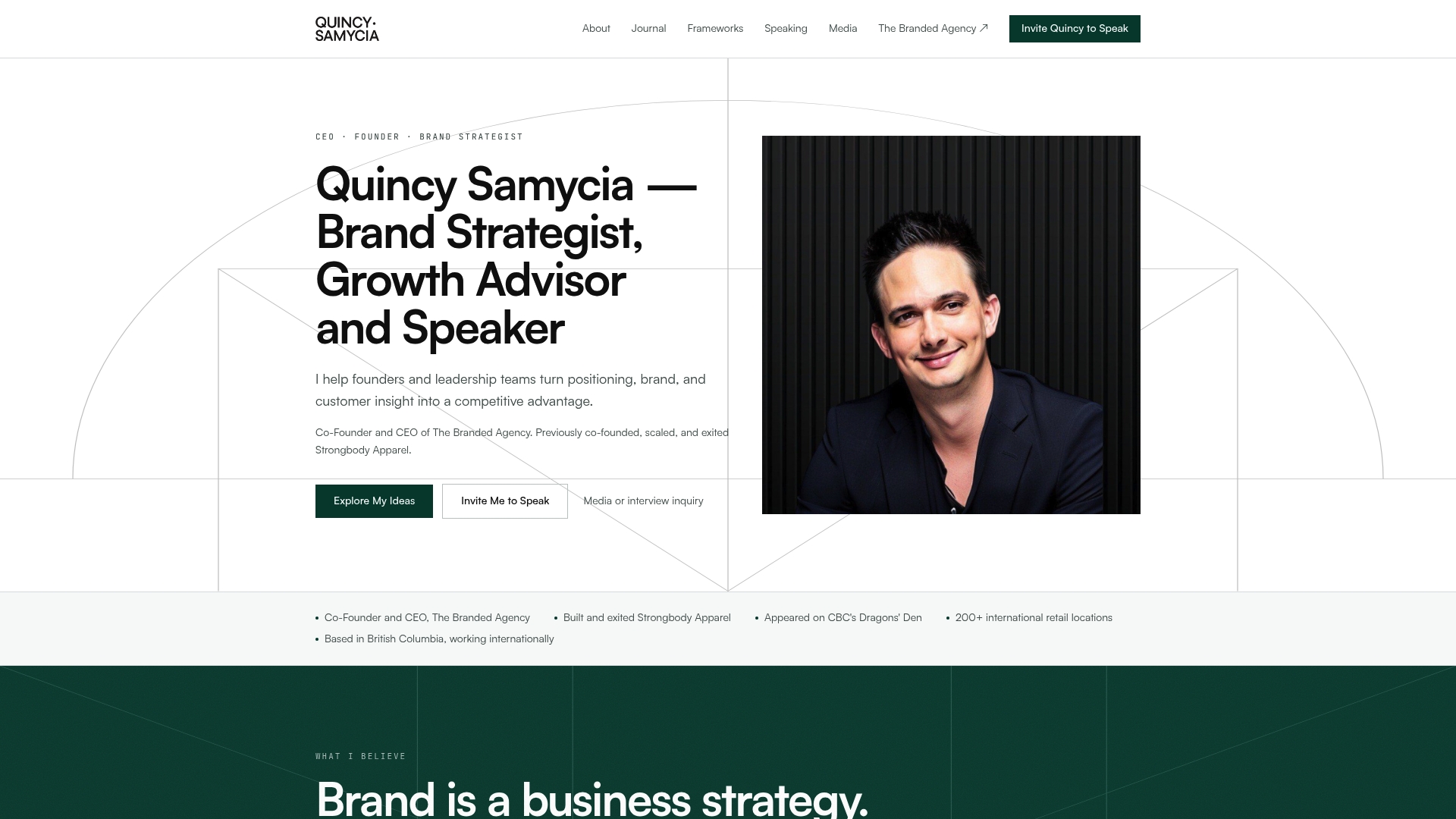
That’s the gap Quincy Samycia works in directly. Rather than handing you another research template, Quincy helps leadership teams take coded win-loss findings and turn them into a positioning stance, updated messaging, and a go-to-market plan sales and product both actually use. For teams that want their people trained on the interview and coding process itself, Quincy also runs workshops and speaking engagements built around exactly this kind of buyer-insight work. If your last win-loss cycle produced a stack of interesting findings and no clear next move, get in touch with Quincy Samycia to talk through what a positioning fix built on that data could look like.
Sources
- How to conduct win-loss interviews — Product Marketing Alliance
- Win/Loss Analysis: Learn Why You Win and Lose — CompeteIQ