
Go to Market Checklist: Test Readiness Through Five Lenses
Before any launch, confirm these in order: a validated ICP, a one-sentence value proposition with proof points, pricing and packaging decisions, named distribution channels, sales enablement materials, product and operational readiness, a measurement plan tied to business outcomes, and a dated launch timeline with executive sign-off. This article gives you the full template, a step-by-step checklist, and a launch-readiness framework to pressure-test each item before you commit a date.
TL;DR:
- Run at least one pricing test before publishing a price, and calculate assumed lifetime value or annual contract value before choosing packaging.
- Get written executive approval for launch KPIs before setting the timeline; verbal agreement leaves room for targets to shift after launch.
- Set dashboard thresholds that trigger escalation, and prepare fallback plans to add support, replace weak messaging, or reallocate underperforming channel resources.
- Train and certify sales representatives before launch, then track demo to trial conversion and time to first value before quarterly revenue results arrive.
- During the first 30 days, combine customer interviews, support ticket themes, and usage data; review findings weekly, then monthly, and feed changes back to customers.
Table of Contents
- What Are the Building Blocks of a GTM Strategy?
- Pre-Launch Checklist: What to Prepare and Who Owns It
- Launch Execution: What Happens on Launch Day and Right After
- Is Your Launch Actually Ready? The 5-Lens Test
- Is Your Sales Team Actually Ready to Sell This?
- How to Customize and Run the Checklist Template
- Know Where You Stand Before You Launch Into It
- Who Owns What: Aligning Teams Before Launch Day
- What Happens After Launch Decides If It Actually Worked
- Why Most Launches Lose Value Before They Even Launch
- How We Help Teams Get GTM-Ready
- FAQ
- Sources
What Are the Building Blocks of a GTM Strategy?
A go-to-market strategy works only when each checklist item connects to a business outcome rather than sitting as an isolated task. Treating a checklist as a list of boxes to tick, instead of a map of strategic questions, is how teams end up with what practitioners call random acts of launch: busy teams, scattered effort, no clear signal on whether the launch actually worked.
Four elements carry most of the weight.
- Ideal customer profile (ICP) and buyer personas: who specifically buys, who influences the purchase, and where they sit in the customer decision journey.
- Value proposition and positioning: the organizing claim that every piece of messaging, every sales conversation, and every piece of collateral has to support.
- Pricing and packaging: the commercial model that determines whether the product is easy to buy and easy to expand into over time.
- Distribution and channels: the specific paths (direct sales, partnerships, self-serve, marketplaces) you will use to reach the ICP, chosen deliberately rather than by default.
Measurement sits underneath all four. A rock-solid GTM plan answers what you are selling, who will buy it, why they will buy it, and how you will know it worked, then ties every deliverable back to those answers. Skip that step and you get a task list with no way to tell success from motion.
Buyer journey alignment matters because messaging that resonates in isolation can still miss the moment a buyer actually makes a decision. Pricing and packaging decisions made late, after channels are already locked in, tend to force rework. Sequence these four building blocks before you start filling in tactical detail, and the rest of the checklist becomes much easier to execute.
Pre-Launch Checklist: What to Prepare and Who Owns It
Preparation is where most launches succeed or fail quietly, long before launch day. Work through this sequence and assign a named owner to each step.
- Lock business goals and KPIs. Define the specific, measurable outcomes the launch must hit and get executive sign-off before any tactical work starts.
- Validate the ICP and buyer journey. Collect research artifacts: customer surveys, win/loss interviews, and existing usage data that confirm who buys and why.
- Finalize messaging and proof points. Write a single-sentence value proposition, back it with three supporting proof points, and get collateral approved before it goes to channels.
- Decide pricing and packaging. Choose the model, run the assumed LTV or ACV math, and schedule at least one pricing test before the price goes live. Our pricing and positioning playbook walks through this decision in more depth.
- Confirm product and operational readiness. Complete QA, compliance review, support staffing plans, and incident runbooks before the first customer touches the product.
If you are expanding into a new segment or region as part of this launch, our guide to market expansion strategy covers how to score which markets are worth entering first. Teams weighing outside product or engineering support during this phase sometimes bring in a specialist like WVE Labs for product-strategy input before launch commitments are locked.
Pro Tip: Require executive sign-off on KPIs in writing before the timeline is finalized. A verbal nod is not the same as a reviewed target, and shifting targets after launch day is one of the most common sources of post-launch conflict.
Launch Execution: What Happens on Launch Day and Right After
Execution day runs on checklists, not improvisation. Work through activation in this order:
- Activate campaigns. Confirm channels, finalize content, set any access gating, and lock timing across every channel simultaneously.
- Equip sales. Distribute playbooks, battlecards, and demo scripts, and run at least one role-play session before the first live call.
- Open onboarding and support. Confirm escalation paths are staffed and tested, not just documented.
- Stand up daily monitoring. Build a shared dashboard, run short daily standups, and define the specific metric thresholds that trigger escalation.
A few things tend to break in predictable ways. Build a short contingency playbook for each before launch:
- Demand outpaces support capacity: have a pre-approved plan to pull in backup staff or temporarily throttle new signups.
- Messaging doesn’t land: have an approved backup message ready, not a committee meeting scheduled for launch week.
- A channel underperforms: have a reallocation plan for budget and attention that doesn’t require a new round of approvals.
Teams relying on earned visibility as part of channel activation sometimes use a partner like Storyline Pros for launch-day distribution and PR tactics. For a longer view past the first week, our 90-day product launch playbook covers how to sequence effort across the full quarter instead of burning everything in the first 48 hours.
Is Your Launch Actually Ready? The 5-Lens Test
Most launch delays aren’t caused by missing tasks. They’re caused by unexamined assumptions that nobody checked out loud. The 5-lens framework gives you a fast way to surface those assumptions before launch day instead of after.
Run a readiness review through these five lenses:
- Shared assumptions: does everyone on the team believe the same thing about who the customer is and what they need?
- Dependency visibility: are the handoffs between product, marketing, and sales actually mapped, or assumed?
- Decision readiness: can the team make a call on launch day without escalating every judgment call?
- Handoff completeness: does sales have everything it needs from marketing, and does support have everything it needs from product?
- Readiness-review quality: has anyone actually stress-tested the plan, or has it only been reviewed for completeness?
End the review with one question: if we launched today, what would break first? Use the answer to decide whether to proceed, delay, or scope down.
Executive alignment closes the loop. A short CMO-CFO rehearsal on KPIs and budget, run before launch rather than after, reduces the odds that expectations shift once results start coming in. Our guide to sales and marketing alignment covers how to structure that conversation.
Pro Tip: If a lens check fails, don’t patch it with a meeting. Assign a named owner, a specific fix, and a re-check date before moving forward.
Is Your Sales Team Actually Ready to Sell This?
Sales readiness runs on its own timeline, separate from marketing readiness, and needs its own checklist.
- Pre-launch: complete the training curriculum, finish the playbook, and set a certification threshold every rep has to clear before they can sell.
- Launch: confirm scripts are final, target accounts are named, and CRM fields and enablement tools are configured and tested.
- Post-launch, first 30 days: run weekly pipeline reviews, complete early win/loss interviews, and schedule reinforcement training based on what reps are actually hearing from prospects.
A sales readiness checklist built around these three stages should include pre-launch training, playbooks and battlecards, CRM enablement, launch support processes, and a structured post-launch reinforcement plan focused on measurement.
Track leading indicators throughout, not just closed deals: demo-to-trial conversion and time-to-first-value tell you early whether the pitch and the product are landing, long before quarterly revenue numbers confirm or deny it.
How to Customize and Run the Checklist Template
A template only works when you adapt it to your launch, not the other way around.
- Prioritize ruthlessly. Separate must-have items from nice-to-have items and time-box scope so the launch date doesn’t quietly slip to accommodate extras.
- Assign a RACI. Every task needs one person responsible, one accountable, and a short list of people consulted and informed.
- Build the tracking fields in from the start: priority, owner, due date, status, and acceptance criteria, so progress is visible without a status meeting.
- Run a post-launch retro. Capture what broke, what held, and feed those findings into the next launch’s version of the template.
| Field | Purpose |
|---|---|
| Priority | Separates must-have from nice-to-have |
| Owner | Names who is accountable, not just involved |
| Due date | Keeps the timeline visible and enforceable |
| Status | Shows progress without a status meeting |
| Acceptance criteria | Defines what “done” actually means |
Our startup growth strategy guide covers how to structure these tasks into 12-week sprints if you are time-boxing scope across a longer runway, and our brand strategy deliverables guide has templates for the proof-point and collateral work that feeds into this checklist.
Know Where You Stand Before You Launch Into It
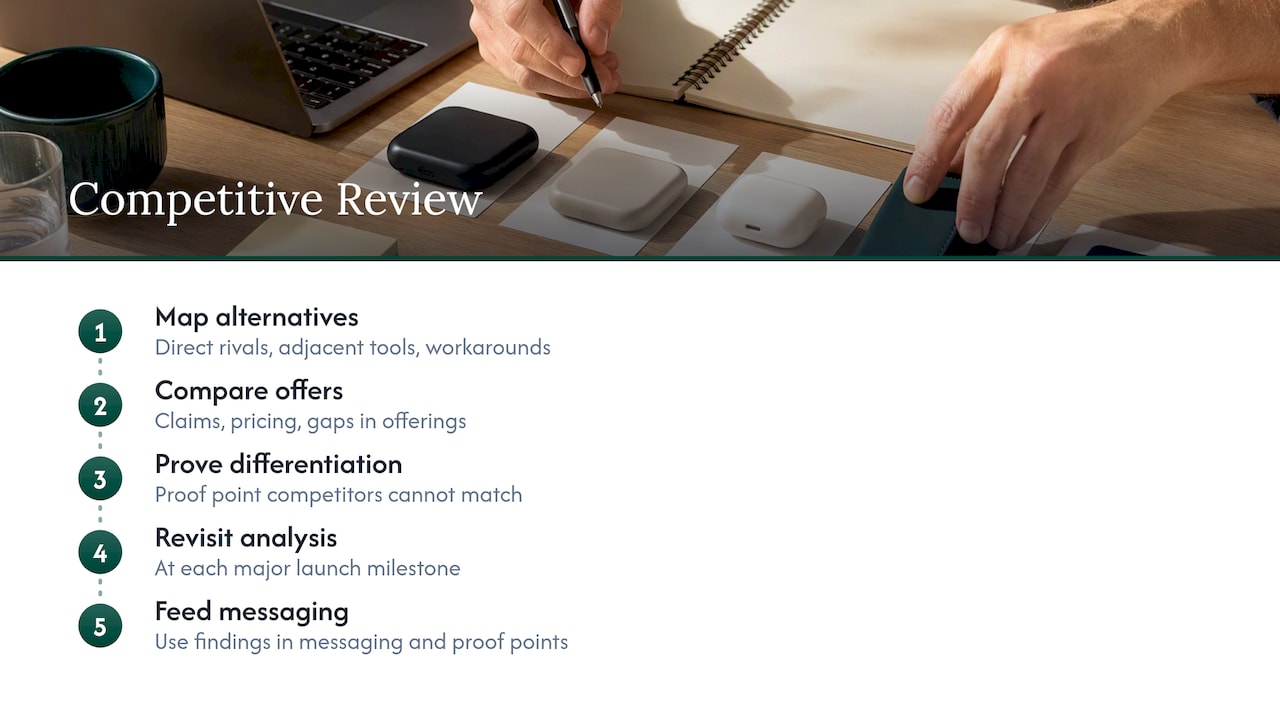
Skipping a competitive landscape review is one of the fastest ways to launch messaging that collapses on contact with a prospect’s inbox. Before you finalize positioning, map who else the ICP is evaluating, not just direct competitors but adjacent tools and workarounds they might already be using instead.
For each competitor category, note three things: their core claim, their pricing model, and the gap in their offering that your value proposition exploits. This isn’t a one-time exercise. Top-performing GTM teams combine multiple coordinated tactics, hyper-personalized outreach, hybrid sales models, marketplace presence, rather than relying on a single differentiator, and that combination only makes sense once you understand what the market already offers.
Keep the review specific. Generic statements like “we’re easier to use” rarely survive a sales call. A specific claim, backed by a proof point your competitor genuinely cannot match, holds up under pressure. Revisit this analysis at each major launch milestone, not just once during planning, because competitive positioning shifts as rivals respond to your own launch activity.
Feed what you learn directly into the messaging and proof-point work from the preparation checklist. A value proposition built without this context tends to sound good internally and fall flat externally.
Who Owns What: Aligning Teams Before Launch Day
Launches fail less often from bad ideas than from unclear ownership. Every checklist item needs a named owner, and every handoff between teams needs to be mapped before launch week, not discovered during it.
Product, marketing, and sales each have a distinct job in a launch. Product owns readiness and the runbook for what happens when something breaks. Marketing owns the message, the content, and channel timing. Sales owns the pitch, the account list, and the feedback loop from live conversations. When these three groups work from different assumptions about the ICP or the value proposition, the launch fractures quietly, usually visible only in inconsistent messaging across channels.
A short internal alignment session, run before the readiness review in the 5-lens framework, surfaces these gaps early. Ask each function to state, in one sentence, who the customer is and what problem the launch solves. Differences in those answers point directly to where handoffs will break.
Executive sponsorship matters here too. A launch without a named executive owner tends to lose priority the moment a competing initiative needs the same resources. Naming that owner, and giving them visibility into the readiness review, keeps the launch protected through the inevitable resourcing conflicts that show up in the weeks before go-live.
What Happens After Launch Decides If It Actually Worked
A launch date is not a finish line. The real test starts once customers begin using the product and telling you, directly or through their behavior, whether the value proposition held up.
Build a structured feedback loop before launch, not after. Combine three sources: direct customer interviews in the first 30 days, support ticket themes, and product usage data. Each source catches something the others miss. Interviews surface language and objections you didn’t anticipate. Support tickets reveal friction points. Usage data shows where customers drop off regardless of what they say in interviews.
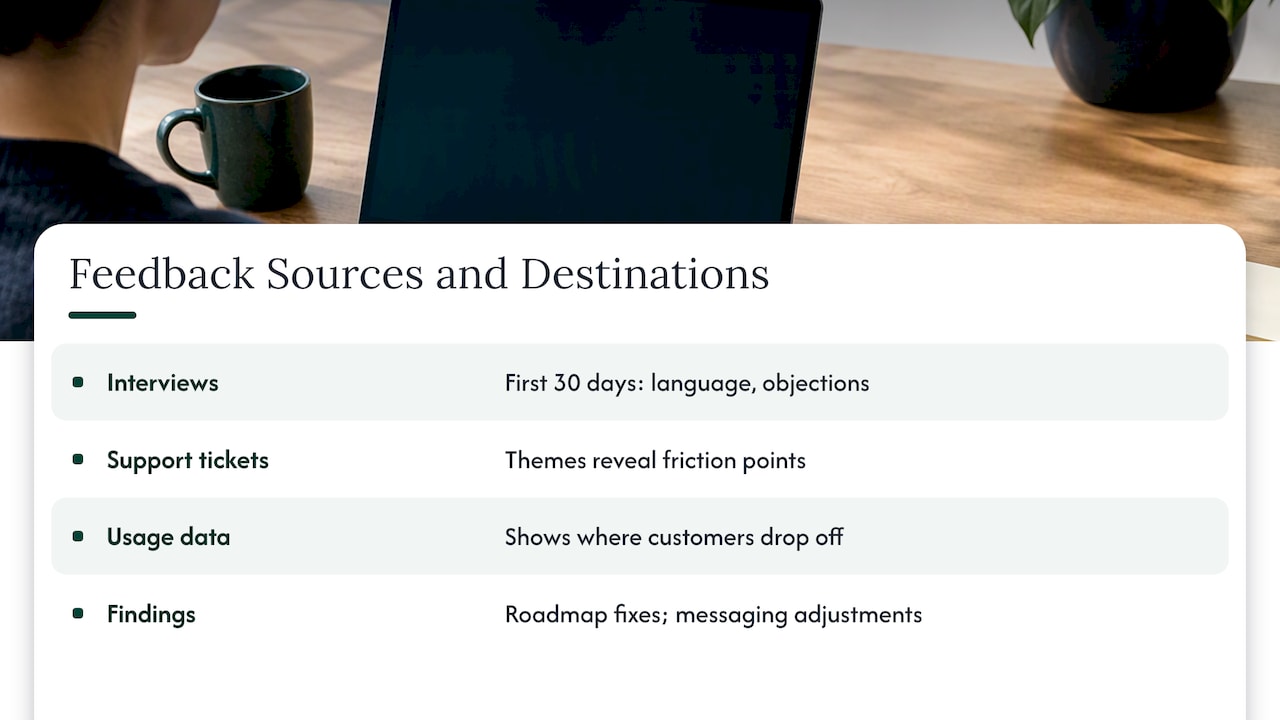
Set a cadence for reviewing this feedback, weekly for the first month, then monthly, and assign ownership so it doesn’t quietly stop happening once the initial launch excitement fades. Feed findings into two places: the product roadmap for fixes and features, and the messaging for adjustments to the value proposition itself.
The goal isn’t just collecting feedback. It’s closing the loop by shipping visible changes based on what customers tell you, then communicating those changes back to the customers who raised the issue. That loop is what turns a one-time launch into a repeatable GTM motion for the next release.
Why Most Launches Lose Value Before They Even Launch
The gap between a good GTM plan and a good launch usually isn’t effort. It’s staging. Teams write strong positioning, then let channels and sales scripts drift from it during execution, so the value proposition that tested well in a workshop never actually reaches the customer intact.
Two staging moves catch most of this early. First, gate every piece of launch messaging against the single-sentence value proposition before it ships, not after a campaign is live. Second, rehearse the KPI conversation with executives before launch, the same way you’d rehearse a sales pitch, so nobody is negotiating success metrics after the numbers come in.
Brand strategy and GTM execution are the same discipline split across two calendars. Our frameworks page goes deeper on how positioning and performance connect in practice.
— Quincy
How We Help Teams Get GTM-Ready
We work directly with founders and executive teams to close the gap between a GTM plan on paper and a launch that holds up under real market pressure. Our services include:
- Growth and go-to-market strategy, built around your specific ICP, positioning, and readiness gaps.
- Executive and founder advisory, including the KPI rehearsal and readiness review work covered above.
- Workshops and speaking engagements for teams that want to run the 5-lens review live with their own leadership in the room.
Engagements typically shorten the distance between “we think we’re ready” and “we can prove we’re ready,” catching misalignment before it becomes a missed quarter. If your team is heading into a launch and wants a second set of eyes on readiness, visit our services page to see where to start.
FAQ
What are the 4 Ps of GTM?
The 4 Ps, product, price, place, and promotion, are a classic marketing framework often applied to GTM planning, though modern GTM practice typically expands this into ICP, positioning, pricing and packaging, and distribution channels. The core idea stays the same: decide what you’re selling, at what price, through which channels, and with what message before you commit to a launch date.
What should be in a go-to-market plan?
A solid GTM plan answers what you’re selling, who will buy it, why they’ll buy it, and how you’ll measure success, then ties every deliverable to those answers rather than listing tasks in isolation, according to Product Marketing Alliance. It should also include a validated ICP, a value proposition with proof points, a pricing model, named distribution channels, sales enablement materials, and a timeline with executive sign-off.
What is the GTM process?
The GTM process moves through three phases: preparation (defining goals, ICP, messaging, pricing, and product readiness), execution (activating channels, enabling sales, and monitoring the launch), and post-launch iteration (collecting feedback and reinforcing what worked). A readiness review, like the 5-lens framework, sits between preparation and execution to catch gaps before launch day.
How do I make a GTM plan?
Start by defining your ICP, your one-sentence value proposition, and your pricing model, then map distribution channels and sales enablement needs around those decisions. Get executive sign-off on KPIs before finalizing the timeline, and run a readiness review to surface misaligned assumptions before you commit to a launch date.