Brand Governance Framework: Roles, Rules and Rollout
A brand governance framework is the system that keeps your brand consistent as more people touch it: the rules, the owners, the approval paths, the tools and the measures that turn brand guidelines into daily behavior. Guidelines say what the brand looks and sounds like. Governance decides who applies those standards, who approves exceptions, and what happens when someone gets it wrong. This guide shows what to include, how to assign ownership, and how to roll it out without turning brand into a bottleneck.
TL;DR
- Governance is not a bigger brand book. It is the combination of rules, roles, processes, tools and measurement that makes the book usable.
- Cover five things: strategy, process, people, tools and structure, then measure compliance and brand experience.
- Decide in advance what must stay fixed, where teams can adapt, and what triggers escalation.
- Tier your oversight by risk. A press release and a social post should not take the same route.
- Start with an audit, name owners, and roll out in phases. Ninety days is a realistic first cycle for most teams.
Table of Contents
- What a brand governance framework is, and what it is not
- Why governance matters as you grow
- What a brand governance model should include
- Who owns brand decisions
- Fixed, flexible and escalated: the three rules that keep governance light
- Match oversight to risk
- How to implement it: a 90-day plan
- Common mistakes
- Our perspective: governance is a growth system, not a rulebook
- Where we can help
- FAQ
- Sources
What a brand governance framework is, and what it is not
Most companies start with a brand identity guide: logo rules, colors, typography, tone of voice. That document is necessary. It is also passive. It sits in a shared drive and gets read once, usually by the person who needed a logo file.
Governance is the layer that makes the guide operational. It answers questions the guide cannot: Who can edit a sales deck template? Who signs off on a new product name? How does a regional team ask for an exception? How do you know whether anyone is following the standards?
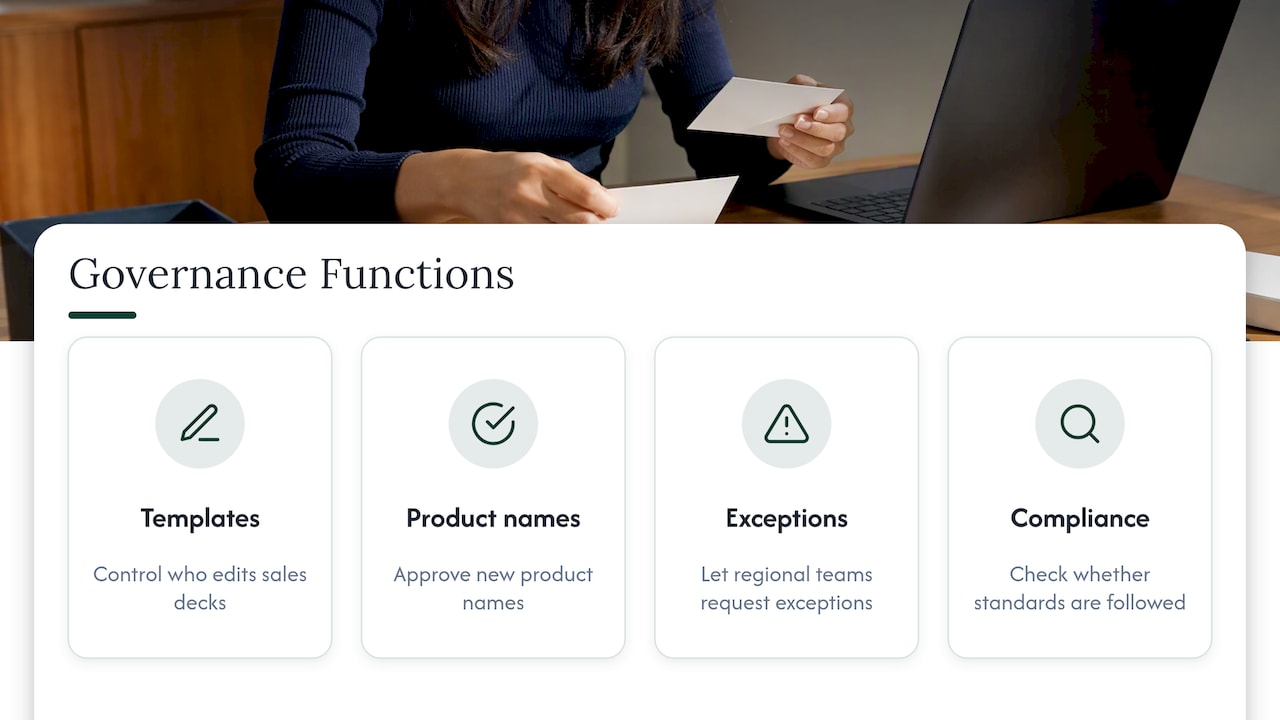
That distinction shows up in how practitioners describe the problem. CMSWire’s piece on franchise consistency makes the point that guidelines tell local operators what is allowed, while governance builds compliance into the tools and workflows people use, so consistency does not rely only on after-the-fact review.
There is also a strategic reason to care. David Aaker, writing for the American Marketing Association, describes brand equity as a strategic asset that needs direction, resources and a person or team actively managing it, and that has to be defended against silo pressure and short-term results. Governance is how that management becomes a routine rather than a rescue effort.
Brand governance versus brand management
Brand management is the ongoing work of building and shaping the brand: positioning, campaigns, experience. Governance is the control structure around that work. You can manage a brand brilliantly with three people in a room and no formal governance. Once you have sales reps building their own decks, a regional team localizing messaging, agencies producing assets and a product team naming features, you need the structure, or the brand drifts.
Why governance matters as you grow
Drift is gradual. A founder who approves everything personally is the brand’s governance system, and that works until the company hires its tenth marketer, its first regional lead or its second agency. Advertising Week’s explainer notes that growth, more channels and larger creative libraries make brand integrity harder to maintain, and that governance gives you visibility into compliance at scale and protects a consistent customer experience.
The Arthur W. Page Society, a professional association of senior communications executives, goes further. Its guide to corporate brand leadership says that clear brand governance and a brand operating model help an organization deliver on its brand promise and use the brand to drive transformation and long-term success.
In practice, we see three symptoms that tell a team it has outgrown informal control:
- Sales decks say different things about who you serve and why you win.
- Product, marketing and sales each describe the offer in their own words.
- Every new asset triggers a debate about whether it is “on brand” because nobody agreed on what that means.
If that sounds familiar, the problem is rarely visual. It is usually a positioning and decision-rights problem. Our guide to product marketing versus brand marketing covers the handoff where much of that drift starts.
What a brand governance model should include
The Page Society’s operating-model approach is a useful backbone because it is built for organizations, not only for design teams. It organizes the work around strategy, process, people, tools and structure, then adds measurement. Here is what each piece means in plain terms.
| Component | What it covers | A question it should answer |
|---|---|---|
| Strategy | Positioning, narrative, values, the promise you make | What must every customer interaction reflect? |
| Process | Approvals, requests, updates, exceptions, feedback | How does a new asset get from idea to published? |
| People | Owners, council, champions, agencies | Who decides, who is consulted, who executes? |
| Tools | Guidelines hub, asset library, templates, workflow software | Where does a team find the approved version? |
| Structure | How central and local teams relate | What can a region decide without asking? |
| Measurement | Compliance, sentiment, preference, consideration, NPS | How do we know it is working? |
The same guide lists measures including brand compliance, reputation, sentiment, brand experience, preference, consideration and Net Promoter Score. You do not need all of them on day one. Pick two or three you can actually collect, and add more once the system is running.
Strategy comes first
Governance without a clear strategy just enforces confusion consistently. Before you write approval rules, be able to state in a few sentences who you serve, what you do better than the alternatives, and what proof backs that up. If you cannot, fix positioning first. Our competitive brand analysis guide is a practical place to start, and our brand positioning workshop examples show how teams get to a shared statement in one sitting.
Guidelines that people can use
The Page Society recommends that guidelines cover the corporate narrative, verbal and visual identity, brand experience and application rules. Notice that two of those four are not about logos. Narrative and experience rules are where most governance gaps live, because they affect sales conversations, onboarding, support and pricing pages, not just marketing collateral.
A brand playbook is the most practical container for this. We break down what the strongest ones contain in brand playbook examples.
One useful habit: where a rule can be checked objectively, write it so it can be tested. “Friendly” is not testable. A list of words you use, words you avoid and sentence-length norms is. This piece on turning brand voice into testable rules shows one way to do that for tone.
Who owns brand decisions
Ownership is where most frameworks fail. If everyone is responsible, nobody is. The Page Society guide sorts roles by how they relate to the brand:
- Support and approve: the CEO and executive leadership.
- Consulted: legal, compliance and finance.
- Activate: marketing, communications, HR, digital, innovation, product development, supply chain, operations and agencies.
That third group is long on purpose. Brand is delivered by the whole organization, so governance that only addresses the marketing team will miss most of the places where the brand is actually experienced.
A simple ownership structure
For a growing company, we suggest a lean version:
- One accountable owner. Usually the head of marketing or brand. This person owns the standards, the guidelines hub and the exception process.
- A small brand council. Three to six people from marketing, product, sales and customer success, plus legal as needed. They meet on a set cadence and settle questions the owner cannot.
- Brand champions. One person in each team or region who answers day-to-day questions and flags problems early.
- An executive sponsor. Someone senior who backs the standards when a deadline pushes against them.
The Page Society recommends appointing and educating a Brand Council and Brand Ambassadors, which maps closely to the council and champions above. A RACI chart (who is responsible, accountable, consulted and informed) is a handy way to put decision rights on one page. Keep it to a page.
Shared ownership beats policing
A central team that reviews everything becomes a queue, and people route around queues. A better model is that departments understand their own responsibilities, champions help their colleagues, and brand specialists spend their time on high-value work rather than checking slide margins. This is the same logic behind our advice on brand rollout starting with employees: people follow standards they understand and helped shape.
Fixed, flexible and escalated: the three rules that keep governance light
The most useful thing a framework can do is sort decisions into three buckets. MarketingProfs frames this well: define what must remain recognizable, where teams may adapt, what they may decide independently, and when a decision changes strategy and needs escalation. Consistency, in that framing, does not mean sameness. You preserve the strategic meaning and allow contextual expression.
Here is how that looks in a table you can adapt.
| Bucket | Examples | Who decides |
|---|---|---|
| Fixed | Logo, core positioning statement, legal disclaimers, product names | Brand owner and council |
| Flexible | Imagery for a local campaign, channel-specific copy, examples and case studies | Local team within the playbook |
| Escalate | Anything that changes who you target, what you promise or how you compare yourself to competitors | Council, with executive sponsor if needed |
The third bucket is the one teams forget. Most brand damage does not come from a wrong shade of blue. It comes from a campaign or a sales message that quietly changes the promise. Escalation triggers should be about strategy, not aesthetics.
Handling regional and local exceptions
Local markets always have needs the central team did not foresee: different regulations, languages, venues, formats. A framework without an exception path forces people to either break the rules or stall. Build a short form: what is the change, why, for how long, and who approved it. Let exceptions expire so they get reviewed instead of becoming permanent forks.
Printed and physical materials are where versions multiply fastest, because every market orders its own banners, signs and displays. This guide to versioning promotional materials across regional markets is a good illustration of how central standards and local needs can coexist when the variants are defined up front.
Match oversight to risk
Not every asset deserves the same scrutiny. A governance system that routes a social post through the same approvals as a investor presentation will be ignored within a month. Tier your content:
- Low risk: templated assets built from approved components, such as social posts or event invitations. Self-serve, with templates that lock the fixed elements.
- Medium risk: new campaigns, landing pages, sales collateral. Reviewed by the brand owner or a trained champion.
- High risk: press statements, pricing and positioning changes, rebrands, crisis communications. Council and legal review.
The principle is the same one many practitioners now recommend: tailor oversight to the risk of each content type, and build the rules into the workflow instead of leaving them as a static document. Where a rule is mechanical (a locked logo, a required disclaimer), let the template enforce it. Where it needs judgment (does this message fit our positioning?), route it to a person.
If you are weighing a bigger change to the brand itself, our guide on rebrand versus brand refresh will help you decide which category of decision you are facing before you push it through governance.
How to implement it: a 90-day plan
You do not need a year-long program. A first version that is simple, owned and used beats a comprehensive one nobody reads. Here is a sequence we recommend.
Days 1 to 30: audit and decide
- Inventory the assets that actually circulate: decks, templates, web pages, one-pagers, onboarding material, signage.
- Note where versions conflict and where people cannot find the approved one.
- Interview a handful of people in sales, product, support and any regional or franchise teams about what slows them down.
- Name the brand owner, the council and the executive sponsor.
- Confirm the positioning statement and narrative everything else will sit on.
The Page Society’s guide begins in the same place: assess existing brand assets and how well the brand is understood, then create the operating model.
Days 31 to 60: standardize
- Publish a single home for approved guidelines and assets, so there is one place to look.
- Write the fixed, flexible and escalate rules in plain language.
- Set the risk tiers and the approval route for each.
- Create the exception form and the feedback route.
- Convert your most-used assets into templates that lock the fixed elements.
Days 61 to 90: roll out and measure
- Launch with one team or region first, then expand once the friction points are fixed.
- Train champions before everyone else, so they can answer questions from day one.
- Choose two or three measures: for example, the share of new assets built from approved templates, average approval turnaround and a quarterly check of customer-facing pages against the standard.
- Schedule the first council review and decide what you will change.
Treat the end of day 90 as a checkpoint, not a finish line. The Page Society’s guidance is that the brand should be continuously adapted to stay aligned with business strategy as the organization changes. A good governance framework has a review date built in.
Common mistakes
- Writing rules nobody can find. If approved assets take more than a minute to locate, people will use whatever is in their downloads folder.
- Policing instead of enabling. If governance feels like a gate, adoption collapses. Make the compliant path the fastest path.
- Ignoring non-marketing teams. Sales, support and product shape the brand more than most marketing calendars do.
- No exception path. Rigid rules produce quiet rule-breaking, which is worse than visible exceptions.
- No measurement. If you do not track anything, the framework becomes a one-time project and decays.
- Governing before positioning. Rules that enforce a vague strategy only spread vagueness faster.
Our perspective: governance is a growth system, not a rulebook
We come at this as operators first. Having built brands through scale and exit, and having worked across more than 200 international retail locations, we have seen what consistency actually costs and what inconsistency costs more. The pattern is the same everywhere: brand strategy that lives in a deck decays, and brand strategy wired into how product, marketing and sales make decisions compounds.
That is why we do not treat governance as a compliance exercise. It is the mechanism that keeps positioning, product, marketing and sales pulling in one direction, so the brand can be measured against business performance rather than admired in a presentation. Our Golden Spiral™ and Brand-Backed Performance™ frameworks are built on that idea: clarity first, alignment second, then iterative improvement as the market responds.
Our advice to leaders is blunt. Do not start by buying software or rewriting the brand book. Start by agreeing on what the brand promises, who is allowed to change that promise, and how you will know when it slips. Everything else is implementation.
— Quincy
Where we can help
If your team has outgrown informal brand control and you want a framework that ties positioning, product, marketing and sales to measurable outcomes, we work with founders and executive teams on exactly that. Our brand strategy, positioning and growth advisory work covers the audit, the positioning that governance rests on, and the alignment across teams. For leadership events, we also offer keynotes and workshops on brand as a business strategy.
Bring us the current state of your brand, even if it is messy. A conversation about where drift is costing you is usually the fastest way to see what the framework needs to include.
FAQ
What is the difference between brand guidelines and brand governance?
Guidelines describe what the brand should look and sound like. Governance is the system that makes people follow them: roles, approval workflows, permissions, tools, training and measurement. You need both, because guidelines without governance are suggestions, and governance without guidelines has nothing to enforce.
What are the core components of a brand governance model?
A practical model covers strategy, process, people, tools and structure, with measurement on top. In plain terms, that means a clear positioning and narrative, defined approval paths, named owners and champions, a single source for approved assets, and a way to track compliance and brand experience. The Page Society’s corporate brand guide uses this structure.
Who should own brand governance in a company?
One accountable owner, usually the head of marketing or brand, should own the standards and the exception process. A small cross-functional council handles disputes and strategic questions, and champions in each team provide day-to-day support. Executive leadership approves and backs the standards, while legal and finance are consulted.
How long does it take to put a brand governance framework in place?
A first working version typically takes about three months: a month to audit and assign owners, a month to standardize rules, workflows and templates, and a month to roll out, train and measure. Expect to refine it afterward. Complexity depends on how many teams, regions and agencies produce brand assets.
How much control is too much?
If people route around the process, you have too much. Tier your oversight by risk, lock the elements that must never change into templates, and give local teams clear room to adapt within the playbook. Escalate only when a decision changes the underlying strategy, not when it merely changes the execution.
Sources
- Corporate Brand Leadership, Arthur W. Page Society (May 2023)
- A New Branding Framework: The 5Bs, American Marketing Association
- Keeping Brand Consistency Across the Franchise, CMSWire
- WTF is Brand Governance And Why Is It Important?, Advertising Week
- Brand Governance: How to Scale Decision-Making Without Losing Consistency, MarketingProfs
- Versioning Promotional Materials Across Regional Markets
- AI Brand Voice: Turn Friendly Into Rules You Can Test