
Go-to-Market Research: What to Study Before You Launch

Go-to-market research is the work you do before a launch to learn who will buy, what they need, what they will pay and how they will hear about you. It feeds a go-to-market (GTM) strategy but is not the strategy itself. Done well, it tells you where to aim. Done badly, it gives you confident numbers about the wrong market.
This guide covers what GTM research is, the questions it has to answer, the methods that fit a B2B company, and how to turn findings into positioning and a launch plan your product, marketing and sales teams all run the same way.
TL;DR
- GTM research is the evidence layer under a go-to-market strategy: customers, competitors, pricing and product value, studied for one specific launch or market move.
- Start with the decision you need to make, then pick the method. Mix primary research (interviews, surveys) with secondary research (reports, competitor materials).
- Findings only matter once they become a named target customer, a clear position, proof points and a message that sales, marketing and product all use.
- Decide how you will measure success before launch, and use a soft launch to test your assumptions cheaply.
- If your research keeps producing a pile of data and no decision, the gap is usually positioning, not information.
Table of Contents
- What go-to-market research is, and what it is not
- Why the research is worth doing
- The questions your research has to answer
- Choosing research methods
- A five-step process for running GTM research
- Turning insight into positioning and aligned execution
- Perspective: research does not fix a fuzzy position
- Measuring whether the research is paying off
- When to bring in an advisor
- FAQ
- Sources
What go-to-market research is, and what it is not
A GTM strategy is the plan for how a business brings an offer to the customers who want it. Amazon Ads describes it as an extensive plan for launching, positioning, pricing and promoting a product or service to a target audience. Stripe’s guide puts research inside that plan, alongside target-customer definition, sales and marketing plans, pricing and distribution channels.
So the relationship is simple. The strategy is broad and cross-functional. Research is one input that shapes it. Forbes breaks a GTM strategy into four connected parts: market insights generated by research, messaging and positioning, enablement, and launch. The same piece notes that a GTM strategy is not the same thing as a product launch. It can also apply to new positioning, new pricing or expansion into a new market.
Two distinctions save a lot of wasted effort.
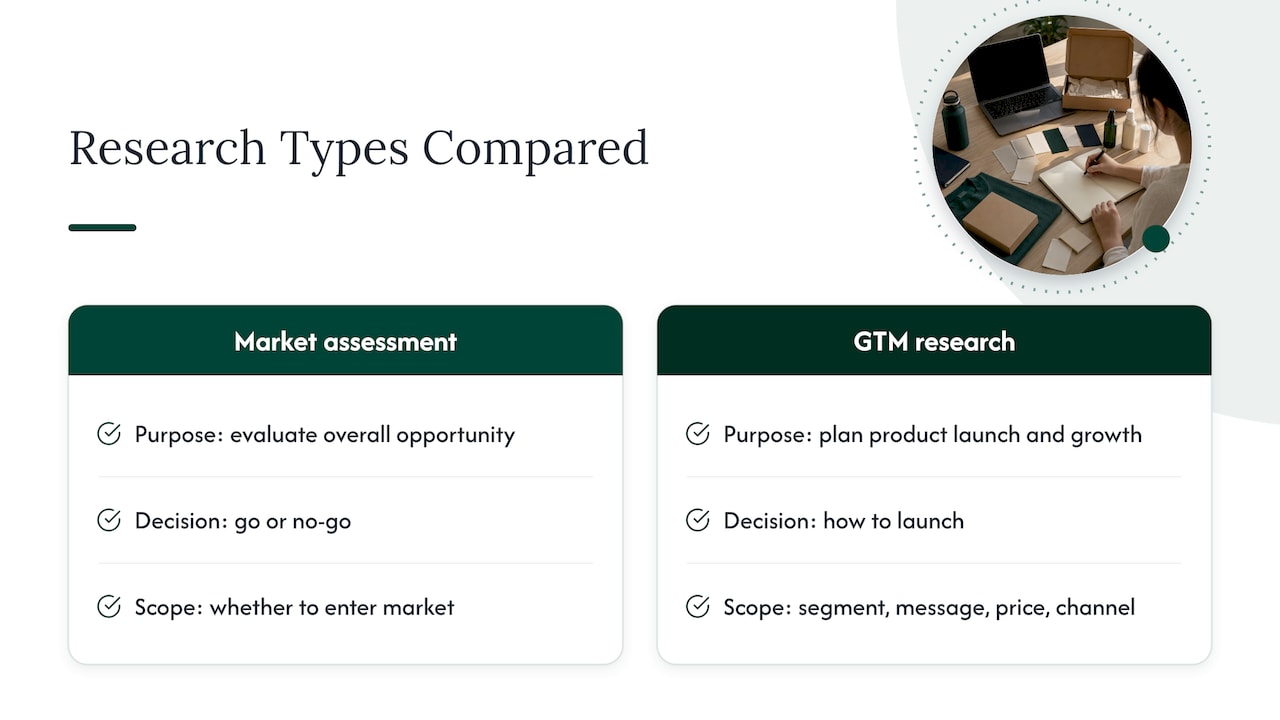
GTM research versus market assessment. According to Adience, market assessment research evaluates the overall opportunity and informs go or no-go decisions. GTM research is narrower. It focuses on the operational plan for launching and growing one particular product or service. If you are still asking whether a market is worth entering at all, you are in assessment. If you have decided to go and need to know how, you are in GTM research.
GTM research versus general market research. General research can be open-ended. GTM research is tied to a decision with a date on it: which segment first, which message, which price, which channel. Logica’s guide frames the work as refining your markets, assessing product-market fit and identifying what differentiates you. Every study you commission should map to one of those.
Why the research is worth doing
Research is the foundation of the plan and also its limit. Forbes makes that point directly: if research is rushed or misread, the strategy rests on a shaky understanding of what the market needs.
The practical benefits are concrete. A Forbes Business Council piece lists the decisions research supports: finding market gaps, uncovering customer needs, benchmarking how competitors position themselves and testing pricing models. By making those inputs visible, it reduces investment risk and sharpens how sales and marketing plans are executed.
The stakes show up in failure data. A CB Insights study, cited by HubSpot, found that 35% of startups fail because there is no market need for what they built. HubSpot’s page also reports NIQ analysis of more than 70,000 manufacturers, which found that practices grounded in strong consumer-led ideas double a brand’s chances of sustained sales growth. Neither figure is about B2B services specifically, but both point the same way: guessing is expensive.
Forrester offers a useful picture: building a GTM strategy without data is like cooking a complex dish without a recipe. Data provides the structure that keeps execution on track.
The questions your research has to answer
Before choosing a method, write the questions. Drive Research’s B2B guide groups them well, and we have organized them into four areas.
Customer questions
- Who is the target audience, and what do they need?
- Which barriers stand between them and a purchase?
- How do they prefer to be reached, and which messages resonate?
In B2B, “customer” is plural. Forrester notes that portfolio marketers prioritize personas by their role in the buying process, drawing on qualitative input from analyst firms, industry associations and customer advisory boards. The person who feels the pain is rarely the person who signs. Our guides on the ideal customer profile and on customer segmentation show how to turn this into a short list of accounts and actions for reps.
Product and value questions
- What is the product worth to the buyer, in their words?
- How sensitive are they to price?
- Which alternatives do they use today, including doing nothing?
On price, IDC’s go-to-market planning guide says methods such as focus groups, surveys and conjoint analysis can help align price with perceived value. Price research is also where positioning and revenue meet, which we cover in pricing and positioning for founders.
Competitor questions
Drive Research says competitor research should identify similar offerings and how buyers perceive them. The second half of that sentence is the important one. What a competitor says on its website matters less than what your buyers believe about it. IDC adds that competitive pricing work draws on price lists, competitor advertising and pricing databases. For the brand side, see our practical guide to competitive brand analysis.
Go-to-market questions
- Which segment do we enter first?
- Which channels reach that segment at a cost we can afford?
- What proof does a buyer need before they trust us?
These are the questions that connect research to action, and they are the ones teams most often skip.
Choosing research methods
The Go To Market Alliance recommends combining primary research (surveys, interviews, focus groups and observation) with secondary research such as industry reports, competitor analysis and online searches. It also advises using representative samples, analyzing data thoroughly and sharing findings across departments.
Here is how we would match method to question for a B2B company.
| Question | Best-fit method | Watch out for |
|---|---|---|
| Why do buyers choose us or a rival? | Buyer interviews, including recent losses | Interviewing only happy customers |
| How big is the problem across a segment? | Survey with a representative sample | Small samples that look like patterns |
| What price fits perceived value? | Surveys, focus groups, conjoint analysis | Asking “what would you pay” with no context |
| How do rivals position themselves? | Competitor websites, decks, price lists, review sites | Treating their claims as buyer perception |
| Which accounts are worth targeting? | CRM and win/loss data, industry reports | Stopping at firmographics |
| Which message lands? | Message tests, soft-launch feedback | Testing wording before the position is settled |
Start with secondary research because it is cheap. It tells you what is already known, so your primary research can focus on what is not. Then spend your interview time on the questions secondary sources cannot answer: why this buyer, in this situation, picks one option over another.
The point of all of it, as HubSpot puts it, is to test assumptions systematically before they become expensive mistakes. We cover interview design and the methods that actually change decisions in B2B customer research methods.
A five-step process for running GTM research
- Name the decision. Write one sentence: “We need to decide X by date Y.” Examples: which of two segments to lead with, whether to reprice, or how to reposition against a crowded field. Research without a decision attached becomes a report nobody uses.
- List your assumptions. Write down what you currently believe about the buyer, the problem, the price and the competition. Mark each as known, believed or guessed. Your research budget goes to the guessed items that would change the decision.
- Collect secondary data first. Pull industry reports, analyst commentary, competitor materials and your own pipeline data. Note the gaps.
- Run targeted primary research. Interview a mix of buyers, users and people who chose someone else. Run a survey only when you know which question needs numbers.
- Synthesize into choices. Convert findings into a target customer, a problem statement, a position and a price range. If a finding does not change a choice, set it aside.
The common failure sits at step 5. Teams collect, present and file. The findings never reach the people who write the pitch, build the roadmap or run the sales call.
Turning insight into positioning and aligned execution
The research brief behind this guide describes the conversion clearly, and we agree with it. Use the evidence to define the target customer, the unmet problem, the differentiated value proposition, the proof points and the messaging. Then translate those decisions into product priorities, pricing, channels, sales enablement, campaigns and launch activity. Forbes treats these as connected components, not separate departmental projects.
In practice, that means one page that everyone can read. A useful test: can a sales rep, a product manager and a marketer each describe, in their own words, who you serve, what problem you solve and why you win? If three people give three answers, the research has not landed yet.
Adience stresses that research findings must be embedded across the whole organization, so product, sales and marketing stay aligned and consistent through a launch. A few habits help:
- Share raw buyer quotes, not just summaries. Reps trust what customers actually said.
- Turn each finding into an owner and an action: a change to the pitch deck, a roadmap item, a pricing test.
- Put positioning in writing and test it before launch. Our positioning frameworks guide shows how to pressure-test a position in a 60 to 90 minute workshop.
- Agree on how sales and marketing hand off leads and feedback. Our piece on sales and marketing alignment covers the agreement that keeps this going.
If your launch is regional or you plan to adapt messages by market, a localized marketing strategy workflow is a handy reference for carrying one set of research into several markets without the message drifting.
Perspective: research does not fix a fuzzy position
We see the same pattern across the teams we advise. A company runs a large research effort, gets a thick deck, and still launches with a message that sounds like everyone else’s. The data was fine. The missing piece was a decision about what the brand stands for and who it is for.
Brand is not decoration applied after the product is built. It is a business strategy, and GTM research is where it gets its evidence. When positioning, product and sales are not tied together, two things happen: the company drifts, and buyers fall back on comparing you with the nearest alternative on price.
So we use research to settle four things in order. Who is the customer we will win most often? What problem do they feel enough to pay for? What do we offer that they cannot get elsewhere? What proof will they accept? Then we push those answers into the product plan, the sales conversation and the campaign, and we pick the measures that show whether it works. Our approach comes from building brands in the field, including across more than 200 international retail locations, and from the operator’s side of the table, not just the advisor’s.
The discipline that matters most is restraint. Pick one segment and one position for the first launch. You can widen later, with better evidence.
— Quincy
Measuring whether the research is paying off
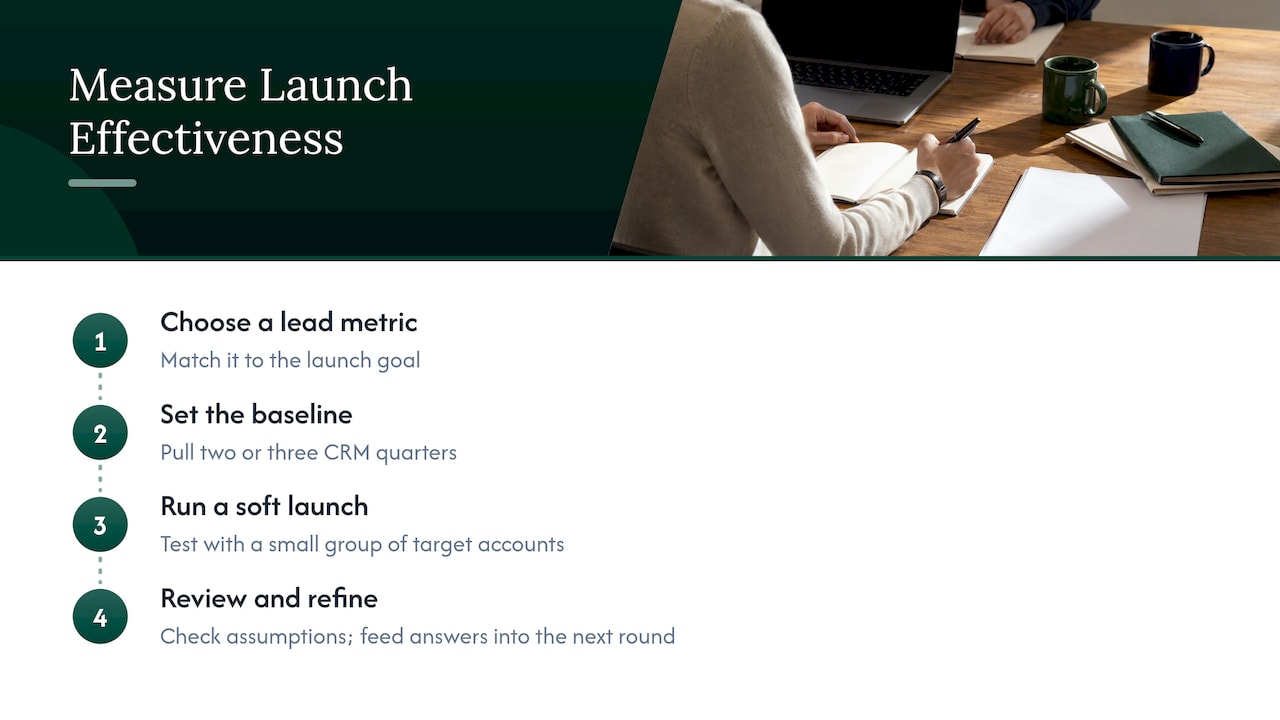
Adience’s advice is to decide in advance how you will measure launch effectiveness, pick a metric specific to the offering, and use soft-launch customer feedback to improve the full launch. We would add structure to that.
Pick one lead metric and a few supporting ones. The lead metric should reflect the goal of this launch. A new-segment entry might track qualified pipeline from that segment. A repositioning might track win rate against the competitor you targeted. A pricing change might track average deal size and discount rate. Supporting measures might include sales-cycle length and how often reps use the new message.
Set the baseline before you launch. You cannot show improvement without a starting number. Pull the last two or three quarters from your CRM.
Use a soft launch as a research tool. Release to a small group of target accounts first. Listen to how buyers describe the product back to you. If their words differ from yours, fix the message before the full launch. When you test variations, size the test properly. Guidance on A/B testing sample size explains why small samples mislead, a lesson that applies to message tests as much as to the content it was written for.
Review on a schedule. Check the assumptions you marked as guessed in step 2. Which proved true? Which did not? Feed the answers into the next round. For a pre-launch review across five lenses, use our go-to-market checklist.
When to bring in an advisor
Many teams can run the research themselves. Outside help earns its fee in three situations: the team is too close to the product to see how buyers compare it, research findings are sitting unused because product, marketing and sales disagree on the position, or a launch date is fixed and you need a decision-ready plan fast.
Our work covers brand strategy, positioning, growth and go-to-market strategy, customer experience, AI and marketing strategy, and founder and executive advisory. The method ties positioning, product, marketing and sales together through iterative frameworks, so research ends in decisions and measurable results, not a deck. If you want a second opinion on your launch plan or a position that needs pressure-testing, see how we work with founders and leadership teams. To see our approach before you talk to us, browse our brand strategy frameworks.
For a founder-focused version of this material, our go-to-market framework puts brand to work over 90 days.
FAQ
What is the difference between go-to-market research and a go-to-market strategy?
Research is the evidence. Strategy is the plan built on it. Stripe describes the strategy as broader and cross-functional, covering the whole process of bringing a product to customers, with research as one input that shapes it. You do research to decide; you write the strategy to act.
How long should GTM research take?
It depends on the decision, so work backward from the date you must decide. A focused B2B study built around a handful of buyer interviews and existing data can be done much faster than a multi-market survey program. Set the scope by the questions you must answer, not by a fixed number of weeks.
Which research methods should a B2B startup start with?
Begin with secondary research and your own pipeline data, then run buyer interviews. The Go To Market Alliance recommends blending primary methods, such as surveys, interviews, focus groups and observation, with secondary sources. Add a survey only when you know which question needs numbers from a representative sample.
What are “go-to-market insights”?
They are the conclusions your research supports: who the best-fit customer is, which problem drives purchase, how buyers see competitors, and what price matches perceived value. An insight is only useful if it changes a decision about segment, message, price or channel. Findings that change nothing are just data.
How do I know if my research was good enough?
Test it against behavior. Can sales, marketing and product describe the same target customer and the same reason you win? Did a soft launch confirm that buyers describe your offer the way you do? If yes, the research has done its job.
Sources
- How To Create Good, Better and Great Go-To-Market Strategy (Forbes)
- Making A Winning Go-To-Market Strategy By Leveraging Market Research (Forbes Business Council)
- How to Use Research to Inform Your B2B Go-To-Market Strategy (Adience)
- Logica’s Go-to-Market Research Guide
- What is a Go-To-Market Strategy? (Amazon Ads)
- What is a go-to-market strategy? (Stripe)
- How to do market research (HubSpot)
- Data And Insights For Smart Go-To-Market Decision-Making (Forrester)
- B2B Go-To-Market Research Strategy (Drive Research)
- Data-Led Go-To-Market Planning Guide (IDC)
- How to conduct market research for Go-to-Market (Go To Market Alliance)
- Localized Marketing Strategy Workflow
- A/B Testing Sample Size