
B2B Customer Research Methods That Change Decisions
The B2B customer research methods that pay off most are customer interviews, win-loss interviews, call transcript analysis, and targeted surveys, used together. Interviews and win-loss tell you why buyers choose. Surveys tell you how common each reason is. Transcripts show what buyers say when no one is asking. The method matters less than what happens afterward: research only earns its cost when it changes your positioning, your sales conversations, or your roadmap.
This guide covers each method, when to use it, how to avoid the usual traps, and how to turn findings into action. It is written for founders, marketing leaders, and executive teams who need answers about their buyers, not a research project for its own sake.
TL;DR
- Start with interviews of current customers and recent lost deals. They are the fastest route to the real reasons buyers choose you or someone else.
- Pair qualitative work (interviews, transcripts) with quantitative work (surveys, NPS, CSAT). One explains why, the other measures how much.
- Time matters: contact lost-deal buyers within a week, and have someone other than the account executive run the conversation.
- Most programs fail at synthesis. Tag every finding by theme and route it to a named owner and a deadline.
- Research is a brand input. Use it to sharpen positioning, then align product, marketing, and sales around it.
Table of Contents
- Why B2B research is not consumer research
- The core methods, and when to use each
- Choosing a method by the question you have
- Where research programs break down
- Our perspective: research is a brand decision
- From research to positioning and go-to-market action
- When to bring in an outside advisor
- A practical 30-day plan
- FAQ
- Sources
Why B2B research is not consumer research
A consumer buys alone, quickly, and often on feeling. A B2B purchase involves a champion, a budget holder, a skeptical user, sometimes procurement and legal, and a cycle that runs for months. That changes the research in three ways.
- You are researching a group, not a person. The person who signs is rarely the person who uses the product, and each has different reasons.
- Samples are small. Your market may hold a few hundred real buyers, not millions. Ten good interviews can outweigh a 400-response survey sent to the wrong people.
- Memory and politics distort answers. Buyers rationalize after the fact, and internal sellers explain losses in the way least threatening to themselves.
That last point is large. According to a win-loss analysis playbook, sellers and buyers cite completely different reasons for lost deals 50 to 70 percent of the time. Sellers lean toward price and missing features. Buyers point to weak needs discovery, little differentiation, and slow responses. If your picture of the market comes only from the CRM and the sales team, you are likely working from the seller’s version.
The core methods, and when to use each
The usual split is primary versus secondary research and qualitative versus quantitative data. HubSpot’s overview of B2B market research describes a good report as blending all four. In practice, these are the methods worth your time.
| Method | Best for | Typical effort | Watch out for |
|---|---|---|---|
| Customer interviews | Discovering needs, language, buying triggers | 8 to 15 conversations | Interviewing only happy customers |
| Win-loss interviews | Why you win and lose, versus whom | Every meaningful deal | Rep-run interviews, late outreach |
| Call transcript analysis | Pricing objections, competitor mentions at scale | Ongoing | Treating a few vivid calls as the trend |
| Surveys | Sizing and ranking what interviews surfaced | 50 to several hundred responses | Poor sample quality, leading questions |
| Voice of customer metrics (NPS, CSAT, CES) | Tracking trends over time | Continuous | Scores with no follow-up question |
| Secondary research | Market context, competitor claims | A few days | Stale data, generic conclusions |
| Customer experience mapping | Finding friction across the journey | A workshop plus follow-up | Mapping what you intend, not what happens |
Customer interviews
This is the workhorse. A 30 to 60 minute conversation with one stakeholder, described by one research guide as the gold standard for B2B discovery, gives you the language buyers use, the trigger that started their search, and the alternatives they considered.
Good questions are about behavior, not opinion. Ask what happened the week they decided to look for a solution. Ask who else was in the room. Ask what they tried first. Avoid asking whether they would like a feature. People answer hypotheticals generously and accurately almost never.
How many? For a voice of customer program, one guide suggests 15 to 25 interviews per round across segments, tenure, and usage. For a first pass on positioning, eight to twelve across two or three segments usually shows the repeating patterns.
Win-loss interviews
If you do only one thing, do this. Unlike CRM data, which records outcomes, a conversation with a buyer reveals the reasoning behind the choice. The same playbook calls win-loss the highest-return method for refining market positioning.
Three rules make it work:
- Use a neutral interviewer. Experts recommend an independent researcher or marketer, never the account executive who ran the deal. Buyers are candid with someone who has no commission at stake.
- Move fast on losses. Response rates fall 34 percent when outreach comes more than a week after a loss, and recall of specific decision factors degrades by roughly 15 percent for every week of delay, per the same source.
- Interview wins too. For won deals, the suggested window is 30 to 45 days after close, once implementation has started but the evaluation is still fresh. Wins tell you what to protect and repeat.
Tag every interview by competitor involved, deal stage, loss reason in the buyer’s words (not the CRM’s), product line, region, vertical, and deal size. Without consistent tags, ten interviews are ten anecdotes.
Call transcript analysis
Your sales and support calls already contain thousands of unprompted buyer statements. Chattermill’s guide to voice of customer analysis points to call transcript analysis as an underused source in B2B, surfacing pricing concerns and competitive weaknesses before a deal concludes.
Use it to answer narrow questions: How often is a named alternative mentioned? At what stage does price come up? Which phrases do buyers repeat when describing the problem? Treat it as a way to size and monitor what interviews found, not a replacement for them. Check your recording consent rules and customer contracts before you export or process any call data.
Surveys
Surveys answer “how many,” not “why.” Run them after interviews, so you know which answer options are real. A survey built from your own assumptions mostly confirms them.
For B2B, respondent quality beats respondent volume. Screen for role, company size, and buying involvement. Keep surveys under ten questions. Include one open-ended question and read every answer. If you buy sample from a panel, verify that respondents are who they claim to be, since business titles are easy to fake for an incentive.
Voice of customer metrics
NPS, CSAT, and customer effort scores are useful as trend lines. Chattermill’s guide describes effective programs as hybrids: quantitative measures show the scale of an issue and qualitative sources give the context needed to fix it. A score that dropped three points tells you nothing until someone calls five of the detractors.
Secondary research and competitor review
Industry reports, analyst commentary, competitor websites, and review sites are cheap and fast. They are the right start, because they stop you from asking buyers questions you could have answered yourself. They are the wrong finish, because everyone has the same sources. Our competitive brand analysis guide shows how to read competitor positioning without copying it.
Customer experience mapping
A journey map built in a room tends to show the journey you designed. Build it from interview and transcript evidence instead: where buyers waited, where they got confused, where a competitor was faster. Pre-purchase moments matter as much as onboarding, since research on pre-purchase experience argues that voice of customer studies should cover the whole buying journey, not just life after the sale.
Choosing a method by the question you have
Start with the decision, then pick the method.
- “Why are we losing to the same competitor?” Win-loss interviews, supported by transcript analysis.
- “Who should we target first?” Customer interviews and a short survey, then build your ideal customer profile from the patterns.
- “Does our message land?” Interviews with recent buyers asked to describe your offer in their own words, followed by a message test.
- “Is satisfaction improving?” NPS or CSAT with a required open-text follow-up.
- “Are we early enough to enter this segment?” Secondary research first, then interviews with potential early adopters. Stanford course material on early customer research notes you should usually start with likely early adopters, but be wary when business viability depends on mainstream adoption.
Where research programs break down
The collection step is rarely the failure. Teams run interviews, store recordings, and share a slide deck. Then nothing changes.
According to a guide on turning win-loss into go-to-market intelligence, most programs stall at synthesis: insights are collected but do not alter anything. Its suggested fix is a pipeline that tags transcripts by theme, routes recurring competitive objections to battle card updates within a five-day service level, and feeds feature gaps into product roadmap reviews.
A simple version you can start this month:
- Tag. Apply the same theme tags to every interview and call.
- Assign. Each theme gets one owner: sales for objections, product for gaps, marketing for language.
- Set a clock. Objection handling updates inside a week. Roadmap items reviewed at the next planning meeting.
- Close the loop. Tell the people you interviewed what changed. It raises participation in the next round.
- Re-read quarterly. Patterns that repeat across three quarters are positioning, not noise.
Our perspective: research is a brand decision
We see the same pattern in nearly every engagement. Companies treat customer research as a marketing task, run it once before a rebrand, and file the results. Then product describes the offer one way, marketing another, and sales improvises a third. Buyers feel that drift, and they resolve it by comparing you on price.
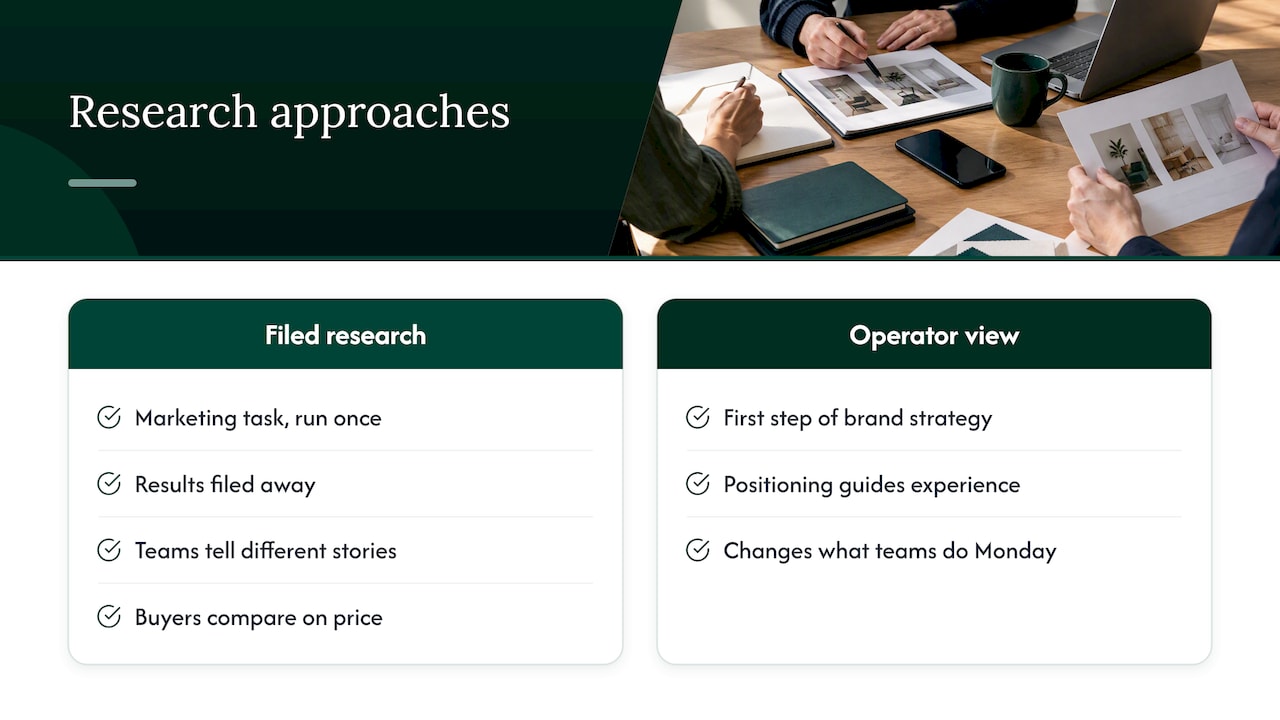
We treat research as the first step of brand strategy, because brand is a core business strategy and not a coat of paint. The questions we bring to every set of interviews are simple. What did the buyer believe before they met us? What made them choose, or walk? Which words did they use to describe the problem? Where did product, marketing, and sales tell different stories?
The answers become the raw material for positioning, and the positioning has to survive contact with the whole customer experience. That is the operator’s view we bring, shaped by building brands across more than 200 international retail locations: a finding matters only if someone in product, marketing, or sales changes what they do on Monday. If your research ends in a deck, it is not finished.
— Quincy
From research to positioning and go-to-market action
Once you have tagged evidence, translate it in a set order.
Language. Pull the exact phrases buyers use for the problem and the outcome. Put them in headlines, sales decks, and outreach. Your own jargon rarely matches theirs.
Differentiation. List the reasons buyers chose you and the reasons they chose others. A real differentiator shows up in both lists, repeatedly. Our guide to brand positioning examples includes a 60 to 90 minute workshop format to turn this evidence into a positioning statement.
Targeting. If wins cluster in one segment and losses in another, that is a go-to-market decision, not a sales coaching problem. The go-to-market framework for founders lays out how to act on it in 90 days.
Rollout. New positioning fails when employees cannot explain it. Plan the internal launch first, as in our brand rollout plan.
For early-stage companies, the same evidence also tells you whether you need a full rebrand or only a refresh, and which brand measures belong in your startup brand strategy.
When to bring in an outside advisor
You can run the first round yourself. Two situations call for outside help. The first is when you cannot be neutral: founders interviewing their own lost deals tend to defend the product. The second is when the findings point at conflicts between product, marketing, and sales that nobody inside has the standing to resolve.
We work with founders, executive teams, and marketing leaders on exactly this: brand strategy, positioning, and go-to-market work that ties customer evidence to measurable business performance. If you want a conversation about your own buyer research, start there. For leadership offsites and conferences, we also offer keynotes and talks.
A practical 30-day plan
- Week 1: Pull the last 20 closed deals, wins and losses. List stakeholders and contact details. Write a one-page interview guide focused on behavior and alternatives.
- Week 2: Run six to ten interviews, with losses first. Use a neutral interviewer. Record and transcribe with permission.
- Week 3: Tag, find the top five themes, and review a sample of sales call transcripts for the same themes.
- Week 4: Run a short survey to size the top themes. Assign owners, set deadlines, and update one battle card, one landing page, and one sales talk track.
Then repeat on a rolling basis. Win-loss is a habit, not a project.
FAQ
What are the main B2B customer research methods?
The core set is customer interviews, win-loss interviews, surveys, call transcript analysis, customer satisfaction metrics, and secondary research. Interviews and transcripts are qualitative and explain motives. Surveys and metrics are quantitative and measure scale. Strong programs use both.
How many interviews do I need?
For a first pass on positioning, eight to twelve across two or three segments usually exposes the repeating patterns. An ongoing voice of customer program may run 15 to 25 interviews per round. Stop when new interviews stop producing new themes.
What is voice of customer research?
It is the systematic collection and analysis of what customers say about your product and experience, drawn from interviews, surveys, support tickets, calls, and reviews. The goal is to turn those statements into decisions about product, messaging, and service, not to produce a score.
Should the salesperson run win-loss interviews?
No. Buyers soften their answers for the person who sold to them, and the rep has a stake in the outcome. Experts recommend an independent researcher or marketer.
How is B2B research different from B2C research?
B2B involves multiple stakeholders, longer cycles, and much smaller pools of qualified respondents. You research a buying group, so you must understand each role’s concerns, and you must protect sample quality because every response carries more weight.
Sources
- Win-Loss Analysis: The Complete Playbook for 2026
- Voice of the Customer Analysis Guide
- Voice of Customer from Win/Loss: How Aligned Teams Turn Deal Outcomes Into GTM Intelligence
- B2B Customer Research: The Complete Guide for Product Teams
- Conducting B2B Market Research the Right Way
- Voice of customer research: how to build a VoC programme
- Pre-Purchase CX Research
- Early Customer Research (Stanford CS147)