
Mental Availability: How to Make Your Brand the One Buyers Recall
Mental availability is the probability that a buyer will notice, recognize or think of your brand in a buying situation. It is not awareness, and it is not preference. It is whether your name shows up in the buyer’s head at the moment a need appears. Brands that show up often, in many situations, tend to get shortlisted. Brands that do not, rarely get a chance to compete.
This guide explains what mental availability is, how it differs from awareness and salience, how to build it with category entry points and distinctive brand assets, and how to tell whether it is working. It is written for founders and marketing leaders who want a practical plan, not a glossary.
TL;DR
- Mental availability is the likelihood your brand comes to mind in a buying situation. Awareness only says people have heard of you.
- It is built through category entry points (the situations and cues that start a purchase) and distinctive assets that make you instantly recognizable.
- Most brands cover only a few entry points. Widening coverage is usually the most direct lever you have.
- Distinctive assets work because they are recognized, not because they carry a message. Fame and uniqueness both matter.
- Measure it with buyer surveys on entry points, not just awareness or clicks, and tie it back to pipeline.
Table of Contents
- What mental availability actually means
- Mental availability vs. awareness vs. salience
- Why it matters for growth
- Category entry points: the real unit of work
- How to build mental availability: a seven-step plan
- Distinctive brand assets: the recognition layer
- Mental availability examples
- Perspective: why we treat this as strategy, not decoration
- How to measure it
- Myths worth dropping
- Where to start if you are a startup
- Working with us
- FAQ
- Sources
What mental availability actually means
The idea comes from Professor Byron Sharp and Jenni Romaniuk of the Ehrenberg-Bass Institute for Marketing Science. As Insight Platforms summarizes it, their research, including How Brands Grow and Better Brand Health, is the theoretical foundation for the concept.
The practical version is simple. Buyers do not run a full comparison every time they buy. Most of the time they pick from the few brands that come to mind. If you are not one of them, your product quality, pricing and messaging do not get weighed at all.
A useful way to hold the whole model in your head, as the MiniMBA explainer puts it:
- Category entry points (CEPs): the internal or external cues that trigger a buyer to enter the category.
- Mental availability: how easily your brand is recalled in a buying situation.
- Physical availability: how easy your brand is to buy or access.
The brand that is easy to recall and easy to buy is the one that usually gets bought. That is the whole game, and everything below is about the first half of it.
Mental availability vs. awareness vs. salience
These three terms get used as if they were interchangeable. They are not, and confusing them leads to bad reporting.
| Term | What it tells you | What it misses |
|---|---|---|
| Brand awareness | Whether people know your brand exists | Whether they think of you when they buy |
| Brand salience | How much your brand is thought of in buying situations | Which specific situations drive it |
| Mental availability | The odds you come to mind across the situations that matter in your category | Nothing about how easy you are to purchase |
Experts note that salience is often conflated with awareness. A brand can have high awareness but low salience: people know it, yet it is not what they think of when they are actually buying. Insight Platforms makes this point and argues that mapping and winning specific entry points is the primary driver of growth.
The Quantilope guide to brand health frames it as the difference between being known and being situationally relevant. That framing is a good test for your own dashboards. If your brand tracker asks only “Have you heard of us?”, you are measuring the weaker thing.
Why it matters for growth
The evidence tying mental availability to results is stronger than most brand concepts can claim. According to Product Philosophy’s summary of the research, a 2021 study across 18 categories and 14 countries found that the breadth of category entry points explained roughly 60% of the variance in market share growth. The same source cites a 2024 meta-analysis across 100 brands that found a 0.83 correlation between mental market share and sales market share.
Treat those figures as directional. They come from a secondary summary, and correlation across brands is not a guarantee for any one company. But the direction is consistent: the brands that are present in more buyer minds, in more situations, tend to hold more of the market.
This also reframes a familiar argument. Brand work is often defended as soft and hard to measure. Mental availability gives it a measurable shape: a share of mind across specific buying situations that can be tracked and compared with sales.
Category entry points: the real unit of work
If mental availability is the goal, category entry points are the raw material. They are the specific occasions, needs and cues that make someone think about the category at all.
In consumer examples they sound like “thirsty” or “Friday evening.” In B2B they look different:
- A new VP of marketing inherits a messy message and needs help.
- A funding round closes and the team has to grow into the story.
- A sales team starts losing deals on price and reps cannot explain why.
- A product launch is 90 days out and nobody agrees on the audience.
- A competitor shifts its positioning and the board asks what you are doing about it.
The mistake that ruins most CEP lists
CEPs belong to the category, not to your brand. A common mistake, noted by Product Philosophy, is defining them by product features. They should be defined by the external cues, such as situations, locations, timing and moods, that trigger a buyer to enter the category regardless of who they end up choosing.
A quick check: if your entry point reads like a feature (“needs an integrated platform”), rewrite it as a situation (“the quarter after a merger, when two teams use two sets of language”).
How to build mental availability: a seven-step plan
- List the buying situations. Interview recent customers and lost prospects. Ask what was happening in the business the week they started looking. Aim for 15 to 30 entry points before you prune.
- Group them. Cluster by theme: growth moments, leadership change, competitive pressure, launch, fundraising. Clusters make the work manageable.
- Survey the market. Ask a sample of your category buyers which brands come to mind for each situation. This is your baseline. Run it again on a regular cadence.
- Find the gaps. You will likely own a handful of entry points and be invisible in the rest. Prioritize those that are large and linked to your strengths.
- Link brand to situation in your content and sales. Make sure the cue and your name appear together, repeatedly. A case study titled by situation does more than one titled by industry.
- Keep reaching new buyers. Buyers enter and leave the category continuously. Reach is part of memory building. Sharp’s rules include continuously reaching all category buyers and refreshing memory structures, as Product Philosophy lists them.
- Stay consistent. The same colors, voice, claims and assets, quarter after quarter. Inconsistency resets the learning you paid for.
This connects tightly to positioning. If you want a deeper look at who you are up against in each situation, our guide to competitive brand analysis walks through how leaders map that field.
Distinctive brand assets: the recognition layer
Entry points get you thought of. Distinctive assets make you recognized once you are in front of the buyer. These are the logo, color, typeface, mascot, sound, shape, tagline or visual device that points to you and nobody else.
A counterintuitive finding here: these assets work best when they are meaning-free. As Marketing Science puts it, central to Sharp’s ideas was immediate consumer recognition in a crowded marketplace, with assets as the bricks and mortar of identity. Insiders note that trying to make an asset “mean something,” for example a logo that is supposed to convey reliability, often reduces how distinctive it is.
Fame and uniqueness
Two qualities decide whether an asset is truly distinctive:
- Fame: how many people in your target market link the asset to you.
- Uniqueness: how exclusively they link it to you and not a competitor.
You need both. A famous asset that competitors also use sends buyers to the category, not to you. Think of how many software brands use the same blue gradient and rounded sans-serif. A quieter but ownable choice often beats a polished but generic one.
An asset audit you can run in a week
- List every asset you use consistently: color, shape, phrase, sound, character, layout.
- Show a sample of buyers the asset with the brand name hidden. Ask who it belongs to.
- Score each one on fame (how many name you) and uniqueness (how many name only you).
- Keep and invest in the high-high assets. Retire or rebuild the rest.
Do not redesign everything at once. Distinctive assets are built through repetition, so the most expensive mistake is changing them just because your team is bored of them.
Mental availability examples
The classic examples are consumer brands, because their assets are visible to everyone. The Coca-Cola script and the McDonald’s arches are cited as assets with strong recognition, and Toblerone’s triangular pack is another often-used case, as in this small-business breakdown of Romaniuk’s framework. Each can be recognized with the name removed.
B2B examples are harder to see, but the pattern is the same. Consider how the principle plays out:
- A consultancy that owns a situation. It publishes consistently about one trigger, such as the first 90 days after a leadership change, until buyers associate that moment with it.
- A software company with an ownable look. A single unusual color and illustration style appears on every ad, deck and invoice. A buyer scrolling past can tell whose it is.
- A founder-led brand with a signature phrase. A short, repeated idea appears in every talk and post and becomes shorthand for the company’s view.
These are illustrative patterns, not named case studies. The point is the mechanism: a situation tied to a name, and a recognizable cue attached to both.
Perspective: why we treat this as strategy, not decoration
We see mental availability as a business question before it is a marketing one. When teams come to us with a drifting brand, the symptom is usually the same: product describes the company one way, marketing another, and sales a third. Buyers cannot form a clear memory from three different stories.
So we start with alignment. If the product, the marketing and the sales conversation do not say the same thing, no amount of media spend builds a memory structure. Clarity comes first, then repetition.
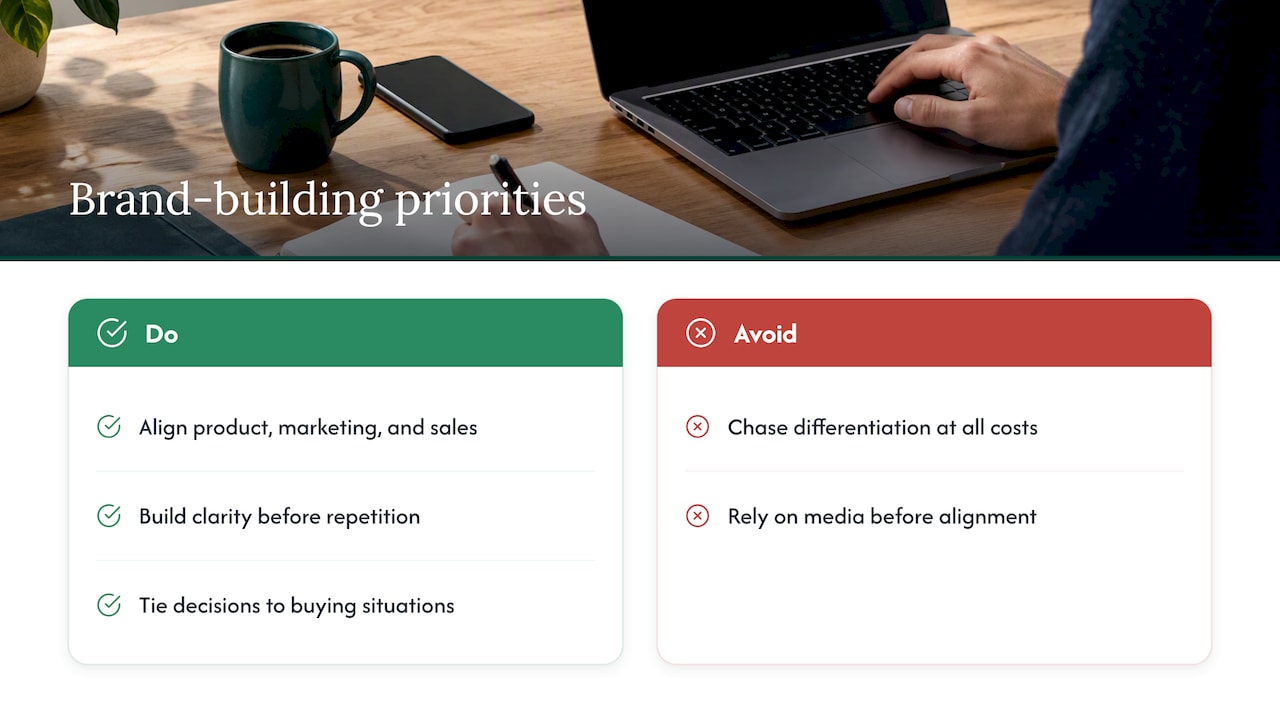
We also push back on the reflex to chase differentiation at all costs. The research points to something more practical: buyers rarely compare brands in depth, and they tend to buy one of the few that come to mind. Being easy to identify and easy to recall often matters more than a clever claim about being different. That does not mean positioning is irrelevant. It means positioning has to be expressed in situations buyers actually live in, and in assets they can actually recognize. Our brand positioning examples workshop is built around that idea.
The operator’s lens matters here. Brand building and exit experience teach you that the brand has to earn its keep in the pipeline. We want every brand decision tied to a performance question: which buying situation does this serve, and how will we know it worked?
— Quincy
How to measure it
Awareness surveys are a start, but they will not tell you whether you are winning situations. A better measurement setup has three layers.
Layer 1: entry point share of mind
Run a periodic survey of category buyers. For each entry point, ask which brands come to mind. Track your share and your rivals’ share per situation, not just overall. The shape of the gaps is the strategy.
Layer 2: asset strength
Repeat the fame and uniqueness test for your assets once or twice a year. Look for movement after campaigns or rebrands.
Layer 3: commercial signals
Tie the brand measures to things the revenue team already watches: share of inbound that arrives unprompted, win rate against named rivals, deal-cycle length, and how often prospects use your language on a first call. If you also track content performance, a framework like content effectiveness metrics can help you separate engagement that signals buying interest from vanity numbers.
Beware one trap. Search and performance channels capture demand that already exists. In a recent podcast discussion, Sharp argued that search advertising confuses purchase availability with memory building. Keep both in the plan, but do not credit search for memory it did not create.
Myths worth dropping
“The 3-7-27 rule.” People Also Ask shows this one often. Sharp has said it is not a foundational law of branding science and that many digital marketing rules are myths, as covered in this WARC podcast episode. Marketing science rests on empirical generalizations, patterns seen in buyer behavior across categories over time, not shortcuts.
“We need to be different from everyone.” The research argument is that distinctiveness, being easy to identify, usually matters more than obsessing over differentiation. See the Product Philosophy summary above.
“Our assets need to say something.” As covered earlier, meaning-free assets are often more recognizable.
“Awareness is enough.” It is not. Salience in buying situations is what moves choice.
For the seven rules readers often ask about, Product Philosophy lists them as: reach all category buyers continuously, make the brand easy to buy, get noticed, refresh and build memory structures, create and use distinctive assets, stay consistent, and stay competitive.
Where to start if you are a startup
You do not have a media budget to saturate the market, so pick your fights.
- Choose three to five entry points where your best customers came from. Own them before you chase the rest.
- Pick one or two ownable assets, such as a color and a phrase, and use them everywhere without exception.
- Write your sales story so a rep, a founder and a website say the same thing about the same situation.
- Review the plan against your growth targets, not just brand metrics.
Our guides on startup brand strategy and go-to-market planning go deeper on sequencing. If your team is rolling out a refreshed identity, start with employees so everyone who talks to buyers carries the same cues. And for sharpening which buyers you target, see our ideal customer profile framework.
Working with us
If you want a second set of eyes on your entry points, assets and positioning, we offer brand strategy, brand positioning, growth and go-to-market strategy, customer experience work and founder and executive advisory. We connect brand strategy to measurable performance through The Branded Agency approach. You can see the full list on our services page, or book Quincy for a keynote or team session on the speaking page.
FAQ
What is mental availability in simple terms?
It is the chance your brand comes to mind when someone is about to buy in your category. The more situations that trigger your name, the higher it is. It is a different thing from simply being known.
How is mental availability different from brand awareness?
Awareness means people recognize your name when prompted. Mental availability means they think of you unprompted when a buying need arises. A brand can be well known and still be missing from the shortlist.
How do you build mental availability?
Map the situations that trigger your category, measure which brands buyers link to each, and fill your gaps through consistent content, sales language and media. Pair this with distinctive assets so people recognize you instantly. Repetition over time does most of the work.
What makes a distinctive brand asset?
An asset needs fame, meaning many buyers link it to you, and uniqueness, meaning they link it only to you. Logos, colors, shapes, sounds and phrases can all qualify. Keep them consistent and avoid loading them with meaning.
Sources
- Category Entry Points: A Quantitative Approach to Byron Sharp’s Mental Availability Theory, Product Philosophy
- What Are Category Entry Points and How Do They Improve Brand Tracking?, Insight Platforms
- What are category entry points?, MiniMBA
- Measuring Brand Health: Brand Awareness vs. Mental Availability, Quantilope
- The distinctive asset in the room, Marketing Science
- Building distinctive brand assets: Jenni Romaniuk’s framework for small businesses
- SBP 215: What Marketers Still Get Wrong, with Prof. Byron Sharp, Listen Notes
- Revisiting How Brands Grow with Byron Sharp, The WARC Podcast